
Buyer answer
A reliable radial piston motor supplier should confirm the machine's continuous and peak torque, speed, duty cycle, pressure, displacement, mounting envelope, shaft, ports, brake or sensor requirements, and replacement compatibility before quoting a model. For heavy equipment OEMs, winch and hoist integrators, and mining repair buyers, a technically traceable RFQ is more useful than a catalog promise.
What a Radial Piston Motor Supplier Must Confirm Before Quotation
Buying a radial piston motor is not the same as buying a generic rotating component. The motor converts hydraulic pressure and flow into torque and speed while carrying shock loads through a shaft, flange, bearings, housing and connected drivetrain. A quotation that lists only displacement can therefore be technically incomplete. The supplier must know how the motor is loaded, how long it runs at each load point, how the machine controls direction, where the motor is installed, and which interfaces must remain unchanged.
This guide is written for three procurement situations. A heavy equipment OEM needs a repeatable component for a new machine platform and must protect future production consistency. A winch or hoist system integrator needs predictable starting torque, braking logic and mounting compatibility in a compact package. A mining equipment repair buyer often needs a direct replacement under time pressure, but still has to verify the old motor's dimensions, shaft and hydraulic limits. The purchasing decision is successful only when the selected series is checked against the actual application and the final model drawing.
The BLINCE product pages provide a useful starting point for screening: the hydraulic radial piston motor category groups the radial motor range, while the LD Series radial piston motor page and ZGM Series radial piston motor page identify different series and interface options. Treat those pages as product-family evidence, then ask the engineering team to confirm the exact model for the duty point.
Why Supplier Selection Is Different from a Torque-Matching Article
A sizing article normally starts with a required torque and works toward displacement. A supplier-selection article starts earlier: it asks whether the supplier can prove the information needed to size, integrate, validate and support the motor. This distinction matters because a motor can look suitable on a catalog page and still fail at the machine interface. The wrong shaft spline, an unverified case-drain arrangement, an underspecified bearing load or a misunderstood peak-pressure value can create installation delay and warranty risk.
Existing radial motor guidance can help a buyer understand the relationship between displacement, pressure, torque and speed. It should not replace a supplier audit. The buyer still needs a document trail that connects the requested duty point to a specific model, drawing revision, performance table, test method and acceptance condition. That is the unique purpose of this page: to make the RFQ and technical review precise enough for a supplier to answer without guessing.
The minimum answer a supplier should give
- Which product family and exact model are proposed, and which published or controlled drawing supports the selection?
- What are the continuous, intermittent and peak operating limits for that model, and under which conditions do they apply?
- Which displacement, speed, flow, pressure, shaft, flange, port and mounting dimensions are confirmed rather than estimated?
- What installation changes, accessories, flushing, filtration or control-valve requirements must the buyer plan for?
- How will the sample or first article be checked before a production release?
Start with the Buyer’s Operating Envelope
Before asking for a price, convert the machine requirement into an operating envelope. A useful envelope has a normal working point, a short-duration overload point and a start or stall condition. Write down the torque at the output shaft, shaft speed, hydraulic pressure at the motor inlet, available flow, expected direction changes, operating hours per day, ambient temperature, oil type and the mechanical load on the shaft. If the motor drives a drum, include rope-layer diameter and line pull. If it drives a mining attachment, include breakaway load, impact frequency and the ratio between motor and driven shaft.
| RFQ field | What to provide | Why it changes the selection |
|---|---|---|
| Continuous torque | Torque and duration at the normal duty point | Determines sustainable displacement and pressure demand |
| Peak or breakaway torque | Maximum torque, frequency and duration | Separates short overload capability from continuous rating |
| Speed and flow | Minimum, normal and maximum rpm; available l/min | Prevents overspeed, under-speed instability and pump mismatch |
| Mechanical interface | Flange, pilot, shaft, key or spline, bolt pattern | Controls whether the motor is a drop-in replacement |
| Duty and environment | Hours, shock, dust, temperature, oil and installation orientation | Guides sealing, bearing, cooling and service recommendations |
Do not hide uncertainty. If the original machine data is incomplete, mark each field as measured, taken from a drawing, or to be confirmed. A professional radial piston motor supplier can then identify the missing information and propose a safe verification step. This is faster than exchanging several quotations based on different assumptions.
Torque, Pressure, Displacement and Speed: Read the Limits Correctly
Torque is generated by pressure acting across displacement, but the useful engineering question is not simply “what is the largest torque?” Ask which torque can be maintained continuously, which torque is allowed intermittently, and which peak is permitted only for a defined transient. A winch that starts under load may require a high breakaway torque, while a mining conveyor may spend most of its life at a lower steady torque. Those duty profiles can lead to different model choices even when the maximum number looks similar.
Displacement also affects speed. With a fixed pump flow, a larger displacement generally lowers rotational speed and increases available torque. A supplier should calculate the expected speed from the actual usable flow, not the pump nameplate alone. Account for volumetric efficiency, pressure losses, relief-valve settings and flow shared with other actuators. For a variable-load machine, ask for the expected operating points instead of a single ideal number.
How to use the LD and ZGM published ranges
The BLINCE LD Series page identifies models from LD1 to LD70, with listed displacements from 77 ml/r (LD1-80) to 7,122 ml/r (LD70-7000). The page lists model-dependent rated pressure from 15 to 25 MPa, peak pressure up to 32 MPa, rated torque from 284 Nm to 16,849 Nm, and speed from 0.5 to 1,500 rpm. These are family-level ranges, not a single LD motor rating. The exact model, duty category and operating conditions must be confirmed against the current data sheet.
The ZGM page describes the ZGM05 family with a listed displacement range of 59 to 115 ml/r, a 25 MPa rated pressure and 31.5 MPa peak pressure; it lists 235 to 458 Nm rated torque for the ZGM05 size and a speed range beginning at 1 rpm, with maximum continuous speed up to 1,000 rpm. Larger ZGM5 variants are described as expanding the range, so a buyer must request the exact ZGM model table instead of extending the ZGM05 numbers to every size.
This distinction protects both sides of the RFQ. The buyer receives a model-specific answer, and the supplier does not accidentally turn a family maximum into a guaranteed rating. Include the words “model-specific confirmation required” in your purchase specification whenever a series page is used as the initial reference.
Screen the Mechanical Interface Before Comparing Prices
Many replacement projects fail at the mechanical interface, not in the hydraulic theory. Request a dimensioned drawing showing the mounting flange, pilot diameter, bolt circle, shaft extension, spline or key, rotation direction, port locations and overall envelope. Check clearance for hoses, guards, brakes, couplings and service tools. A motor that fits the hydraulic circuit can still be unusable if the shaft engagement is too short or the flange pilot is wrong.
The LD Series page lists standard rectangular spline, parallel-key, internal-spline and involute-spline shaft options, and notes that custom flanges can match BM, 1JMD, QJM and GM/SI series dimensions. The ZGM Series page lists rectangular external spline options with DIN 5480 and UNI 221 alternatives, plus standard BSP and G thread configurations such as a G1/2 drain port. These details are valuable screening evidence, but they do not remove the need to compare the old motor drawing and the new model drawing line by line.
Questions for a direct replacement
- Is the replacement truly dimensionally compatible, or does it require a spacer, coupling, hose change or control adjustment?
- Does the output shaft transmit the same torque without exceeding key, spline or bearing limits?
- Are inlet, outlet, drain and brake ports in the correct positions and thread standards?
- Does the requested rotation match the machine's directional valve and load-holding logic?
- Are brake release pressure, sensor plugs and auxiliary functions documented for the exact variant?
For a repair buyer, send photographs of the nameplate, shaft end, flange face and ports together with the old part number. A photograph is useful evidence, but it is not a substitute for a measurement or drawing. Ask the supplier to mark the confirmed dimensions on a controlled PDF so the purchasing and maintenance teams are working from the same revision.
LD or ZGM? Use an Application-Based Shortlist
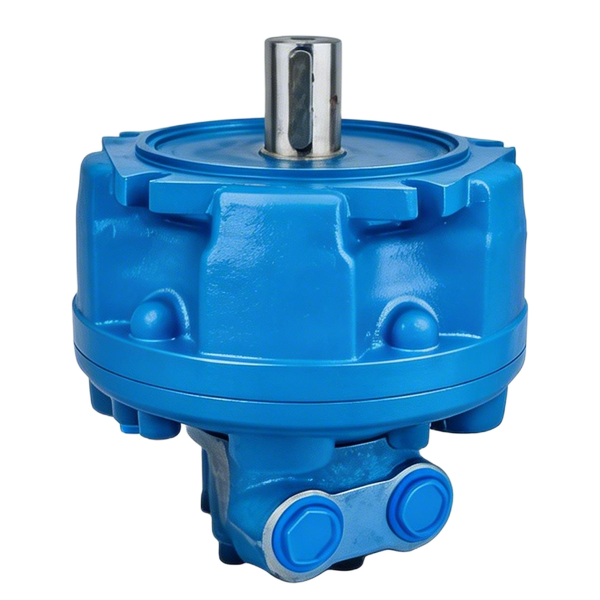
LD and ZGM should not be treated as interchangeable labels. They represent different product families with different size ranges, published interfaces and replacement references. The right question is not “which series is stronger?” but “which family contains a model that satisfies the duty point and installation constraints with documented evidence?”
| Screening question | LD Series evidence | ZGM Series evidence |
|---|---|---|
| Typical procurement use | Large family for low-speed/high-torque and replacement screening | Compact five-star family for stable low-speed and replacement screening |
| Published family range | LD1 to LD70; 77 to 7,122 ml/r listed across models | ZGM05 listed at 59 to 115 ml/r; larger ZGM5 needs model table |
| Interface clues | Multiple shaft options; custom flange matching noted | DIN 5480/UNI 221 spline options; BSP and G ports noted |
| Replacement references stated on page | KAWASAKI-STAFFA HMB dimensional and performance equivalence claim | GM5, INM5 and XHS5 replacement claim |
For a new OEM platform, shortlist both families only after calculating the required torque, speed and envelope. For a winch or hoist retrofit, start with the old motor's flange and shaft because those dimensions can eliminate an otherwise attractive option. For mining repair, use the stated replacement reference as a lead, then verify the actual machine variant, port arrangement, brake package and operating pressure.
Hydraulic Circuit Checks That Belong in the RFQ
A radial piston motor supplier cannot validate a motor from mechanical data alone. Describe the circuit that feeds it. State whether the motor is in an open or closed circuit, the pump type, relief setting, flushing arrangement, return-line pressure, filtration level and any counterbalance or brake valve. Explain how the motor is protected during overrunning loads and emergency stops. If the machine uses a flushing or cooling circuit, identify the expected flow and allowable temperature range from the system design.
Case-drain requirements deserve a separate line in the specification. Do not assume that a drain port can be blocked, combined with another return, or routed through a restrictive fitting. Ask the supplier for the exact drain connection, permissible case pressure and installation instructions for the selected model. The ZGM page specifically identifies a drain-port example, but the exact port and limit remain model-dependent. The same discipline applies to brake-release pressure, pilot lines and sensors.
Oil cleanliness and commissioning
Contamination is a procurement issue because the motor's life depends on the complete system, not only the motor body. Put the planned oil grade, filtration strategy, flushing procedure and commissioning cleanliness target into the RFQ. Ask whether the supplied motor is shipped preserved, which ports must remain capped, and what pre-start inspection is required. These questions are more useful than asking for an unqualified “long service life” statement.
During commissioning, verify free rotation, correct direction, leakage, pressure rise, temperature trend and stable operation at no load before applying the full machine load. Record pressure and speed at the defined duty points. If the motor stalls, runs hot or shows unstable low-speed motion, stop and identify whether the cause is motor sizing, air, contamination, relief setting, valve timing or mechanical overload. A supplier's technical team should receive the recorded data and the exact model code before recommending a change.
Evidence to Request from a Radial Piston Motor Supplier
Supplier quality is visible in the way technical evidence is organized. A serious response should separate published family information from controlled model information and from optional customization. Request the following package before releasing a purchase order:
- Exact model code, revision-controlled dimensional drawing and performance data sheet.
- Continuous, intermittent and peak pressure, torque and speed limits for that model.
- Displacement, theoretical flow relationship, efficiency assumptions and allowable operating temperature.
- Mounting, shaft, spline, key, port, drain, brake and sensor details, including applicable standards.
- Recommended hydraulic circuit, filtration, flushing and commissioning instructions.
- Material or heat-treatment information only where the supplier is prepared to document it for the specific component.
- Inspection and test records agreed for the sample or first production lot.
- Packaging, identification, preservation and traceability details for the shipment.
- Warranty scope, technical contact, spare-parts path and escalation process.
BLINCE states on its company page that Dongguan Blince Machinery & Electronics Co., Ltd. was established in 2004, operates in Dongguan near Shenzhen and Guangzhou ports, maintains R&D and testing capabilities, and works to ISO 9001 and CE standards. Those company-level facts support supplier due diligence, but they do not replace model-specific evidence. Ask the technical team to attach the current drawing and rated-value table to the quotation so the commercial document remains auditable.
A Practical RFQ Template for OEM, Winch and Mining Buyers
Copy the following structure into your purchasing request. It gives the supplier enough context to screen LD and ZGM while leaving room for the engineering team to confirm the final model.
| Section | RFQ wording to adapt |
|---|---|
| Machine | Application, machine model, annual quantity, operating hours and environment. |
| Duty point | Continuous/peak torque, rpm, pressure, flow, duty cycle and direction changes. |
| Interface | Attach old drawing or photos; list flange, pilot, shaft, spline, ports, brake and sensor needs. |
| Target solution | Please screen LD and ZGM where applicable and identify the exact proposed model. |
| Evidence | Return drawing, data sheet, limits, test plan, lead-time assumption and technical contact. |
| Validation | Quote sample or first article with agreed inspection and machine trial criteria. |
For an OEM, add the target production release date, forecast quantity, change-control expectation and interchangeability requirement. For a system integrator, add the valve schematic, brake logic, control signal and available pump flow. For a repair buyer, add the failed unit's nameplate, serial or code, measured dimensions, photographs and the reason for failure. The more specific the request, the less likely a supplier is to quote a visually similar but technically unsuitable motor.
Sample Approval and First-Article Validation
A sample is not only a physical fit check. Use it to validate the complete chain from drawing to installed performance. First inspect the nameplate and model code against the quotation. Measure the flange, pilot, shaft, bolt pattern, port threads and critical envelope. Confirm that the supplied accessories, plugs and seals match the agreed configuration. Record any deviation before installation.
Run a controlled no-load test first. Confirm direction, smooth start, stable low-speed behavior and absence of external leakage. Increase load in stages while recording inlet pressure, return or case pressure where applicable, speed, temperature and noise. Compare the readings with the model-specific limits supplied by the vendor. For a winch, include a controlled holding and lowering test with the safety system active. For mining equipment, include the impact or duty cycle that caused the original failure only after the basic checks pass.
Approval should be based on agreed acceptance criteria rather than a subjective statement that the motor “feels strong.” Keep the drawing revision, test data, photos and corrective actions with the purchase record. If a change is made to the shaft, flange, seals or port configuration, request a revised code or drawing so future replacement orders do not repeat the same uncertainty.
Common Supplier-Selection Mistakes
Choosing the family maximum
A family maximum is useful for screening but is not a universal rating. Selecting a motor because the series page shows a high peak torque can hide a mismatch in continuous duty, speed, pressure or mounting. Always move from family page to exact model drawing.
Comparing price before interface
A lower unit price disappears quickly if the motor needs a custom coupling, hose rerouting, spacer or emergency machining. Compare the installed cost and validation effort, not only the line-item price.
Treating an interchangeability claim as automatic
LD and ZGM pages describe replacement relationships, but the machine variant still matters. Confirm flange, shaft, ports, rotation, brake and control requirements. A replacement claim is a starting point for engineering review.
Requesting unsupported evidence
Do not publish or approve invented material grades, test hours, MOQ, delivery promises or efficiency numbers. Ask the supplier for evidence that applies to the exact model and batch. A transparent “to be confirmed” is safer than an attractive but unverifiable specification.
Ignoring after-sales ownership
Define who answers installation questions, who reviews test data and how replacement parts are identified. BLINCE lists technical support, quality assurance and after-sales service as part of its company capabilities; put the contact path into the project record and confirm the response process for your region.
FAQ: Buying from a Radial Piston Motor Supplier
What should I send when requesting a radial piston motor quotation?
Send the machine application, continuous and peak torque, rpm, pressure, flow, duty cycle, oil and environment, plus the mounting drawing or clear photos of the old unit. Include shaft, spline, port, drain, brake and sensor requirements. If any value is unknown, label it as unknown so the supplier can recommend a measurement.
Can the LD Series replace a Kawasaki-STAFFA HMB motor?
The LD Series page states that its dimensions and performance data are designed to match the KAWASAKI-STAFFA HMB series. Treat this as a replacement-screening claim, not a blanket approval. The supplier must confirm the exact LD model, shaft, flange, ports, operating limits and machine duty before release.
Can the ZGM Series replace GM5, INM5 or XHS5?
The ZGM Series page describes direct replacement compatibility with GM5, INM5 and XHS5. Ask for the model-specific drawing and compare mounting, spline, port, rotation, pressure, speed and any brake or auxiliary option on the motor being replaced.
Are the published LD and ZGM ranges the rating of every motor in the series?
No. The ranges summarize multiple models. LD values vary by model, and the ZGM05 values should not be extended to larger ZGM5 variants without a controlled data sheet. Use the range for an initial shortlist, then request the exact model rating and operating conditions.
What evidence should I require before approving a sample?
Require the exact model code, drawing revision, performance data, interface dimensions, hydraulic limits, installation instructions and agreed inspection or test plan. During the sample trial, record speed, pressure, temperature, leakage and the application duty points. Keep the records with the purchase order.
Can a supplier customize shafts, flanges or ports?
BLINCE product information lists several shaft options and notes custom flange matching for the LD family, while the ZGM page lists spline and port standards. Customization must be quoted against a drawing, with a new model code or revision and engineering confirmation of strength, sealing and compatibility.
Conclusion
The best radial piston motor supplier is the one that can turn your machine data into a traceable, model-specific and testable proposal. Start with the real operating envelope, separate continuous duty from transient peaks, verify displacement and speed against available flow, and check the shaft, flange, ports, drain, brake and control interfaces before comparing prices. Use the LD and ZGM pages to build a shortlist, but do not treat a family range or replacement statement as a single-model rating.
For an OEM, integrator or mining repair buyer, a complete RFQ should include the duty cycle, drawings or measured interfaces, hydraulic circuit information and sample acceptance criteria. BLINCE's radial piston motor category and product pages provide the product-family starting point; the engineering team should confirm the current model drawing, rated values, compatibility and configuration before production or field replacement.