
Short answer
OMP and OMR are both orbital hydraulic motor families, but they are not selected by the family name alone. BLINCE positions OMP as a compact, broad-range motor with published family guidance of 36–500 cm³/rev, up to about 1500–1650 rpm, up to 400+ Nm and up to 60 L/min. OMR/OMRS is presented as a compact Geroler-style motor range from 36 to 375, with speed up to about 1085 rpm, continuous torque up to 345 Nm, a stated continuous pressure drop up to 14 MPa and intermittent pressure drop up to 17.5 MPa. Use those figures to create a shortlist, then confirm the exact displacement, pressure, speed, shaft, flange, ports, external loads and duty cycle with engineering.
When comparing OMP vs OMR orbital motors, the practical difference is an application and configuration question, not a simple “OMP is better” or “OMR is better” answer. An OEM choosing a motor for an agricultural implement, conveyor, sweeper, compact construction machine or service replacement must match the motor to flow, speed, torque, pressure, start-under-load behavior, mounting and operating environment. The correct family is the one that fits the real machine duty and can be documented as an exact model.
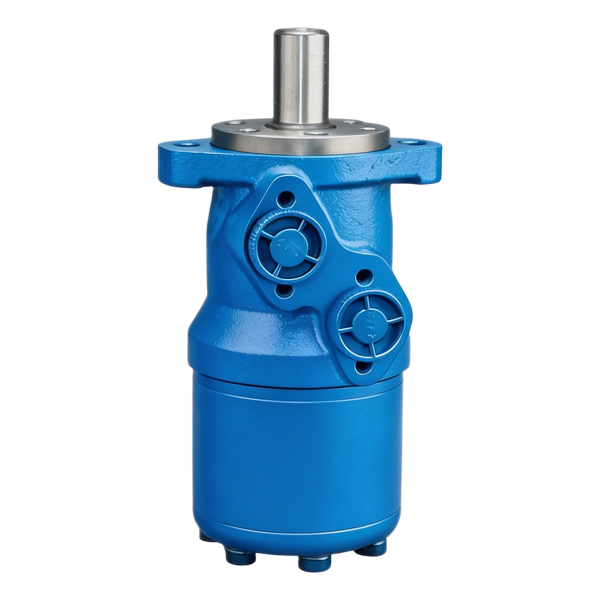
BLINCE's hydraulic orbital motor category is the right commercial starting point because it gathers the available orbital motor families. The OMP series product page publishes compact construction, low-speed smoothness, shaft sealing for parallel and series systems, and family-level performance information. The OMR/OMRS product page is the selection entrance for another compact orbital motor architecture with multiple shaft and installation options. The page, drawing and current quotation must be read together.
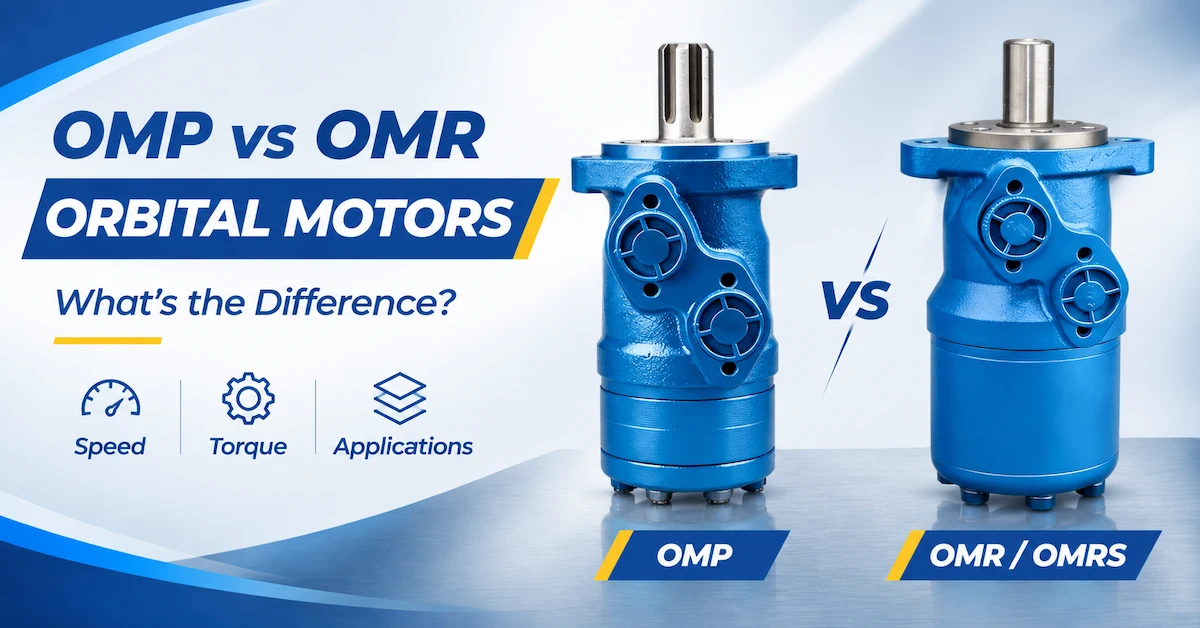
OMP vs OMR orbital motors: The Selection Difference in One Table
The table below is a screening tool. It uses public family-level information to help a buyer choose which product page to review first. It does not replace a model-specific data sheet or written confirmation.
| Selection question | OMP product-page direction | OMR/OMRS product-page direction | What must be confirmed next |
|---|---|---|---|
| Required displacement | Family guidance from 36 to 500 cm³/rev | Family range from OMR/OMRS 36 to 375 | Exact displacement, tolerance, model code and operating point |
| Speed target | Family maximum up to about 1500–1650 rpm, depending on model | Family maximum up to about 1085 rpm, depending on model | Continuous, intermittent and minimum controllable speed at the selected displacement |
| Torque target | Family maximum listed up to 400+ Nm | Continuous output listed up to 345 Nm | Pressure drop, efficiency, duration, temperature and exact model torque |
| Pressure duty | Product page lists resistance to pressure fluctuations and series/parallel shaft sealing | Technical information states up to 14 MPa continuous and 17.5 MPa intermittent pressure drop | Port pressure, return pressure, duty duration and exact model limits |
| Shaft and mounting | Configuration must be selected from the OMP order code and drawing | 25 mm/25.4 mm parallel key, SAE 6B spline and tapered shaft options; G1/2, 7/8-14 UNF or manifold options are listed | Flange, pilot, shaft, key/spline, ports, rotation and external loads |
| Typical decision | Start here when a broad displacement and higher speed screening range fits the machine | Start here when the stated OMR/OMRS interface, low starting pressure and load arrangement fit the machine | Application evidence, drawing comparison, sample test and engineering approval |
The most important row is the last column. The published ranges help a buyer avoid an obviously wrong family, but they do not prove that an OMP 200 or OMR 200, for example, has the same torque, speed, flange, shaft or pressure behavior. Treat “OMP versus OMR” as a routing decision to the correct engineering review, not as an automatic interchangeability statement.
1. Start With the Machine Duty, Not the Model Name
Write the normal, intermittent and abnormal operating points before comparing the two families. For each point, record motor speed, flow, pressure at both ports, differential pressure, running torque, starting torque, duration, number of cycles, direction changes and external radial or axial loads. Include the oil temperature and the environment because viscosity, contamination, dust, water and vibration affect starting behavior, sealing and service performance.
| Duty input | What the buyer should provide | Why it changes the OMP or OMR choice |
|---|---|---|
| Speed | Normal rpm, maximum rpm, minimum controllable rpm and speed during reversal | OMP and OMR family maximums are not identical; low-speed stability and leakage must be checked at the actual model |
| Flow | Continuous and peak L/min, pump sharing, flow-control method and variation | Flow and displacement determine speed; excess flow can create overspeed or heat |
| Pressure | Continuous and intermittent differential pressure, port pressure, return back pressure and relief setting | Torque and seal loading depend on the pressure condition and its duration |
| Load | Running torque, breakaway torque, shock load, inertia, radial load and axial load | Bearing and shaft configuration can matter more than the headline torque number |
| Cycle | Hours per shift, starts per hour, reversals, stalls, overrunning loads and emergency stops | A short peak rating cannot be used as a continuous production rating |
| Environment | Fluid, viscosity, temperature, filtration, dust, water, corrosion and vibration | Seals, housing protection, oil management and test conditions must match the installation |
For an agricultural OEM, a motor may drive a seeder, sprayer, harvester attachment or auger with frequent starts and changing loads. For a conveyor manufacturer, the motor may run for long periods at a stable speed but face jam or restart torque. For a repair buyer, the failure history may reveal excessive case pressure, contamination or a gearbox misalignment that a simple nameplate match would miss. The duty description should reflect the machine's actual use.
2. How OMP and OMR Differ in Displacement, Speed and Torque Screening
Displacement, flow and speed are linked. In a first-pass calculation, ideal speed is approximately proportional to flow and inversely proportional to displacement. A larger displacement generally produces more theoretical torque at the same differential pressure, but it also requires more flow to reach the same speed. Actual values depend on volumetric efficiency, mechanical losses, pressure drop, oil viscosity, temperature and the selected configuration.
BLINCE publishes a wider upper displacement and speed screening envelope for the OMP family: 36–500 cm³/rev and up to about 1500–1650 rpm. The OMR/OMRS family is listed from 36 to 375 with speed up to about 1085 rpm. Those figures suggest a useful first routing rule: review OMP first when the machine needs the upper part of the published speed or displacement range; review OMR/OMRS first when the proposed installation and lower-speed duty align with its model range. The rule is only a shortlist rule, not a final selection.
Torque must be compared under the same pressure and duration. OMP's published family maximum of 400+ Nm and OMR/OMRS continuous output up to 345 Nm are not directly comparable unless displacement, pressure drop, efficiency, speed, temperature and duty definitions are identical. Ask the supplier to return continuous, intermittent and peak torque for the exact model, and identify whether each value is measured, calculated or taken from a family-level range.
A practical screening calculation
Use the machine flow and target rpm to estimate a displacement range, then check torque at the actual differential pressure. For a fixed orbital motor, the ideal relationship can be expressed as n ≈ Q × 1000 / Vg, where n is rpm, Q is flow in L/min and Vg is displacement in cm³/rev. This is a screening equation. Apply volumetric efficiency, allow for flow variation and compare the result with the exact model's speed limit. For torque, use the pressure drop across the motor rather than the pump relief setting, and include mechanical efficiency and the starting condition.
Example: if an implement receives 30 L/min and needs approximately 150 rpm, the ideal displacement is about 200 cm³/rev before losses and margin. That calculation does not prove that an OMP 200 or OMR 200 is suitable. The buyer must still confirm the model code, shaft, flange, pressure category, starting torque, external loads and thermal behavior. Showing the calculation in the RFQ gives the supplier a clear starting point and exposes any different assumptions.
3. When the OMP Selection Path Makes More Sense
The OMP page is a logical first review when the machine needs a compact orbital motor with a broad published displacement range, higher speed screening range or a familiar OMP replacement path. BLINCE describes OMP motors as compact and lightweight, with smooth low-speed operation, resistance to pressure fluctuations and high shaft sealing performance for parallel and series systems. The product page also identifies agricultural machinery, forestry equipment, construction machinery and material-handling systems as application areas.
For a procurement team, the OMP path can be attractive when one platform must cover several machine variants. A smaller displacement can serve a light conveyor or implement, while a larger configuration may fit a higher-torque attachment. That does not mean one motor covers every variant: the engineering team still needs to approve each displacement, shaft, flange, port arrangement and pressure condition. Ask for a common interface strategy if the OEM wants to simplify service stock.
OMP should not be chosen solely because its family maximum appears higher. A higher maximum speed may be irrelevant if the machine operates at 100 rpm and needs high breakaway torque. Conversely, a broad displacement range may not help if the machine has a fixed flange and a high radial load that only one shaft option can carry. Use the OMP page to enter the conversation, then move immediately to the duty and drawing.
4. When the OMR/OMRS Selection Path Makes More Sense
The OMR/OMRS page is a logical first review when the machine needs the listed OMR/OMRS range, compact installation, low starting pressure, a high-pressure shaft seal and specific shaft or port choices. The product information describes Geroler gear sets, axial flow distribution, smooth rotation, flexible installation and shaft options including 25 mm or 25.4 mm parallel key, SAE 6B spline and tapered shaft. It also lists G1/2, 7/8-14 UNF and manifold installation options.
Those interface options can be decisive for a repair buyer or a compact equipment OEM. A motor may be hydraulically adequate but impossible to install without changing a gearbox, coupling, hoses or frame clearance. If the old unit uses a 25.4 mm keyed shaft, the buyer should not assume that a similar OMP displacement with another shaft is an equivalent. Send the old drawing, photographs, shaft measurement, port markings and rotation direction before asking for a replacement quote.
OMR/OMRS information states a continuous pressure drop up to 14 MPa and intermittent pressure drop up to 17.5 MPa. These figures must remain tied to the applicable model and duty definition. They should not be treated as a universal pressure rating for every OMR or OMRS configuration. Confirm return pressure, case pressure, speed, oil temperature, duration and the exact order code in writing.
5. Compare Shaft, Flange and Port Compatibility Before Price
Many OMP-versus-OMR mistakes happen because buyers compare displacement first and interfaces last. Reverse that order for a replacement or a tightly packaged OEM machine. Ask for a controlled drawing and compare the pilot diameter, flange face, bolt pattern, shaft extension, key or spline, port thread, port orientation, drain requirement, rotation, overall length and external load path.
| Interface item | Buyer check | Evidence required before approval |
|---|---|---|
| Flange and pilot | Does the motor locate on the existing gearbox or frame without an adapter? | Dimensioned drawing with pilot, bolt circle and tolerances |
| Shaft and spline | Is the shaft diameter, key, spline or taper identical to the driven component? | Model code, shaft drawing and coupling or gearbox confirmation |
| Ports | Do thread standard, size, location and hose bend radius match? | Port drawing, thread callout and installation photograph |
| Rotation | Is clockwise/counter-clockwise behavior defined from the shaft view? | Supplier notation and machine test procedure |
| External load | Does the motor or gearbox carry radial and axial loads? | Allowable load data for the exact model and mounting |
| Sealing and drain | Can the motor handle return back pressure and the actual drain routing? | Seal option, case-pressure limit and circuit confirmation |
OMR/OMRS has explicitly listed shaft and interface alternatives, while the OMP order must be tied to its configuration and drawing. This difference is useful for procurement, but it does not mean that OMR is always easier to install or that OMP lacks the required option. The correct conclusion comes from the actual drawings, not from the family names.
6. Series and Parallel Circuits Change the Decision
Ask whether the motor will operate in a parallel circuit, a series circuit, or a mixed circuit with valves and other motors. BLINCE's OMP page highlights high shaft sealing performance for parallel and series systems. The OMR/OMRS information also describes a high-pressure shaft seal that can support series or parallel use in many cases without an external drain pipe. “Can be used in series” is still a starting statement; the supplier must confirm the actual back pressure, case pressure, port pressure and duty for the selected model.
In a parallel circuit, each motor may receive a controlled share of pump flow and pressure. Check flow balancing, simultaneous loads, relief settings and speed matching. In a series circuit, downstream motor pressure and return back pressure become central. Confirm the pressure drop across each motor, the first motor's return condition, shaft seal limits and whether the system needs an external drain. A motor that works in a parallel test may not be suitable in the same machine when installed second in series.
For a closed or semi-closed hydraulic drive, send the full schematic. Include charge pressure, flushing flow, cross-port relief, anti-cavitation valves, brake or freewheel behavior and the response during reversal. For an open circuit, state the pump flow, relief valve, return pressure and valve transition. This information allows engineering to compare OMP and OMR under the same system assumptions.
7. Low-Speed Starting, Reversal and External Loads
Orbital motors are often selected for low-speed, high-torque work, but “smooth at low speed” is not a complete specification. State the minimum rpm, starting torque, available pressure at start, oil temperature, load inertia, breakaway friction and reversal frequency. Ask the supplier for the applicable starting-pressure or starting-torque data and the test condition. A motor that rotates smoothly without load may behave differently when an auger, conveyor, wheel or winch is loaded.
Reversal adds a transient. The hydraulic valve may switch before the mechanical load has stopped, creating pressure spikes and shock torque. Include the deceleration time, direction-change frequency and any overrunning load. For conveyors and agricultural implements, also describe jam recovery: does the operator reverse briefly, raise relief pressure, or stop and clear the machine manually? This determines whether intermittent pressure and shaft load are more important than maximum speed.
External radial and axial loads need equal attention. A chain, sprocket, belt, wheel hub or gearbox can load the shaft independently of hydraulic torque. Ask whether the motor bearings carry the load or whether a separate support bearing is required. Do not infer the allowable load from a photograph or from a different displacement in the same family.
8. OMP vs OMR RFQ Checklist for a Useful Quotation
A comparison becomes commercially useful when both product paths receive the same information. The following checklist can be copied into an RFQ. Ask the supplier to return one recommended model, one technically acceptable alternative, the assumptions, the controlled drawing and the values that remain subject to engineering confirmation.
| RFQ section | Information to send | Supplier response requested |
|---|---|---|
| Machine and application | Machine model, function, environment, annual volume and service market | Recommended OMP or OMR path and application assumptions |
| Operating points | Flow, rpm, differential pressure, torque, starting load, duty duration and reversals | Continuous, intermittent and peak suitability for the exact model |
| Circuit | Parallel, series, open or closed circuit; pump, relief, return pressure, flushing and drain | Case-pressure, seal, port-pressure and protection requirements |
| Mechanical interface | Flange, pilot, bolt pattern, shaft, key/spline, ports, rotation and envelope | Controlled drawing, configuration code and compatibility statement |
| Quality evidence | Required inspection records, test points, traceability and change-control needs | Available test method, sample record, batch identification and documentation format |
| Commercial plan | Sample quantity, target order, forecast, packaging, labeling and required date | Quotation assumptions, sample plan, MOQ or volume basis, lead-time basis and warranty route |
Do not ask only “OMP or OMR?” Ask the supplier to explain why the chosen family fits the duty. A strong response will distinguish verified model data from family-level orientation, identify missing measurements and show how the sample will be tested. If a supplier recommends both families, ask for a side-by-side comparison using the same pressure, flow, speed, torque and interface assumptions.
9. Sample Validation Before an OEM Release or Repair Approval
Before production release, perform a controlled validation. First inspect the model code, displacement, shaft, ports, seals, flange, finish and identification. Compare the drawing to the machine and install the motor without pressure. Check coupling alignment, hose routing, shaft engagement and external support. Record any adapter or assembly change so the approved configuration can be repeated.
Run at low pressure and speed first. Confirm rotation, leakage, noise, vibration, starting behavior and temperature trend. Increase flow and pressure in stages while recording both port pressures, differential pressure, rpm, flow, oil temperature and case or drain pressure. Test the normal continuous point before the intermittent point. Test reversal and jam recovery only after the basic conditions are stable. Agree pass/fail limits with the supplier before the sample arrives.
For a repair buyer, investigate the original failure at the same time. Check contamination, filter condition, relief settings, return back pressure, case-drain routing, gearbox alignment and external loads. A replacement OMP or OMR can be dimensionally correct and still fail again if the circuit or driven machine remains out of specification. Keep the serial number, batch, test instruments, oil condition and acceptance record with the service documentation.
FAQ: OMP vs OMR orbital motors
Is OMP stronger than OMR?
That conclusion cannot be made from the family names. BLINCE publishes OMP family guidance up to 400+ Nm and OMR/OMRS continuous output up to 345 Nm, but the values may use different model sizes and test conditions. Compare the exact displacement, pressure drop, speed, duty duration, efficiency and external loads before deciding.
Which is better for a high-speed orbital motor application?
The OMP page publishes a family maximum up to about 1500–1650 rpm, while OMR/OMRS is listed up to about 1085 rpm depending on model. Review OMP first when the required speed falls in that upper screening range, then confirm the exact model speed limit at the required pressure and displacement. Do not use a family maximum as a continuous operating target.
Which one is better for low-speed starting?
Both families are orbital motor candidates, and the pages describe smooth or reliable low-speed behavior. The correct answer depends on starting pressure, breakaway torque, oil temperature, load inertia and valve control. Request model-specific starting data and validate the motor under the real load.
Can I replace an OMR with an OMP of the same displacement?
Not automatically. Check flange, pilot, shaft or spline, ports, rotation, external loads, pressure drop, speed, sealing, drain routing and the full duty cycle. A same-displacement motor can still be mechanically or hydraulically incompatible.
Does OMR/OMRS require an external drain in a series circuit?
The product information describes a high-pressure shaft seal that can allow series or parallel use in many cases without an external drain pipe. The exact installation still requires confirmation of back pressure, case pressure, port pressure, temperature and model configuration. Ask engineering to confirm the drain requirement in writing.
Can I use the OMP maximum torque in my machine calculation?
No. The published 400+ Nm value is a family-level maximum. Use the exact model's continuous, intermittent and peak torque at the applicable pressure drop, speed, temperature and duty cycle. If the test condition is not shown, ask for clarification before releasing the design.
What should be included in an OMP or OMR replacement RFQ?
Send the old nameplate, photographs, measured flange and shaft dimensions, port markings, rotation, flow, pressure, speed, torque, circuit type, oil, temperature, external loads and failure history. Ask for a controlled drawing, exact configuration code, model-specific limits and a sample test plan.
Which product page should I open first?
Open the BLINCE orbital motor category when the architecture is not yet clear. Open the OMP page when the broad OMP displacement or speed path appears relevant, and the OMR/OMRS page when its shaft, port, mounting and low-starting-pressure characteristics match the machine. The final choice must come from the exact model review.
Conclusion
The difference between OMP and OMR orbital motors is best understood as a selection path. OMP offers a broad published family range and a higher speed screening ceiling, while OMR/OMRS offers a defined compact range with listed shaft and interface options, low-starting-pressure behavior and model-specific pressure-drop information. Neither family should be approved by a headline value or displacement match alone.
For OEMs, conveyor manufacturers, agricultural machinery builders and repair buyers, the reliable process is to define the duty cycle, calculate flow and displacement, compare pressure and speed under the same conditions, verify the shaft and mounting drawing, review series or parallel circuit behavior, and validate the first unit. Send the complete RFQ to the BLINCE engineering team and request written confirmation of the exact model, pressure, flow, speed, torque, interface and compatibility.