
Buyer answer
An axial piston hydraulic motor supplier should answer more than “what is the price?” The supplier must identify the exact model, displacement, pressure and speed limits, open or closed circuit suitability, shaft and mounting interface, control options, documentation and sample validation plan. This question-led guide helps construction equipment OEMs, closed-circuit system integrators and hydraulic repair buyers prepare a complete RFQ.
Why OEM Buyers Ask Different Questions of an Axial Piston Motor Supplier
Axial piston motors are selected inside a system, not in isolation. A motor may be fixed or variable displacement, bent-axis or swash-plate, plug-in or flange mounted, and intended for an open or closed hydrostatic circuit. The same nominal displacement can behave very differently when pump flow, pressure, control logic, shaft loading, cooling and duty cycle change. That is why a useful supplier conversation starts with the machine and ends with a model-specific drawing.
This article is written for three purchasing teams. A construction equipment OEM needs a repeatable motor platform for excavators, pavers, concrete equipment or compact machinery. A closed-circuit system integrator needs a motor that matches the pump, charge circuit, flushing strategy and control signals. A hydraulic repair buyer needs a technically compatible replacement without turning a nameplate match into an unverified promise. All three buyers need clear answers, not generic claims about “high efficiency” or “heavy duty.”
BLINCE lists its hydraulic axial piston motor range as a product category. The category links to product-family pages such as A2FE Series, A2FM Series and the A6VM product page. These pages are useful selection entrances; the exact model, control variant, pressure class and compatibility still require engineering confirmation before an OEM release or field replacement.
Question 1: Which Axial Motor Architecture Fits the Machine?
The first question should be architectural: does the machine need a fixed-displacement motor, a variable-displacement motor, a compact plug-in drive, or a conventional housing with a defined flange? The answer depends on how the machine controls torque and speed. A fixed motor is often easier to integrate when the pump or gearbox already determines the operating point. A variable motor can support a wider speed and torque envelope, but it adds control, commissioning and documentation requirements.
Fixed displacement versus variable displacement
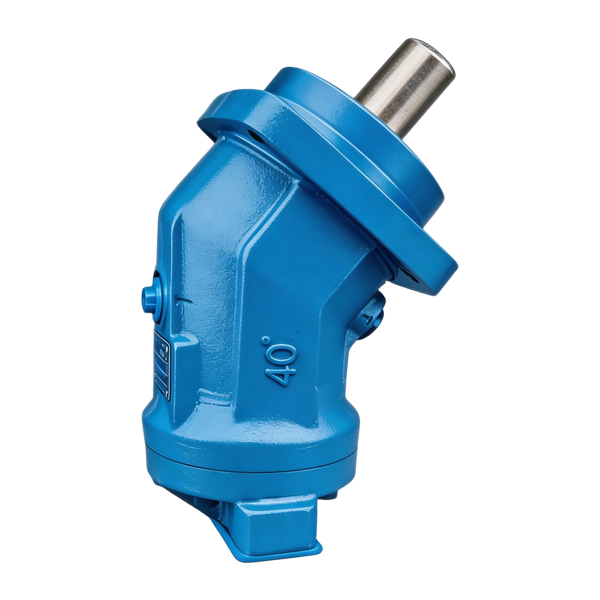
For a fixed-displacement motor, output speed is primarily related to motor displacement and available flow. Torque is related to displacement and pressure, subject to efficiency and losses. This can be practical for a defined winch, travel or gearbox duty point. The A2FE and A2FM product information on the BLINCE site describes fixed-displacement bent-axis axial piston designs, with different installation and application profiles.
A variable-displacement motor changes the hydraulic volume per revolution to adapt speed and torque. It may be appropriate when the machine must pull hard at low speed and then run faster at a lighter load. The control method, minimum displacement, response behavior and safe adjustment range must be confirmed for the exact model. Do not assume that a variable motor is automatically a drop-in replacement for a fixed unit.
Bent-axis and swash-plate questions
A bent-axis motor has a different geometric and mechanical layout from a swash-plate motor. The choice affects the housing, shaft line, installation envelope, bearing loads, service procedure and control arrangement. Ask the supplier to identify the design in the quotation and to provide the relevant cross-sectional or installation drawing. A product name that contains “axial piston” is not enough to establish interchangeability.
For a construction OEM, record why the architecture was selected: packaging, gearbox integration, speed range, torque density, control response or commonality with an existing pump family. For a repair buyer, begin with the failed unit's physical design and code. For an integrator, include the hydraulic schematic so the supplier can evaluate the complete loop rather than a motor in isolation.
Question 2: Can the Supplier Match the Real Duty Cycle?
Every RFQ should describe at least three operating points: continuous work, intermittent overload and start, stall or emergency conditions. Give torque, speed, inlet pressure, differential pressure, flow and duration for each point. Include the number of starts per hour, direction changes, overrunning loads and the percentage of time spent at high pressure. A motor that survives a short pressure spike may not be suitable for several hours of continuous operation.
| Duty point | Buyer should state | Supplier should confirm |
|---|---|---|
| Continuous | Torque, rpm, pressure, flow and operating hours | Continuous limits, cooling and efficiency assumptions |
| Intermittent | Duration, frequency and recovery time | Intermittent pressure, torque and speed limits |
| Start or stall | Breakaway load and expected peak duration | Starting torque, transient pressure and control conditions |
| Overrunning | Load-driven speed, braking and emergency stop behavior | Circuit protection, case pressure and safe deceleration |
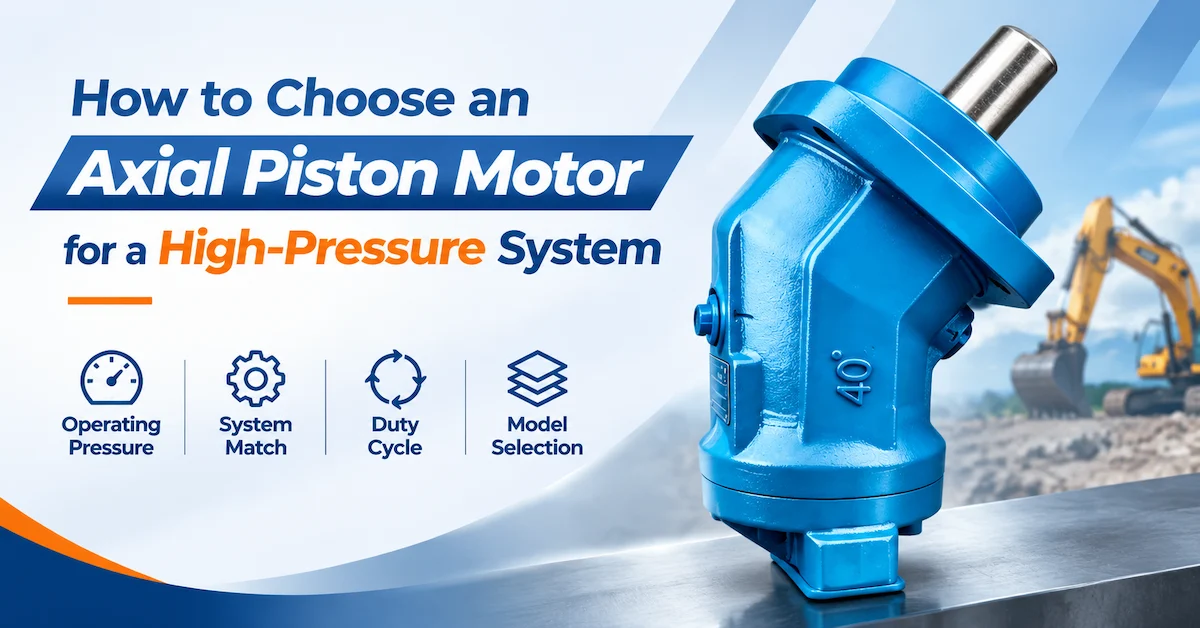
Use the terms “nominal,” “rated,” “intermittent” and “maximum” exactly as they appear in the supplier's current data sheet. If a supplier gives one pressure figure without a duty definition, ask for clarification. The published A2FE page, for example, identifies nominal pressure up to 40 MPa and peak pressure up to 45 MPa, with the qualification that values depend on shaft type and radial-load conditions. That wording is useful because it shows why a single number cannot represent every installation.
When comparing quotations, preserve the same duty cycle for every supplier. Otherwise, one vendor may quote a continuous rating while another quotes a short peak rating. The lowest price can look attractive simply because the operating assumptions are hidden.
Question 3: How Do Displacement, Flow and Speed Interact?
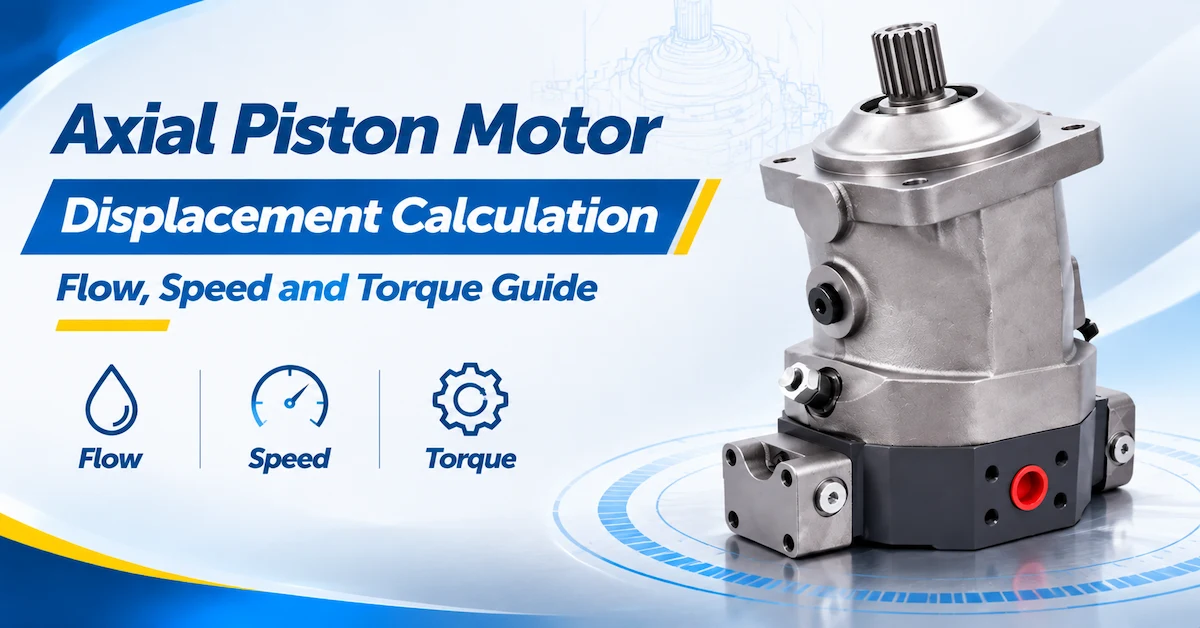
Displacement is the fluid volume associated with one shaft revolution. In a simplified selection, speed is related to available flow divided by displacement, while torque is related to displacement multiplied by pressure. Real systems must also account for volumetric and mechanical efficiency, leakage, pressure drop, pump sharing and control limits. A supplier should show the calculation basis and identify which values are theoretical and which are expected at the operating point.
The A2FE Series page lists fixed-displacement sizes of 28, 32, 45, 56, 63, 80, 90, 107, 125, 160, 180, 250 and 355 cm³/r. The A2FM Series page lists sizes from 10 through 180 and provides family-level displacement, speed, power and torque information. These ranges help an engineer create a shortlist, but they do not make every size suitable for every pressure, speed or shaft load. Ask for the exact size and variant in the quotation.
A useful selection worksheet
- Calculate the required shaft speed at the normal machine condition.
- Record the actual pump flow available to the motor after flow sharing and losses.
- Estimate the displacement needed, then verify the predicted speed at minimum and maximum flow.
- Calculate continuous and peak torque at the actual differential pressure, not only the relief-valve setting.
- Check efficiency, heat generation, case pressure and the supplier's allowable speed range for the exact model.
For closed-circuit systems, also describe charge pressure, flushing flow, cross-port relief and loop control. A motor supplier may need pump displacement, control type and swash-plate settings to assess the complete hydrostatic transmission. For a repair project, provide the pump and valve data if the original motor failed after overheating or loss of charge pressure; replacing the motor without addressing the circuit can repeat the failure.
Question 4: Is the Motor Compatible with an Open or Closed Circuit?
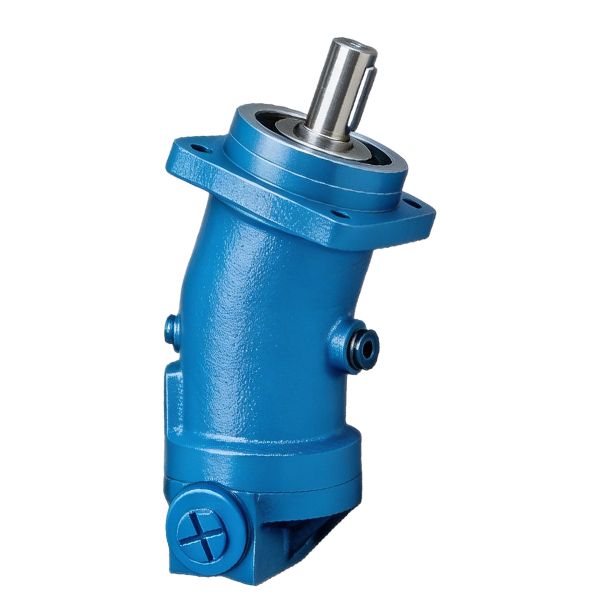
Axial piston motor compatibility depends on the complete hydraulic circuit. Ask whether the proposed motor is intended for an open circuit, a closed hydrostatic loop, or both, and which operating conditions apply. Confirm inlet and outlet pressure limits, case-drain routing, allowable return pressure, flushing requirements, oil viscosity range and filtration. For a closed circuit, the supplier should review charge-pressure behavior, loop relief protection and the motor's response to overrunning loads.
The A2FM product information describes a fixed-displacement bent-axis unit for hydrostatic drives in open and closed circuits. That is a useful family-level indication, not a replacement for the exact installation instructions. A2FE is described as a plug-in motor for direct gearbox integration; the gearbox, shaft support and drain arrangement therefore become part of the hydraulic and mechanical review.
Case drain and cooling questions
Case pressure is often overlooked because it is not visible in a basic pressure-gauge test. Ask for the permissible case pressure and the required drain connection for the exact model. Keep the drain line short, correctly sized and free from unintended restriction. Confirm whether the motor requires an external flushing or cooling flow and how the supplier defines acceptable oil temperature. Never block a required drain or merge it into a restrictive return without engineering approval.
For an OEM design, add these requirements to the hydraulic schematic and installation manual. For a repair buyer, photograph every old port and mark its function before removal. For an integrator, provide the valve block and hose routing because port location can affect pressure spikes and serviceability.
Question 5: Which Model Entrance Should I Use?
Use the product category to understand the available families, then move to the product page that matches the machine's architecture. The following screening logic keeps the purchasing path clear.
| Buyer requirement | Product entrance to review | Information to confirm next |
|---|---|---|
| Compact gearbox or plug-in drive | A2FE Series | Displacement, A/Z shaft, gearbox flange, radial load and pressure duty |
| Fixed motor for hydrostatic drive | A2FM Series | Exact size, speed, pressure, shaft, flange and circuit suitability |
| Variable-speed or variable-torque application | A6VM product page | Control type, displacement range, pressure, speed, port and mounting variant |
| Uncertain architecture or replacement search | Axial motor category | Send nameplate, drawing, photos and duty point for engineering screening |
This table is a navigation aid, not a substitute for a technical selection. It deliberately separates “product entrance” from “information to confirm next.” That distinction prevents a buyer from treating a family page as a purchase specification.
Question 6: What Mechanical Interfaces Must Be Checked?
Request a dimensioned drawing before approving a quotation. Check the flange face, pilot diameter, bolt circle, shaft extension, spline standard, key or spline engagement, rotation direction, port positions, drain location, overall length and service clearance. Add the connected gearbox or pump drawing when the motor is a plug-in unit. A nominally similar motor can fail to install if the pilot, shaft shoulder or port orientation differs by a few millimeters.
The A2FE product information specifically describes a plug-in flange for direct gearbox installation and A-type and Z-type splined shaft configurations. The A2FM information describes a bent-axis fixed unit for mobile and stationary hydrostatic drives. These interface clues help identify the correct product family, but the final drawing must show the exact shaft, mounting and port variant being quoted.
Replacement checklist
- Photograph the nameplate and record every code, suffix and revision.
- Measure flange pilot, bolt pattern, shaft diameter, spline or key, and shaft extension.
- Identify every port, thread standard, drain and optional brake or control connection.
- Confirm left/right rotation and whether the machine reverses direction under load.
- Record mechanical radial and axial loads from the gearbox, drum, wheel or sprocket.
- Ask the supplier to mark the proposed dimensions on the quotation drawing.
Do not use the phrase “direct replacement” without defining what must remain unchanged. It may mean dimensional interchangeability, functional equivalence, or simply a similar application. Ask which meaning applies to the proposed model and what adaptation is required if one interface differs.
Question 7: Can the Supplier Support OEM Documentation and Change Control?
An OEM needs more than one motor. It needs a controlled product record that can survive production changes, field service and future sourcing. Ask for a model code structure, drawing revision, performance table, installation instructions, inspection points, packaging identification and change-notification process. If the supplier changes a shaft, seal, control, port or material, the OEM should know whether the change affects interchangeability or validation.
BLINCE's company information describes Dongguan Blince Machinery & Electronics Co., Ltd. as a hydraulic manufacturer established in 2004, with R&D, production and testing capabilities, ISO 9001 and CE standards, and technical and after-sales support. These facts help with supplier due diligence. They should be paired with model-specific documents, sample records and a named technical contact for the project.
Evidence package to request
- Exact model code and current drawing revision.
- Displacement, pressure, torque and speed limits separated by duty category.
- Hydraulic circuit and installation requirements, including case drain and flushing.
- Interface dimensions, shaft standard, port standard and control or brake details.
- Inspection or test plan for a sample and first production lot.
- Identification, preservation, packaging and traceability method.
- Warranty boundaries, spare-parts path and response process for technical issues.
Do not ask a supplier to invent evidence that is not available. If a material grade, MOQ, lead time, test duration or efficiency value is not documented for the exact model, label it as “to be confirmed.” A transparent gap is easier to close than an unsupported promise that later becomes a field failure.
Question 8: How Should a Sample Be Tested?
Sample approval should verify three things: physical fit, hydraulic behavior and machine performance. Start with a document check. Compare the model code, drawing revision, shaft and port configuration with the purchase request. Inspect the sample for damage, contamination, missing plugs, incorrect accessories and visible leakage.
Next perform a controlled no-load run. Confirm direction, smooth acceleration, stable low-speed behavior, noise, leakage and temperature trend. Increase pressure and load in stages while recording inlet pressure, differential pressure, speed, case or return pressure, oil temperature and control input. Use the actual machine duty cycle only after the basic checks pass. For closed-circuit systems, include charge pressure, flushing flow and cross-port relief behavior in the test record.
Construction OEMs should test the motor in the machine configuration that controls production release. System integrators should validate the pump-motor-control combination and emergency stop sequence. Repair buyers should record before-and-after performance and investigate the original failure cause. A replacement motor that works briefly but is installed into a contaminated or pressure-imbalanced circuit is not a successful repair.
Agree acceptance criteria before the sample arrives. “No external leakage,” “reaches target speed,” or “holds load safely” should be connected to measurable conditions. Keep the drawing, test sheet, photographs and corrective actions with the supplier record.
Question 9: What Should the RFQ Say?
Use a structured RFQ so every axial piston hydraulic motor supplier receives the same technical information. The following wording can be adapted for a new OEM project, a closed-circuit integration or a repair replacement.
| RFQ section | Information to include |
|---|---|
| Machine and use | Machine model, application, environment, annual quantity and operating hours. |
| Duty points | Continuous/intermittent/peak torque, rpm, pressure, flow, duration and direction changes. |
| Circuit | Open or closed circuit, pump, charge pressure, relief settings, flushing, oil and filtration. |
| Interface | Drawing or measurements for flange, pilot, shaft, spline, ports, drain, brake and sensors. |
| Requested response | Exact model, drawing, data sheet, limits, options, sample plan and commercial assumptions. |
| Validation | Fit, no-load, staged-load and full-duty acceptance criteria with recorded measurements. |
Ask the supplier to list any assumption separately. For example, “pressure supplied is differential pressure at the motor,” “shaft radial load is based on the attached gearbox drawing,” or “quoted speed requires the stated flow.” This makes technical comparison easier and gives the engineering team a clear list of items to close.
Question 10: What Are the Most Expensive Buying Mistakes?
Mistake: choosing by displacement only
Displacement does not define the complete operating envelope. Pressure, speed, efficiency, shaft load, cooling, control and duty cycle all matter. A correct displacement with an incorrect shaft or circuit is still the wrong purchase.
Mistake: treating a family maximum as a single-model rating
Series pages summarize multiple sizes and configurations. The A2FE pressure and displacement information, for example, varies with shaft type, radial-load conditions and selected size. Always request the exact model table.
Mistake: ignoring the pump and control package
A motor can be mechanically strong but poorly matched to pump flow, charge pressure, relief settings or control response. Review the entire loop, especially in closed-circuit equipment.
Mistake: approving a sample without a baseline
Without agreed measurements, a trial becomes a subjective demonstration. Define speed, pressure, temperature, leakage and load conditions before the sample is shipped.
Mistake: using unsupported commercial claims
MOQ, lead time, service life, material grade and efficiency should be quoted only when they are valid for the exact model, batch and contract conditions. Do not publish or approve a number simply because it sounds competitive.
FAQ for OEM Buyers
What should I send to an axial piston hydraulic motor supplier first?
Send the application, machine model, operating hours, continuous and peak torque, rpm, pressure, flow, circuit type, oil and environment. Add the old motor nameplate, installation drawing or measured flange, shaft, spline and port dimensions. Mark unknown values clearly instead of guessing.
Which BLINCE axial motor is a good starting point for a compact gearbox drive?
The A2FE Series is the logical product-page starting point because BLINCE describes it as a fixed-displacement plug-in motor with a mounting flange for direct gearbox integration. The exact size, A or Z shaft, pressure, radial load and gearbox interface must still be confirmed.
What is the difference between the A2FE and A2FM selection path?
A2FE is presented as a compact plug-in fixed-displacement motor for direct gearbox mounting. A2FM is presented as a fixed-displacement bent-axis unit for hydrostatic drives in mobile and stationary applications. Use the installation architecture and circuit requirement to choose the path, then confirm the exact model data.
Should I choose A6VM for every variable-speed application?
No. The A6VM page is a model entrance for engineering review, not a universal rating. Confirm control type, displacement range, pressure, speed, shaft, flange, ports and closed-circuit compatibility for the exact variant and duty cycle.
Can a product page prove that a motor is a drop-in replacement?
A product page can identify the family, stated applications and interface options. A drop-in decision requires the current model drawing and a comparison with the motor being replaced, including shaft, flange, ports, rotation, brake or control options and operating limits.
What should be included in a sample acceptance test?
Include document and visual inspection, dimensional fit, no-load rotation, staged pressure and load, speed, temperature, leakage, case or return pressure and the actual machine duty cycle. Agree the pass criteria before testing.
How can a repair buyer avoid repeating the original failure?
Inspect oil cleanliness, pump and valve behavior, charge pressure, relief settings, case-drain routing, cooling and mechanical overload before installing the replacement. Record the old motor's failure evidence and send it with the RFQ.
Conclusion
The right axial piston hydraulic motor supplier does not simply recommend the largest or most familiar model. The supplier should translate your duty cycle, circuit, mechanical interface and control requirements into an exact, documented and testable proposal. Start with the architecture, separate continuous and peak conditions, verify displacement and speed against actual flow, and review case drain, cooling, shaft load and mounting before comparing prices.
For construction OEMs, closed-circuit integrators and hydraulic repair teams, the BLINCE axial motor category provides a clear starting point, with A2FE, A2FM and A6VM product entrances for different selection paths. Before production release or field replacement, request the current model drawing, rated-value table, configuration code and engineering confirmation of pressure, flow, speed and compatibility.