
Short answer
Choose an axial piston motor for a high-pressure system by matching the complete operating envelope, not by selecting the highest pressure number on a product page. Start with continuous, intermittent and transient pressure; then verify differential pressure, flow, speed, displacement, torque, duty cycle, circuit type, case drain, cooling, shaft load and mounting. The final choice should be an exact, documented model that a supplier's engineering team confirms against your machine.
Why High-Pressure Motor Selection Starts With the System
When an OEM or system integrator asks, “How do I choose an axial piston motor for a high-pressure system?”, the useful answer is not a list of the biggest motors. A high-pressure motor is a component inside a hydraulic energy path. Pump displacement, relief settings, charge pressure, valve timing, gearbox ratio, external loads and oil temperature can change the motor's actual duty even when the nameplate pressure appears acceptable.
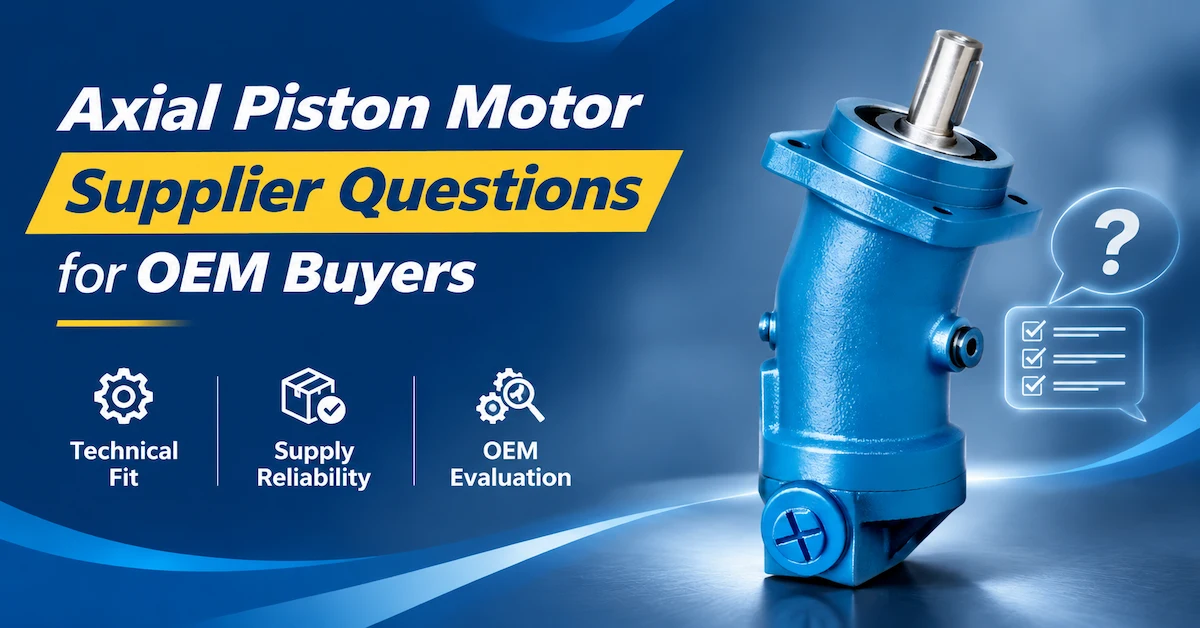
This guide is written for construction equipment OEMs, closed-circuit hydraulic system integrators and hydraulic repair buyers who are comparing a shortlist before requesting a quotation. It treats selection as a commercial-investigation task: define the machine, screen the product family, request the missing model data and agree how the first unit will be validated. It is deliberately different from a general supplier-evaluation article because the decision here is driven by a high-pressure operating envelope and an exact series or model match.
BLINCE provides a dedicated hydraulic axial piston motor category with product-family entrances. The category is the correct starting point for a new design or replacement search, while the current model drawing and written engineering confirmation remain the purchasing authority. Dongguan Blince Machinery & Electronics Co., Ltd. states that it has operated since 2004, with R&D, manufacturing and testing capabilities in Dongguan, China; those company facts support supplier due diligence but do not replace the data sheet for a particular motor.
1. Write the Operating Envelope Before Comparing Models
A pressure rating is meaningful only when its duration, speed, temperature and circuit conditions are known. Put the machine's normal and abnormal states into a short worksheet before opening a catalogue. For each state, record the motor torque, shaft speed, inlet and outlet pressure, differential pressure, flow, duration, direction and external load. If the number is unknown, mark it as unknown; a guessed value can make a quotation look precise while hiding the real risk.
| Operating state | Buyer records | Supplier confirms |
|---|---|---|
| Continuous work | Torque, rpm, flow, differential pressure, hours per shift and oil temperature | Continuous pressure, speed, cooling assumptions, efficiency basis and allowable case pressure |
| Intermittent overload | Peak torque, pressure, duration, frequency and recovery time | Intermittent limits for the exact displacement and the permitted duty ratio |
| Start, stall or jam | Breakaway torque, maximum pressure rise rate and expected stall duration | Starting torque, transient pressure capability and protection requirements |
| Overrunning or braking | Load-driven speed, deceleration time, back pressure and emergency-stop sequence | Loop relief, cross-port protection, flushing and safe control response |
Use three pressure labels in the RFQ: continuous, intermittent and peak or transient. “Maximum pressure” without a duty definition is not enough for an OEM release. Also state whether the pressure is pump outlet pressure, motor inlet pressure or differential pressure across the motor. Torque is created by differential pressure, while housing and seal stresses can depend on absolute port and case pressure. This distinction is especially important in a closed circuit where one port can experience high return pressure during overrunning.
Continuous pressure is a thermal question as well as a strength question
A motor can tolerate a short pressure event that would be unsuitable as a steady operating point. Continuous operation produces heat through volumetric leakage, mechanical friction, throttling and bearing losses. The system must remove that heat through the reservoir, cooler, flushing flow and housing. Ask the supplier which efficiency assumptions support the continuous rating and what oil temperature or viscosity range is required. Do not convert a family peak value into a continuous rating.
Transient pressure needs a cause and a time history
Record why a transient occurs: a valve closes quickly, a winch load overruns, a travel drive meets an obstacle, or a cylinder reaches the end of stroke. Give the expected duration and repetition rate. A pressure spike caused by a fast valve event may require a different protection strategy from a two-second stall every cycle. A supplier can then review relief response, shaft inertia, brake release timing and the motor's allowable peak condition together.
2. Screen the Motor by Differential Pressure, Torque and Speed
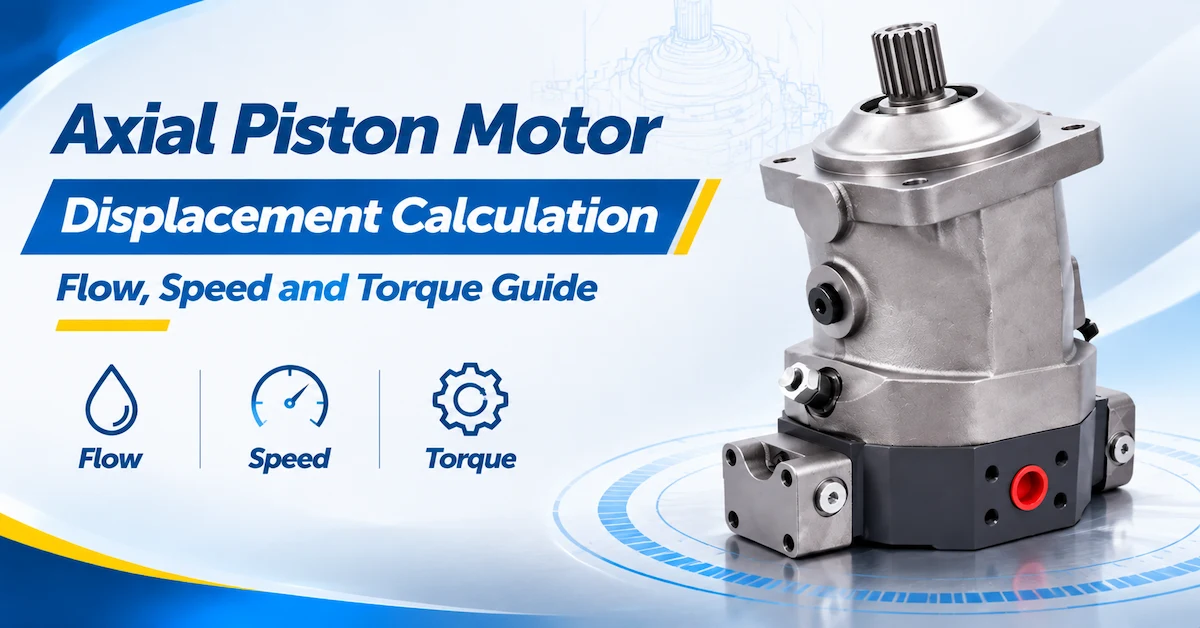
The core sizing relationships are simple, but the assumptions must be visible. In a first-pass calculation, motor speed is related to available flow and displacement; shaft torque is related to displacement and differential pressure. Actual speed and torque are lower or higher than the ideal calculation depending on volumetric and mechanical efficiency, pressure drop, leakage, temperature and control limits. Use the equations to create a shortlist, then ask for the exact model performance data.
For a fixed-displacement motor, the ideal speed relationship can be written as n ≈ Q × 1000 / Vg, where n is rpm, Q is flow in L/min and Vg is displacement in cm³/rev. A practical calculation applies volumetric efficiency and checks the supplier's maximum speed at the selected pressure. The ideal torque relationship can be expressed as T ≈ Δp × Vg / (2π) when pressure is in consistent SI units; a real selection applies mechanical efficiency and leaves margin for acceleration, shock and friction. These are screening equations, not a substitute for a model-specific data sheet.
| Parameter | Why it matters | Evidence to request |
|---|---|---|
| Differential pressure | Sets available hydraulic torque and heat generation | Continuous, intermittent and peak values for the exact size |
| Displacement | Links flow to speed and pressure to torque | Nominal displacement, tolerance and variable-control range if applicable |
| Flow | Determines speed, leakage margin and cooling demand | Minimum, normal and maximum flow at the motor ports |
| Speed | Limits lubrication, centrifugal stress, noise and bearing life | Exact-model speed limits at the stated pressure and displacement |
| Torque and inertia | Controls acceleration, stopping and overrunning behavior | Torque curve, start torque, load inertia and gearbox ratio assumptions |
Keep pump flow, motor flow and shared flow separate in your worksheet. A motor may receive less flow when another actuator operates, and an accumulator or flushing circuit may add flow that does not create useful shaft speed. For a closed-loop drive, state charge pressure, charge-pump flow, loop relief settings and the intended flushing flow. For an open circuit, state return-line back pressure and the valve arrangement. The same motor family can require a different confirmation path in the two architectures.
Leave margin without oversizing the motor
Oversizing can create its own problems. A much larger displacement may deliver the required torque at low pressure but demand more flow for the target speed. It can also increase cost, mass, installation envelope and control sensitivity. Undersizing can force the system to run near relief pressure, raise temperature and leave no reserve for acceleration. Set the margin by duty point: protect the continuous condition first, then verify intermittent and transient points against documented limits.
3. Choose Fixed or Variable Displacement Deliberately
A fixed-displacement motor is usually the simpler path when the pump, gearbox and machine controller already define a narrow operating range. The motor's displacement remains constant, so the control system can be easier to commission and the RFQ can focus on pressure, speed, torque and interface. BLINCE describes the A2FE Series as a fixed-displacement, bent-axis plug-in motor with a gearbox-oriented flange. The published family information lists 28 to 355 cm³/r sizes, nominal pressure up to 40 MPa and peak pressure up to 45 MPa. These are family-level selection references; the exact size, shaft and duty definition must be confirmed before purchase.
BLINCE describes the A2FM Series as a fixed-displacement bent-axis unit for hydrostatic drives in open and closed circuits. The family page lists sizes from 10 through 180, with size-dependent displacement, speed, power and torque information. The published range is useful for a first shortlist, but it is not a single rating for every A2FM model. Request the current data for the proposed size and configuration.
A variable-displacement motor can be appropriate when the machine must produce high torque at low speed and then increase speed at lighter load, or when the transmission needs a controlled ratio change. The control type, minimum displacement, response, pressure compensation and safe adjustment range become part of the selection. BLINCE's A6VM product page can be used as a variable-displacement product entrance, but current model-specific control, pressure, speed, shaft, port and compatibility data must be requested from engineering.
4. Match the Mechanical Architecture and Interface
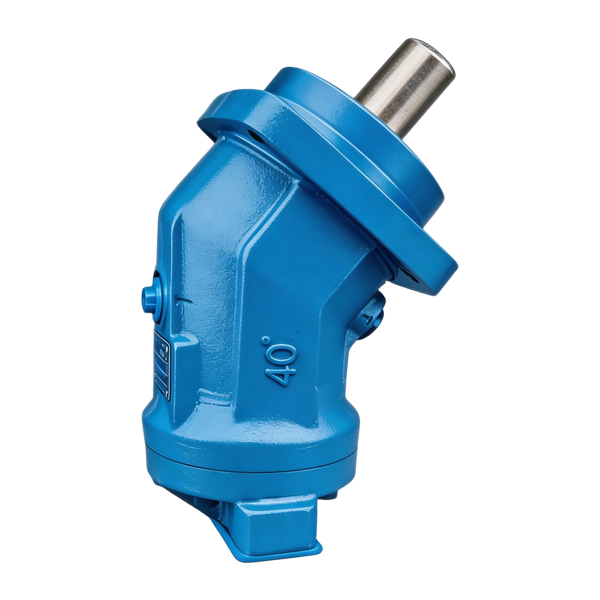
High-pressure capability does not make two motors interchangeable. Confirm the housing design, mounting flange, pilot diameter, bolt circle, shaft or spline, rotation, port locations and allowable external loads. A bent-axis motor and a swash-plate motor can have the same nominal displacement but completely different installation envelopes and shaft-line behavior. A plug-in motor may be designed to sit inside a gearbox, while a conventional flange-mounted unit may need a separate coupling and support bearing.
Ask for a current two-dimensional drawing or controlled CAD file. Compare the old motor and proposed motor dimension by dimension: flange face, pilot, shaft extension, spline standard, key or thread, port size and orientation, drain position, brake interface, sensor provision and overall length. Record whether radial and axial loads are carried by the motor or by the gearbox. If a gearbox carries the load, provide its bearing arrangement and coupling details; if the motor carries the load, request the allowable load direction and speed conditions.
For the A2FE path, BLINCE identifies A-type and Z-type spline configurations and a plug-in flange for direct gearbox integration. That is a useful architectural clue, not a drop-in guarantee. The chosen spline, flange, radial-load condition and displacement must be named in the quotation. For an A2FM or variable-motor path, confirm the housing and shaft configuration from the exact model drawing rather than assuming it matches another family.
Rotation and port orientation
Many axial piston motors support bidirectional operation, but the installation still needs a defined rotation and port convention. State clockwise and counter-clockwise behavior as viewed from the shaft, identify the pressure port in each direction and show how the drain is routed. A repair buyer should photograph the installed motor, hoses and nameplate before removal. An OEM should put the port orientation and rotation into the released drawing so assembly and service teams do not infer it from a photograph.
5. Verify the Hydraulic Circuit, Case Drain and Oil Management
High pressure is only safe when the surrounding circuit controls it. For an open circuit, review inlet conditions, return back pressure, valve transitions, relief protection and the reservoir's ability to remove heat. For a closed circuit, review charge pressure, loop relief, flushing, anti-cavitation protection, overrunning loads and the pump-motor control relationship. Send the hydraulic schematic with the RFQ; a motor cannot be confirmed from a pressure number alone.
Case drain routing deserves a separate line in the specification. Confirm the drain port, allowable case pressure, hose size, routing height, return location and whether the drain can be submerged or exposed to pressure during a stop. A blocked or undersized drain can raise housing pressure, force leakage past seals and invalidate an otherwise correct motor selection. Ask the supplier to state the case-pressure measurement point and the conditions used for its limit.
Oil cleanliness, viscosity and temperature influence both pressure capability and service behavior. Include the fluid type, viscosity range, filtration rating, contamination-control method, ambient temperature and expected oil temperature. If the machine works outdoors, in dust, at high altitude or near water, state those conditions. The supplier should identify any fluid compatibility exclusions and the commissioning steps for flushing the circuit before the first load test.
Closed-circuit questions for integrators
- What is the charge-pressure range at cold start, normal work and hot oil?
- How much flushing flow is available, and where does it return?
- What are the loop relief and cross-port relief settings?
- How is an overrunning load controlled during braking or downhill travel?
- What happens to motor pressure when the controller commands zero displacement or neutral?
- How are case pressure, oil temperature and filter restriction monitored?
Answering these questions lets a supplier evaluate the motor with the pump and controls rather than treating it as a stand-alone cartridge. It also gives the integrator a clear commissioning checklist and helps distinguish a component problem from a loop-protection problem during testing.
6. Use a Series and Model Verification Gate
After the operating envelope and interface are defined, create a verification gate before requesting a final price. The gate should answer four questions: Is the architecture correct? Does the exact displacement meet speed and torque? Are all pressure categories documented? Does the mechanical and hydraulic interface match the machine? If any answer is “pending,” keep the item on the technical shortlist instead of releasing it as an approved substitute.
| Selection gate | Evidence required before approval |
|---|---|
| Architecture | Fixed or variable displacement, bent-axis or swash-plate, open or closed circuit, control and brake requirements |
| Performance | Exact model displacement, continuous/intermittent/peak pressure, speed, torque and efficiency assumptions |
| Installation | Controlled drawing for flange, pilot, shaft, spline, ports, drain, rotation and external load |
| System protection | Case pressure, relief, charge, flushing, oil, filtration, cooling and commissioning requirements |
| Validation | Sample test plan, acceptance limits, traceability, warranty boundaries and corrective-action process |
Use this gate to keep family information in its proper place. The A2FE and A2FM pages help a buyer find the right product path. They do not authorize a buyer to copy a range value into a machine specification. The exact model code, displacement, shaft, port, pressure category and application conditions must be confirmed in writing by the engineering team.
7. Prepare an RFQ That Produces a Technical Answer
A short “please quote an axial piston motor” email creates a long clarification cycle. A structured RFQ lets the supplier quote the correct family and identify missing information early. Attach a schematic, machine drawing, old-unit photographs or nameplate, and a duty table. Separate mandatory requirements from preferred options so the supplier can propose an equivalent configuration without guessing.
| RFQ section | Information to send | Ask the supplier to return |
|---|---|---|
| Machine | Machine type, model, application, annual quantity, environment and operating hours | Recommended series, application assumptions and exclusions |
| Duty cycle | Continuous/intermittent/peak torque, rpm, flow, differential pressure, duration and direction changes | Exact-model pressure, speed, torque and thermal suitability |
| Circuit | Open or closed circuit, pump, charge pressure, relief, flushing, oil, filtration and cooling | Case-drain, protection and commissioning requirements |
| Interface | Flange, pilot, shaft/spline, ports, drain, rotation, brake and sensor dimensions | Controlled drawing, configuration code and compatibility statement |
| Commercial | Target quantity, sample need, packaging, destination and documentation request | Quotation assumptions, sample plan, lead-time basis, warranty and traceability |
For a repair quotation, add failure evidence: metal debris, discolored oil, damaged spline, seal condition, bearing noise, case-drain measurement and the circumstances of failure. A replacement that fits the flange can fail again if the original cause was contamination, excessive case pressure, cavitation, gearbox misalignment or an overrunning load. Ask the supplier whether the proposed unit requires a circuit correction before installation.
8. Validate the First Unit Before Production Release
Engineering confirmation should end in a testable plan. Start with document and visual inspection: verify model code, displacement, shaft, ports, seals, mounting, finish and identification. Check dimensional fit on the bench before connecting pressure. For a replacement, compare the current drawing with the old motor and record any adapter, hose or coupling change.
Run the motor at low pressure and speed first. Confirm rotation, smooth acceleration, leakage, noise, vibration, case pressure and temperature trend. Increase pressure, flow and load in controlled steps while recording inlet pressure, outlet pressure, differential pressure, rpm, flow, oil temperature and case-drain behavior. Test the continuous duty point before the intermittent or transient point. In a closed circuit, include charge pressure, flushing flow, loop relief response and overrunning-load control.
Agree acceptance limits before the sample arrives. The test record should identify the motor serial or batch, oil and filter condition, instruments, calibration status, ambient temperature and duration at each point. If a value is outside the agreed limit, stop and investigate rather than compensating with a higher relief setting. A clean first-article record becomes useful evidence for later production lots and service replacements.
Common High-Pressure Selection Mistakes
Mistake 1: Choosing by the highest bar value
A high peak-pressure number does not prove continuous suitability. Ask how pressure is defined, at what speed and displacement it applies, and how long it may occur. Compare the full duty cycle, not one headline number.
Mistake 2: Treating a family range as one model rating
A product family can contain many displacements, shafts and mounting variants. Published A2FE and A2FM ranges are useful for screening, but the exact model must be tied to a current drawing and model-specific data. Never copy the smallest or largest family value into a generic specification.
Mistake 3: Ignoring flow at low speed
A motor that meets torque at high pressure may run too fast at maximum pump flow or too slowly when flow is shared. Calculate minimum and maximum speed and include volumetric losses, control limits and gearbox ratio.
Mistake 4: Forgetting case pressure and cooling
Blocked drains, high return pressure and inadequate cooling can damage a motor that is otherwise correctly sized. Put drain routing, case-pressure measurement, oil temperature and flushing into the RFQ and acceptance test.
Mistake 5: Calling a flange match a drop-in replacement
Flange, pilot, shaft, spline, port orientation, rotation, brake and control options all matter. A model-specific drawing comparison is the minimum evidence for a replacement approval.
FAQ: Axial Piston Motor Selection for High-Pressure Systems
What is the first input I should send to a supplier?
Send the machine application, circuit type, continuous and peak torque, speed, flow, differential pressure, duty duration, oil temperature, mounting drawing and old-unit evidence if it is a replacement. Mark unknown values clearly and ask the supplier to identify what must be measured next.
Is a higher pressure rating always better?
No. The rating must match the duty category, speed, displacement, temperature and circuit protection. A motor selected only by a high peak value can run hot or exceed its continuous limit. Request continuous, intermittent and transient values for the exact model.
When should I compare A2FE and A2FM?
Use A2FE as a starting path when a fixed-displacement plug-in motor and direct gearbox integration fit the machine architecture. Use A2FM as a starting path when a fixed bent-axis motor for an open or closed hydrostatic drive is required. Confirm exact size, pressure, speed, shaft, flange and circuit compatibility in both cases.
When does a variable-displacement motor make sense?
It can make sense when the machine needs a controlled change between high torque and higher speed, or when the transmission must adapt to a variable load. The control method and minimum displacement become critical. Treat the A6VM page as a product entrance and request current variant-specific data before approval.
What should I check on a closed-circuit installation?
Check charge pressure, loop relief, cross-port relief, flushing flow, case pressure, overrunning-load control, neutral behavior, oil temperature and filtration. Include the pump and control settings in the review so the motor is evaluated as part of the hydrostatic transmission.
Can the product page confirm compatibility by itself?
A product page can identify a family, applications and published options. Compatibility requires a current model drawing and a written comparison of displacement, pressure, speed, shaft, flange, ports, rotation, control, drain and external loads. Engineering confirmation should control the purchase decision.
What evidence should a repair buyer include?
Include the nameplate, photographs, dimensions, failure mode, oil and filter condition, case-drain measurement, pump and valve information, operating pressure and the event that caused the failure. This helps the supplier avoid repeating a circuit or mechanical problem with the replacement.
Conclusion
Choosing an axial piston motor for a high-pressure system is a controlled matching exercise. Define the real operating envelope, separate continuous from intermittent and transient pressure, calculate flow and displacement at minimum and maximum speed, and check torque against differential pressure rather than pump relief pressure alone. Then verify fixed or variable displacement, circuit type, case drain, cooling, oil management, shaft load, flange, ports and control requirements.
For construction OEMs, closed-circuit integrators and hydraulic repair buyers, the BLINCE axial piston motor category provides a practical starting point, with A2FE and A2FM fixed-displacement entrances and an A6VM variable-displacement review path. Before releasing a purchase order, send the duty table, schematic, interface drawing and RFQ checklist to the engineering team and request written confirmation of the exact model, rated values, pressure, flow, speed and compatibility.