


What Is a Custom Hydraulic System Solution?
A custom hydraulic system solution is an application-specific hydraulic design that combines different hydraulic components according to the machine’s performance requirements, operating environment, installation limitations, and control needs.
Unlike standard hydraulic components purchased separately, a customized hydraulic solution focuses on how the complete system works together.
A complete hydraulic system may include:
- Hydraulic pumps
- Hydraulic motors
- Hydraulic valves
- Hydraulic cylinders
- Hydraulic coolers
- Hydraulic hoses
- Steering control units
- Hydraulic fittings
- Control components
The goal is not only to supply individual products but to achieve the required:
- Pressure performance
- Flow control
- Torque output
- Motion speed
- Load handling capability
- Energy efficiency
- Operating reliability
For OEM machinery manufacturers, choosing the right hydraulic system partner can directly influence machine performance, maintenance costs, production stability, and customer satisfaction.
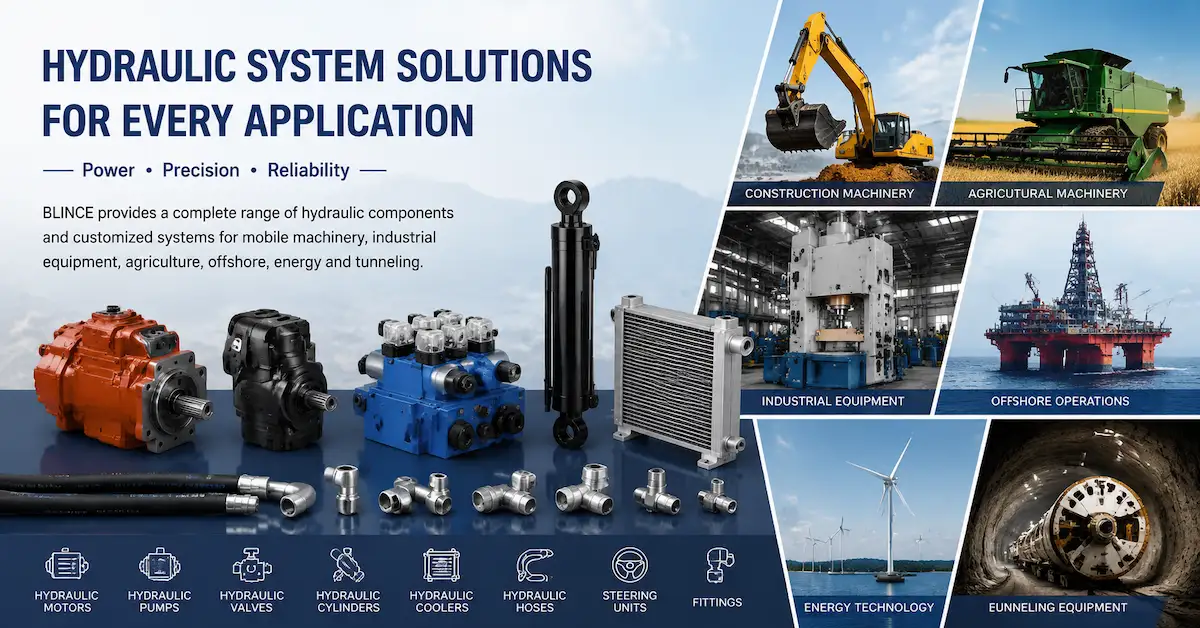
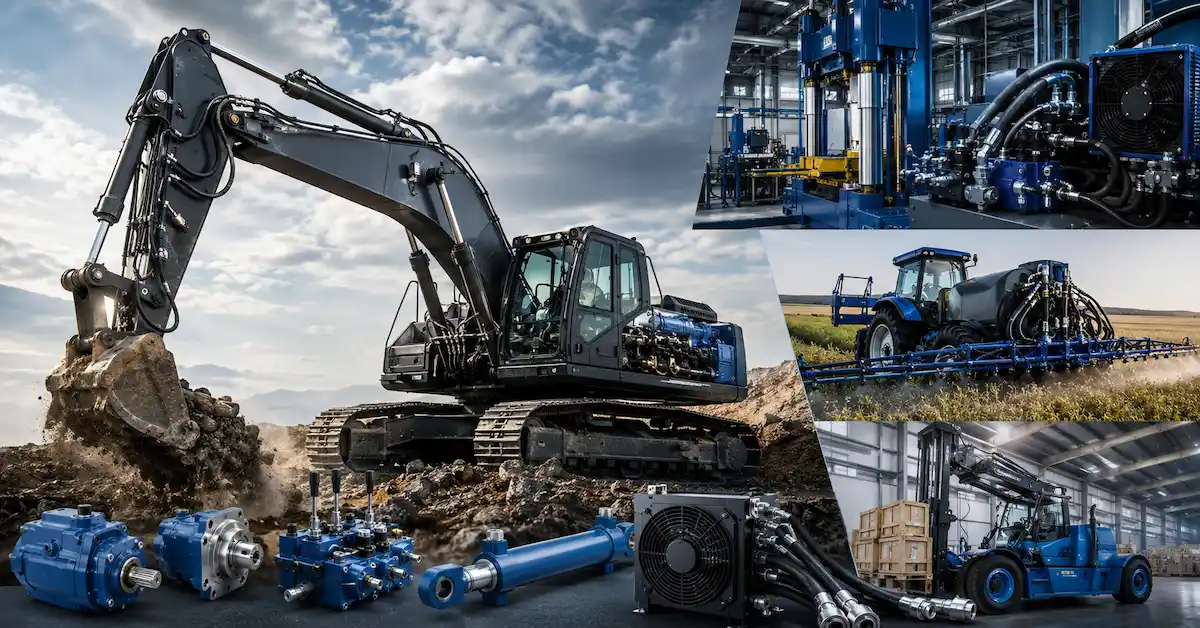
BLINCE provides hydraulic components and system solutions covering hydraulic motors, hydraulic pumps, hydraulic valves, hydraulic cylinders, hydraulic coolers, and hydraulic hoses.
Why Do OEM Buyers Need Custom Hydraulic System Solutions?
Many machinery manufacturers cannot achieve the required performance by simply selecting standard hydraulic components from a catalog.
Different machines have different requirements.
For example:
A compact construction machine may require a small installation footprint but high torque output.
A mining machine may require high-pressure operation, strong durability, and continuous working capability.
An agricultural machine may require stable low-speed operation and easy maintenance.
An industrial machine may require precise control, repeatability, and energy efficiency.
Therefore, a successful hydraulic solution needs to consider the complete application instead of selecting components individually.
Common Problems Solved by Custom Hydraulic Systems
Limited Installation Space
Mobile machinery and special equipment often have restricted installation areas.
A standard hydraulic component may provide suitable performance but fail to fit the available mechanical space.
Customization may involve:
- Port position adjustment
- Shaft modification
- Flange changes
- Compact valve configuration
- Cylinder mounting changes
- Hose routing optimization
The objective is to ensure hydraulic components fit the machine structure without affecting reliability.
Different Pressure and Flow Requirements
Every hydraulic system has different operating conditions.
Important parameters include:
| Parameter | Why It Matters |
|---|---|
| Working pressure | Determines component strength and operating capability |
| Peak pressure | Determines overload resistance |
| Flow rate | Influences actuator speed |
| Displacement | Determines motor output or pump capacity |
| Torque requirement | Defines motor selection |
| Duty cycle | Determines continuous performance requirements |
| Temperature | Affects oil condition and component life |
A custom hydraulic system solution should match these parameters before component selection.
Complex Motion Control Requirements
Modern machinery often requires multiple hydraulic actions working together.
Examples include:
- Lifting and lowering
- Rotating
- Traveling
- Clamping
- Steering
- Position control
- Variable speed operation
This requires proper coordination between:
- Hydraulic pump output
- Valve control
- Actuator size
- Motor torque
- System pressure
Who Needs Custom Hydraulic System Solutions?
A custom hydraulic solution is mainly required by companies that develop, manufacture, or operate specialized equipment.
OEM Machinery Manufacturers
OEM manufacturers are one of the main users of customized hydraulic solutions.
Typical industries include:
- Construction machinery
- Agricultural machinery
- Mining equipment
- Forestry machinery
- Material handling equipment
- Marine equipment
- Industrial machinery
OEM buyers usually require:
- Stable hydraulic performance
- Consistent production quality
- Customized interfaces
- Technical documentation
- Long-term supply capability
- Engineering communication
For OEM projects, the hydraulic supplier needs to understand both the hydraulic system and the machine application.
Hydraulic System Integrators
System integrators are responsible for developing complete hydraulic circuits for equipment manufacturers or industrial projects.
They often need suppliers who can support:
- Component selection
- Hydraulic calculations
- Circuit optimization
- Prototype testing
- Troubleshooting
- Technical documentation
A system integrator may source multiple components from one supplier to simplify technical communication and reduce compatibility risks.
Special Equipment Manufacturers
Some machines do not have standard hydraulic requirements.
Examples include:
- Custom lifting equipment
- Underground machinery
- Offshore equipment
- Automation systems
- Industrial production equipment
These applications often require:
- Special mounting
- Custom dimensions
- Specific operating pressures
- Environmental protection
- Long service life
Key Components in a Custom Hydraulic System Solution
A complete hydraulic solution requires correct matching between different components.
Hydraulic Pump Selection
The hydraulic pump is the power source of the hydraulic system.
BLINCE supplies different pump solutions including:
- Gear pumps
- Piston pumps
- Vane pumps
- Hydraulic pump cartridges
You can view the BLINCE hydraulic pump products.
Pump selection should consider:
- Flow requirement
- Pressure range
- Rotation speed
- Displacement
- Control method
- Efficiency
- Working cycle
A pump with insufficient flow may reduce machine speed, while an oversized pump may increase energy consumption and heat generation.
Hydraulic Motor Matching
Hydraulic motors convert hydraulic energy into rotary mechanical power.
BLINCE provides:
- Radial piston motors
- Axial piston motors
- Gear motors
- Orbital motors
- Travel motors
More information is available on the hydraulic motor product page.
Important motor selection factors include:
| Factor | Influence |
|---|---|
| Displacement | Determines torque and speed relationship |
| Pressure | Determines available output torque |
| Flow | Determines rotation speed |
| Shaft type | Ensures mechanical connection |
| Flange | Ensures installation compatibility |
| Duty cycle | Determines durability requirement |
For low-speed high-torque applications, motor selection requires special attention to starting torque and load conditions.
Hydraulic Valve Configuration
Hydraulic valves control:
- Direction
- Flow
- Pressure
- Sequence
- Machine movement
BLINCE hydraulic valve solutions include:
- Direction control valves
- Flow control valves
- Logic valves
- Proportional electro-hydraulic controls
View the BLINCE hydraulic valve products.
For customized systems, valve configuration should consider:
- Number of sections
- Flow capacity
- Pressure rating
- Spool function
- Control method
- Port connection
Hydraulic Cylinder Design
Hydraulic cylinders convert hydraulic energy into linear movement.
A customized cylinder solution may require adjustments to:
- Bore diameter
- Rod diameter
- Stroke length
- Mounting structure
- Port position
- Seal configuration
- Cushioning design
BLINCE provides hydraulic cylinder solutions for different industrial and mobile equipment applications.
Cylinder design must consider:
- Required force
- Operating pressure
- Load direction
- Working environment
- Installation limitations
Custom Hydraulic Cooler and Hose Selection
A complete custom hydraulic system solution should not only focus on the main power components. Supporting components such as hydraulic coolers, hoses, fittings, and filtration systems also influence long-term reliability.
Hydraulic Cooler Selection
Hydraulic systems generate heat during operation because of:
- Internal leakage
- Pressure losses
- Flow restrictions
- Continuous high-load operation
- Mechanical inefficiency
Excessive oil temperature can reduce viscosity, accelerate seal wear, increase leakage, and shorten component service life.
BLINCE provides hydraulic cooler solutions designed for hydraulic oil temperature control in industrial and mobile applications.
Hydraulic cooler selection should consider:
| Parameter | Importance |
|---|---|
| Oil flow rate | Determines cooling capacity requirement |
| Heat load | Defines required heat dissipation |
| Working temperature | Ensures oil remains within suitable range |
| Ambient environment | Affects cooling performance |
| Installation space | Determines cooler structure and size |
| Hydraulic circuit | Influences connection and integration |
A customized hydraulic solution should evaluate cooling requirements during the design stage instead of adding cooling equipment after overheating problems appear.
Hydraulic Hose and Connection Design
Hydraulic hoses are responsible for transferring pressurized hydraulic fluid throughout the system.
Although hoses are often considered supporting components, incorrect hose selection can cause:
- Pressure leakage
- Excessive pressure loss
- Hose failure
- Safety risks
- Reduced system efficiency
BLINCE supplies hydraulic hose products for different hydraulic applications.
Important hose selection factors include:
- Working pressure
- Burst pressure
- Inner diameter
- Temperature resistance
- Fluid compatibility
- Bend radius
- Reinforcement structure
- Fitting connection
- Installation routing
For OEM projects, hose layout should be considered together with the machine structure, movement range, vibration, and maintenance requirements.
Custom Hydraulic System Design Process
A professional custom hydraulic system solution normally follows a structured engineering process.
Step 1: Application Requirement Analysis
The first stage is understanding the machine and operating conditions.
Engineers need information including:
- Machine type
- Application purpose
- Operating environment
- Load requirements
- Working cycle
- Expected service life
- Installation limitations
For example, a hydraulic system designed for an excavator travel mechanism will have very different requirements compared with a hydraulic press or agricultural machine.
Step 2: Hydraulic Calculation and System Planning
Before selecting components, engineers evaluate:
- Required pressure
- Required flow
- Hydraulic power
- Torque requirements
- Cylinder force
- Operating speed
- Heat generation
- Energy efficiency
Incorrect calculation at this stage can lead to:
- Insufficient machine performance
- Excessive energy consumption
- Overheating
- Component failure
- Reduced service life
A professional hydraulic solution provider should be able to explain the reason behind each component selection.
Step 3: Component Selection and Matching
After defining system requirements, suitable components are selected.
A typical matching process includes:
| System Requirement | Related Component |
|---|---|
| Hydraulic power source | Hydraulic pump |
| Rotary movement | Hydraulic motor |
| Linear movement | Hydraulic cylinder |
| Motion control | Hydraulic valve |
| Temperature management | Hydraulic cooler |
| Fluid transfer | Hydraulic hose |
The goal is not selecting the highest-rated component.
The goal is selecting the component that provides the best balance between:
- Performance
- Reliability
- Efficiency
- Cost
- Maintenance
Step 4: Hydraulic System Integration
During integration, engineers verify:
- Component compatibility
- Installation dimensions
- Port connections
- Shaft and flange matching
- Hydraulic circuit logic
- Control requirements
- Safety considerations
This stage is especially important for OEM machinery because hydraulic components must fit the complete mechanical design.
Step 5: Prototype Testing and Validation
Before mass production, prototype testing helps identify potential issues.
Testing may include:
- Pressure testing
- Leakage inspection
- Performance testing
- Movement verification
- Temperature monitoring
- Load testing
Testing allows engineers to optimize the system before large-scale manufacturing.
Step 6: Production Support and Continuous Improvement
A long-term hydraulic partner should support:
- Production adjustment
- Replacement parts
- Technical communication
- Maintenance feedback
- Product improvement
For OEM customers, the relationship continues after the first delivery because future machine generations may require hydraulic system optimization.
How to Evaluate a Custom Hydraulic System Solution Provider?
Choosing a supplier for a customized hydraulic project requires more than checking product catalogs.
Buyers should evaluate the following areas.
Engineering Capability
A capable supplier should understand:
- Hydraulic principles
- Component matching
- System pressure and flow
- Application requirements
- Mechanical interfaces
- Failure analysis
The supplier should be able to discuss your machine requirements instead of only recommending standard products.
Manufacturing Capability
For customized hydraulic components, manufacturing capability affects:
- Dimensional accuracy
- Product consistency
- Delivery stability
- Repeat production quality
Important evaluation points include:
- Machining capability
- Assembly process
- Inspection procedure
- Production control
- Testing equipment
BLINCE states that it has manufacturing capabilities, R&D resources, testing equipment, ISO 9001 and CE-related compliance, and more than 20 years of hydraulic industry experience. More information is available on the BLINCE About Us page.
Customization Capability
A suitable custom hydraulic system partner should support different customization requirements.
Examples include:
Hydraulic Motor Customization
- Displacement adjustment
- Shaft modification
- Flange customization
- Port arrangement
- Mounting adaptation
Hydraulic Pump Customization
- Displacement selection
- Shaft configuration
- Control options
- Mounting solution
Hydraulic Valve Customization
- Valve sections
- Spool configuration
- Control method
- Port options
Hydraulic Cylinder Customization
- Bore size
- Rod diameter
- Stroke length
- Mounting design
- Seal selection
Documentation and Technical Communication
For B2B projects, technical communication is essential.
Useful documents may include:
- Product drawings
- Installation dimensions
- Technical specifications
- Hydraulic diagrams
- Testing information
- Maintenance recommendations
Poor communication during the design stage often creates problems later during installation or production.
Custom Hydraulic System Solution vs Standard Hydraulic Components
| Comparison Factor | Standard Hydraulic Components | Custom Hydraulic System Solution |
|---|---|---|
| Design approach | Catalog-based selection | Application-based engineering |
| Installation | Limited options | Customized interfaces |
| Performance | General requirements | Optimized for machine needs |
| Integration | Buyer responsibility | Supplier engineering support |
| Development | Faster selection | Requires technical evaluation |
| Best application | Standard equipment | Special machinery and OEM projects |
Standard components are suitable when requirements are already clear.
However, customized solutions provide more value when machines have:
- Unique performance requirements
- Limited installation space
- Special environments
- Complex hydraulic control
- High reliability requirements
Common Risks in Custom Hydraulic Projects
Custom projects can fail when the design process is incomplete.
Selecting Components Without Complete Data
Missing information about pressure, flow, load, or operating environment can result in incorrect component selection.
Ignoring System Interaction
Changing one component may affect:
- Flow distribution
- Pressure losses
- Temperature
- Machine response
- Energy consumption
Lack of Prototype Testing
Without validation, hidden problems may appear after mass production.
Poor Communication Between Supplier and Buyer
Clear communication is required regarding:
- Drawings
- Specifications
- Modification requirements
- Testing standards
- Delivery expectations
A successful custom hydraulic project depends on cooperation between the equipment manufacturer and hydraulic solution provider.
What Information Should Buyers Provide for a Custom Hydraulic Project?
To receive an accurate hydraulic solution proposal, buyers should prepare:
Machine Information
- Machine type
- Application
- Working environment
- Operating cycle
- Space limitations
Hydraulic Requirements
- Working pressure
- Maximum pressure
- Flow requirement
- Hydraulic oil type
- Temperature range
Motion Requirements
For rotary systems:
- Required torque
- Rotation speed
- Duty cycle
For linear systems:
- Required force
- Stroke length
- Movement speed
- Load condition
Existing Component Information
For replacement projects:
- Model number
- Product photos
- Nameplate information
- Dimensions
- Shaft details
- Port specifications
Providing complete technical information helps reduce design time and prevents incorrect recommendations.
Why Choose BLINCE for Custom Hydraulic System Solutions?
BLINCE provides hydraulic components and engineering support for customers requiring customized hydraulic solutions.
Its product range includes:
- Hydraulic Motors
- Hydraulic Pumps
- Hydraulic Valves
- Hydraulic Cylinders
- Hydraulic Coolers
- Hydraulic Hoses
BLINCE's custom hydraulic support focuses on:
- Application analysis
- Component matching
- OEM customization
- Manufacturing
- Testing
- Technical communication
- After-sales support
For OEM machinery manufacturers, system integrators, and industrial equipment companies, working with a hydraulic solution provider that understands both components and applications can reduce development risks.
FAQ
What is a custom hydraulic system solution?
A custom hydraulic system solution is an application-specific hydraulic design that combines pumps, motors, valves, cylinders, hoses, coolers, and related components according to machine requirements.
When should I choose a custom hydraulic system instead of standard components?
A custom solution is recommended when equipment has special performance requirements, limited installation space, unique hydraulic control needs, or complex operating conditions.
What information is required for hydraulic system customization?
Important information includes machine application, pressure, flow, torque, speed, cylinder requirements, installation dimensions, operating environment, and quantity requirements.
Can hydraulic components be customized for OEM machines?
Yes. Depending on the component, customization may include shafts, flanges, ports, displacement, mounting dimensions, valve configurations, cylinder sizes, and other interfaces.
How long does a custom hydraulic system project take?
The timeline depends on system complexity, technical confirmation, prototype requirements, testing, and production quantity. A clear specification can shorten the development process.
What industries use custom hydraulic system solutions?
Common industries include construction machinery, agriculture equipment, mining equipment, marine machinery, industrial automation, material handling, and special equipment manufacturing.
How do I reduce risks when developing a custom hydraulic system?
Provide complete technical information, confirm component matching, review drawings, perform testing before mass production, and work with a supplier that provides engineering support.
What is the difference between a hydraulic component supplier and a custom hydraulic solution provider?
A component supplier mainly provides individual products, while a custom hydraulic solution provider helps analyze requirements, match components, optimize the system, and support project development.
Conclusion
A custom hydraulic system solution is not simply a combination of hydraulic components.
For OEM manufacturers and engineering companies, it represents a complete process that includes requirement analysis, hydraulic calculation, component selection, system integration, testing, production support, and long-term technical cooperation.
The right hydraulic partner should understand both the individual components and how they operate together inside the machine.
BLINCE provides hydraulic motors, pumps, valves, cylinders, coolers, hoses, and customized hydraulic support for different industrial and mobile machinery applications.
If you are developing new equipment or upgrading an existing hydraulic system, provide your machine information, hydraulic requirements, drawings, operating conditions, and project details through the BLINCE Contact Us page for technical evaluation and customized hydraulic system support.