


What Should Buyers Expect From a Hydraulic System Supplier?
A hydraulic system supplier should provide more than a collection of pumps, motors, valves, and cylinders. For B2B buyers, the supplier should help reduce sourcing risk by ensuring that the selected components match the machine's pressure, flow, torque, speed, mounting, control, temperature, and operating environment.
This distinction matters because a component can be individually suitable yet still perform poorly when combined with an incompatible hydraulic circuit. A valve with insufficient flow capacity, a motor with the wrong displacement, an incorrectly specified pump, or inadequate cooling can affect the performance of the complete machine.
For OEM sourcing, the better question is therefore not simply:
“Can this supplier sell me hydraulic components?”
It is:
“Can this supplier consistently provide the right hydraulic components, configurations, technical information, quality control, and support for my equipment?”
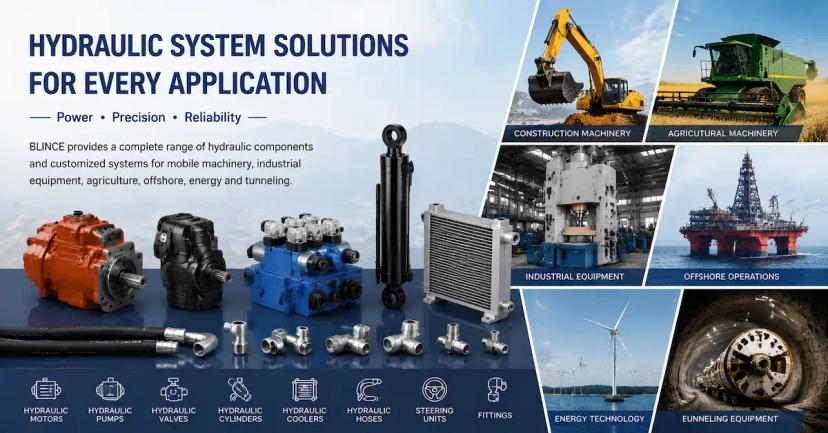
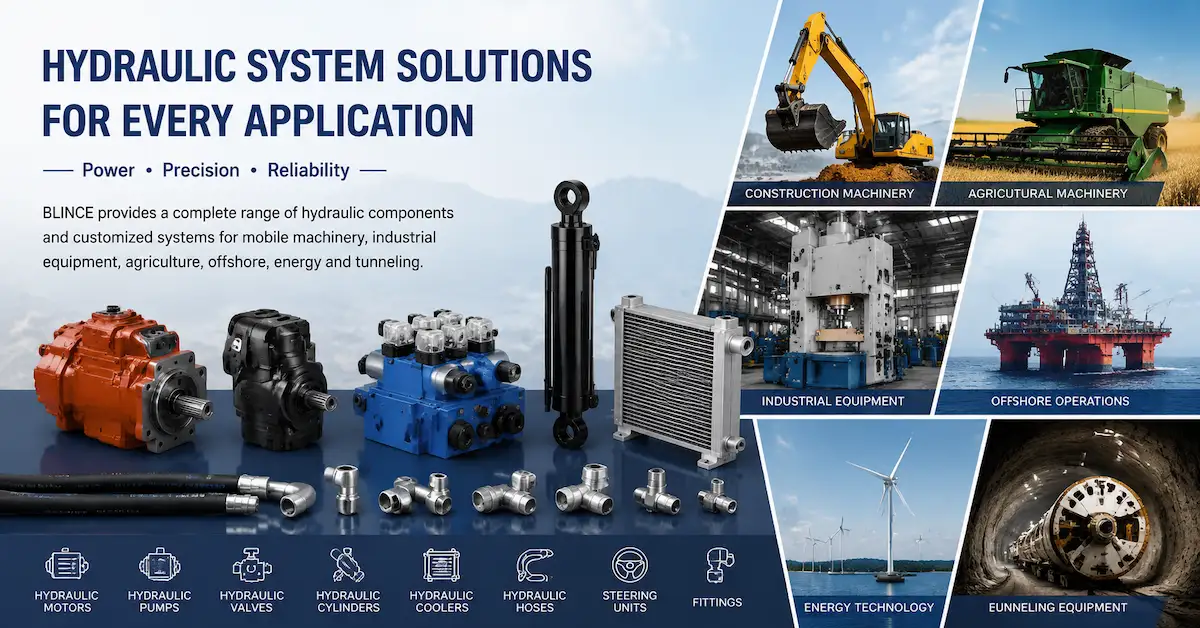
BLINCE currently offers hydraulic motors, pumps, valves, cylinders, coolers, hoses, steering control units, fittings, and custom hydraulic systems for applications including mobile machinery, agricultural equipment, industrial engineering, offshore operations, energy technology, and tunneling equipment.
Who Usually Searches for a Hydraulic System Supplier?
Different buyers use the same keyword for very different procurement tasks.
Understanding these differences helps identify what a suitable supplier must actually provide.
OEM Machinery Manufacturers
OEM manufacturers may need a supplier for:
- New machine development
- Component standardization
- Model upgrades
- Cost optimization
- Localizing an existing supply chain
- Custom interfaces
- Alternative component sourcing
- Long-term production supply
These buyers normally care about repeatability, technical documentation, dimensional consistency, engineering communication, customization, and future replacement availability.
Hydraulic System Integrators
System integrators usually need several components to operate within the same hydraulic circuit.
They may source:
- Pumps
- Motors
- Valves
- Cylinders
- Coolers
- Hoses
- Steering units
- Fittings
Their biggest concern is system compatibility, because the performance of each component affects other components in the circuit.
Hydraulic Distributors and Importers
Distributors often prioritize:
- Broad product coverage
- Stable models
- Replacement options
- OEM branding
- Documentation
- Quality consistency
- Repeat ordering
- Technical support
A supplier that covers several related hydraulic categories may help reduce the number of vendors a distributor needs to manage.
Repair and Maintenance Companies
Maintenance buyers often have a different problem:
The original component has failed, but the machine needs to return to service.
They may need help identifying:
- A replacement hydraulic motor
- An alternative piston pump
- A compatible directional valve
- A replacement pump cartridge
- A custom hydraulic cylinder
- Matching ports, shafts, flanges, or mounting dimensions
For these customers, compatibility information can be more valuable than a large catalog.
Check 1: Does the Supplier Cover the Components Your System Actually Needs?
The first check is product scope.
A supplier does not need to manufacture every hydraulic component in existence, but its product portfolio should match your sourcing strategy.
BLINCE's current hydraulic product range includes multiple core and supporting component categories.
| Product Category | Main Function | Important Buyer Checks |
|---|---|---|
| Hydraulic pump | Generates hydraulic flow | Displacement, flow, pressure, speed, rotation, control |
| Hydraulic motor | Produces rotary output | Torque, displacement, pressure, speed, shaft, flange |
| Hydraulic valve | Controls flow, pressure and direction | Flow rating, pressure, spool function, ports, actuation |
| Hydraulic cylinder | Produces linear force | Bore, rod, stroke, pressure, mounting, seals |
| Hydraulic cooler | Controls oil temperature | Oil flow, heat load, ambient temperature, cooling capacity |
| Hydraulic hose | Transfers pressurized fluid | Working pressure, ID, temperature, fluid, fitting |
| Steering control unit | Controls hydraulic steering | Displacement, pressure, steering circuit compatibility |
| Fittings | Connects hydraulic lines | Thread, pressure rating, material, sealing method |
Buyers can review BLINCE's complete hydraulic product range, including dedicated sections for hydraulic motors, hydraulic pumps, hydraulic valves, and hydraulic cylinders.
A wider product range is useful only when the supplier can also explain how the products fit your application.
Check 2: Can the Supplier Match Technical Parameters Instead of Only Model Numbers?
A strong hydraulic system supplier should ask technical questions before recommending a component.
For example, selecting a hydraulic motor by model name alone can be risky. The buyer may also need to confirm:
- Displacement
- Continuous pressure
- Peak pressure
- Required torque
- Flow rate
- Speed range
- Starting requirements
- Shaft
- Flange
- Port configuration
- Rotation
- Case drain requirements
- Duty cycle
Pump sourcing requires a different set of checks:
- Displacement
- Input speed
- Required flow
- Pressure
- Rotation
- Shaft
- Mounting
- Control type
- Fluid
- Temperature
- Load sensing or pressure compensation where applicable
The same principle applies to valves and cylinders.
A good supplier does not simply answer:
“Yes, we have this type.”
It should determine whether the proposed configuration fits the machine.
Check 3: Does the Supplier Understand System-Level Compatibility?
Hydraulic sourcing becomes more complicated when multiple components interact.
Suppose an OEM changes the hydraulic pump to obtain more flow.
That change may also affect:
- Valve flow capacity
- Motor speed
- Cylinder movement speed
- Pressure loss
- Hose velocity
- Heat generation
- Cooler requirement
This is why system-level communication matters.
ISO 4413:2010 covers general rules and safety requirements for hydraulic fluid power systems and components and considers areas such as system design, construction, modification, installation, reliable operation, maintenance, energy efficiency, and environmental factors.
A supplier supporting OEM projects should therefore understand the complete operating context rather than viewing every hydraulic component as an isolated item.
Check 4: What Quality Control Can the Supplier Explain?
“High quality” is not a useful supplier-audit answer.
A professional buyer should ask how quality is controlled.
Relevant questions include:
- How are incoming materials inspected?
- Which dimensions are checked after machining?
- How are critical tolerances controlled?
- What inspection happens before assembly?
- Are pressure tests performed?
- Is leakage checked?
- Are speed or performance parameters verified?
- How is nonconforming product handled?
- Can production batches be traced?
- What documents can be provided for an OEM project?
BLINCE states that its quality process extends from raw-material selection through final delivery. Its website also describes precision testing that includes pressure, speed, and accuracy testing, alongside ISO 9001 and CE-related compliance claims.
For B2B buyers, the important lesson is simple:
Ask for the quality process, not just the quality promise.
Check 5: Can the Supplier Handle OEM and Custom Hydraulic Requirements?
Standard components are often the lowest-risk choice when they fit the machine.
But OEM equipment may require customization.
Common requests include:
Hydraulic Motors
- Shaft configuration
- Spline
- Flange
- Port position
- Thread
- Rotation
- Displacement
Hydraulic Pumps
- Shaft
- Mounting
- Rotation
- Port arrangement
- Control configuration
- Displacement
Hydraulic Valves
- Number of sections
- Spool function
- Port type
- Actuation
- Voltage
- Control configuration
Hydraulic Cylinders
- Bore
- Rod diameter
- Stroke
- Mounting
- Port location
- Seals
- Cushioning
- Special environmental requirements
A suitable OEM hydraulic system supplier should review why the modification is needed before finalizing it.
That prevents a common sourcing mistake: solving an installation problem while unintentionally creating a performance problem.
BLINCE describes its business as providing design, engineering consulting, project support, production, and hydraulic solution services rather than only standard component sales.
Check 6: Can the Supplier Support Replacement and Cross-Reference Sourcing?
Replacement projects deserve their own evaluation process.
Two hydraulic components may look similar but still be incompatible.
Before approving a replacement, compare:
| Replacement Factor | Why It Must Match |
| Function | The replacement must perform the same hydraulic task |
| Displacement | Affects flow, speed or torque characteristics |
| Pressure rating | Must suit operating and peak pressure |
| Flow capacity | Prevents restricted performance or excess loss |
| Shaft | Must fit the mechanical interface |
| Flange | Determines mounting compatibility |
| Port/thread | Determines connection compatibility |
| Rotation | Important for pumps and motors |
| Dimensions | Determines physical installation |
| Controls | Must match the machine's operating logic |
If the original part number is unavailable, send the supplier:
- Nameplate photo
- Existing model
- Clear product photos
- Shaft dimensions
- Flange dimensions
- Port details
- Machine model
- Operating pressure
- Flow
- Drawings when available
This gives the supplier enough information to assess compatibility instead of guessing from appearance.
Check 7: Can the Supplier Support Long-Term Procurement?
A technically correct component solves today's requirement.
A good supply partner should also reduce tomorrow's procurement risk.
OEM manufacturers and distributors should discuss:
- Repeat-order consistency
- Model continuity
- Custom-part documentation
- Production planning
- Sample approval
- Batch inspection
- Spare-part availability
- Packaging
- Export documentation
- Communication during specification changes
Avoid assuming lead time or production capacity unless the supplier has confirmed them for your specific model and quantity.
For custom products, buyers should ask separately about:
- Technical review time
- Sample or prototype requirements
- Sample approval
- Production lead time
- Inspection
- Packaging
- Shipment
This is more useful than asking only:
“How many days for delivery?”
Check 8: What Technical Support Is Available After Delivery?
A hydraulic supplier relationship should not necessarily end when the shipment leaves the factory.
Technical questions can appear during:
- Installation
- Commissioning
- Initial testing
- Troubleshooting
- Maintenance
- Replacement
- Machine upgrades
BLINCE states that its technical and after-sales services cover installation, maintenance, troubleshooting, and technical training. The company's contact page also offers hydraulic solution consulting and technical support.
This is especially important for OEM machinery and custom hydraulic projects, where the operating environment can reveal issues that are not visible during basic component selection.
Check 9: Does the Supplier Help Reduce Commercial Risk?
Price matters, but purchase price is only one part of hydraulic sourcing cost.
A cheaper component may become expensive if it creates:
- Machine downtime
- Frequent replacement
- Installation modifications
- Oil leakage
- Heat problems
- Inconsistent batches
- Difficult spare-parts sourcing
- Repeated engineering work
- Customer warranty claims
When comparing suppliers, consider the total procurement risk, not simply unit price.
A useful supplier comparison can look like this:
| Evaluation Factor | Supplier A | Supplier B | What Buyers Should Verify |
| Product range | Limited / broad | Limited / broad | Can required categories be consolidated? |
| Technical support | Basic / engineering | Basic / engineering | Can drawings and parameters be reviewed? |
| OEM capability | Standard only / custom | Standard only / custom | Which dimensions or configurations can change? |
| Replacement support | Model only / technical match | Model only / technical match | Are dimensions and operating data checked? |
| Quality control | Claim / documented process | Claim / documented process | What inspection and testing is performed? |
| Documentation | Limited / project-specific | Limited / project-specific | Are drawings and technical records available? |
| After-sales | Sales only / technical | Sales only / technical | Who handles troubleshooting? |
| Long-term supply | Unclear / planned | Unclear / planned | How are repeat orders controlled? |
The lowest quoted price does not automatically represent the lowest sourcing cost.
How Different Industries Change Hydraulic Supplier Requirements
The correct supplier also depends on application environment.
Construction Machinery
Excavators, loaders, skid steers, road machinery, and drilling equipment can require:
- High pressure
- Shock-load resistance
- Compact installation
- Strong contamination control
- Reliable travel and working circuits
Agricultural Machinery
Harvesters, tractors, seeders, balers, and feed equipment may require:
- Low-speed high-torque drives
- Simple serviceability
- Dust and dirt tolerance
- Seasonal reliability
- Distributed hydraulic functions
Mining and Tunneling Equipment
These environments can involve:
- Heavy loads
- Dust
- Vibration
- Long duty cycles
- Restricted maintenance access
- High reliability requirements
Industrial Machinery
Hydraulic presses, injection molding equipment, machine tools, and production systems may prioritize:
- Stable pressure
- Precise control
- Low noise
- Energy efficiency
- Temperature stability
- Continuous operation
Marine and Offshore Equipment
Marine applications may require attention to:
- Corrosion
- Environmental exposure
- Long operating cycles
- Maintenance access
- System reliability
BLINCE lists mobile machinery, agriculture, industrial engineering, offshore operations, energy technology, and tunneling among the application areas served by its hydraulic portfolio.
What Information Should You Send a Hydraulic System Supplier?
The quality of the supplier's recommendation depends partly on the quality of the information you provide.
For a new project, prepare:
Machine Information
- Equipment type
- Application
- Machine model
- Operating environment
- Required duty cycle
Hydraulic Information
- Hydraulic schematic
- Working pressure
- Peak pressure
- Required flow
- Oil type
- Operating temperature
Motion Requirements
For rotary drives:
- Torque
- Speed
- Motor displacement where known
For linear actuators:
- Required force
- Bore
- Rod
- Stroke
- Extension and retraction speed
Mechanical Interfaces
- Shaft
- Spline
- Flange
- Mounting
- Ports
- Thread type
- Installation envelope
Commercial Information
- Order quantity
- Annual demand
- Sample requirement
- Target delivery schedule
- OEM branding requirement
- Destination market
Providing this information early reduces repeated clarification and helps the supplier identify risks before quotation.
A Practical Hydraulic Supplier Sourcing Process
Step 1: Define the Application
Start with what the machine must do, not with the component you think you need.
Step 2: Prepare Technical Data
Collect drawings, schematics, existing models, pressure, flow, torque, speed, dimensions, and operating conditions.
Step 3: Shortlist Suppliers
Compare suppliers based on product relevance, technical capability, quality process, customization, and support.
Step 4: Confirm the Proposed Configuration
Verify every critical parameter before ordering.
Step 5: Evaluate Samples When Necessary
For custom or high-risk components, sample validation can reduce production risk.
Step 6: Define Inspection Requirements
Agree on critical dimensions, functional checks, documentation, and testing expectations.
Step 7: Confirm Commercial Terms
Clarify quotation scope, quantity, lead time, packaging, shipping responsibilities, and after-sales process.
Step 8: Review Performance After Installation
Feedback from real machine operation can improve future orders and specification control.
Why Consider BLINCE as a Hydraulic System Supplier?
Dongguan Blince Machinery & Electronics Co., Ltd. states that it was established in 2004 and has more than 20 years of hydraulic-industry experience. Its website describes R&D capabilities, production equipment, testing facilities, ISO 9001 and CE-related compliance, 10 registered patents, engineering services, and after-sales technical support.
For buyers seeking to consolidate hydraulic sourcing, BLINCE's portfolio currently includes:
- Hydraulic Motors
- Hydraulic Pumps
- Hydraulic Valves
- Hydraulic Cylinders
- Hydraulic Coolers
- Hydraulic Hoses
The wider portfolio also includes steering control units, fittings, and custom hydraulic systems.
For OEM manufacturers, distributors, system integrators, or maintenance buyers, the practical advantage is the ability to discuss several related hydraulic requirements with one supplier while still validating every component against the actual machine specification.
FAQ
What is a hydraulic system supplier?
A hydraulic system supplier provides hydraulic components or integrated sourcing support for pumps, motors, valves, cylinders, hoses, coolers, controls, and related components used in mobile and industrial hydraulic systems.
How do I choose a reliable hydraulic system supplier?
Evaluate product coverage, technical expertise, component compatibility, quality control, testing, OEM capability, documentation, replacement support, communication, and after-sales service rather than comparing price alone.
What should I send when requesting a hydraulic quotation?
Provide the machine application, model, hydraulic schematic, pressure, flow, torque, speed, dimensions, shaft, flange, ports, operating environment, required quantity, and existing component information where available.
Can a hydraulic supplier customize components for OEM machinery?
Customization may include shafts, flanges, ports, displacement, valve configurations, cylinder bore and stroke, seals, mounting, hoses, fittings, and other interfaces. Availability depends on the supplier and product series.
How can I find a replacement hydraulic component?
Start with the existing model number, nameplate, photos, dimensions, pressure, flow, shaft, flange, ports, rotation, control configuration, and machine application. Do not assume that visually similar components are interchangeable.
Is it better to use one hydraulic supplier or several suppliers?
It depends on the project. Consolidating several component categories with one technically capable supplier can simplify communication and purchasing, while specialized components may still require dedicated suppliers. The priority should be technical suitability and supply reliability.
What quality documents should hydraulic buyers request?
Depending on the project, buyers may request drawings, inspection requirements, test records, certification information, dimensional reports, product identification, or other traceability documentation.
Why is hydraulic system compatibility important?
Pumps, valves, motors, cylinders, hoses, and coolers influence one another through pressure, flow, speed, heat, control behavior, and mechanical interfaces. Poor matching can reduce performance even when each individual component meets its own specification.
What international standard applies to hydraulic fluid power systems?
ISO 4413:2010 provides general rules and safety requirements for hydraulic fluid power systems and components used on machinery. The National Fluid Power Association also maintains active standards covering hydraulic component reliability, leakage prevention, viscosity selection, and pressure-related testing.
How can I request a hydraulic system quotation from BLINCE?
Prepare your drawings, machine information, hydraulic parameters, existing model numbers, quantity, and application requirements, then submit the information through the BLINCE Contact Us page. The page supports document and drawing uploads for technical inquiries.
Conclusion
Choosing a hydraulic system supplier is ultimately about reducing engineering, quality, sourcing, and lifecycle risk.
OEM buyers should look beyond catalog size and unit price. A capable supplier should understand the application, verify critical parameters, support compatible component selection, explain quality control, handle appropriate customization, assist with replacement sourcing, and remain available when technical questions arise after delivery.
For new machinery, start with the hydraulic circuit and operating requirements. For replacement projects, start with the existing component's technical and dimensional data. In both cases, better information leads to better supplier decisions.
BLINCE provides hydraulic motors, pumps, valves, cylinders, coolers, hoses, and supporting hydraulic solutions for a range of mobile and industrial applications. Buyers developing OEM machinery, consolidating component sourcing, or replacing existing hydraulic equipment can contact BLINCE with drawings, pressure, flow, torque, speed, model numbers, dimensions, application conditions, and order quantity for technical evaluation and quotation.