


What Should an OEM Buyer Expect From a Hydraulic Fittings Manufacturer?
A hydraulic fittings manufacturer should do more than machine threaded metal connectors. For OEM equipment, distributors, and hydraulic system integrators, the manufacturer must be able to control dimensions, threads, sealing interfaces, materials, surface treatment, batch consistency, and application compatibility.
A fitting may be physically small, but a wrong thread, damaged sealing surface, unsuitable material, or inconsistent machining tolerance can create leakage, pressure loss, unplanned downtime, and costly field repairs.
For this reason, serious B2B buyers should evaluate a fitting manufacturer according to four questions:
- Can the fitting connect correctly?
- Can it operate safely under the required pressure and environment?
- Can the factory reproduce the same specification consistently in future batches?
- Can the manufacturer support drawings, OEM requirements, replacement matching, and technical questions?
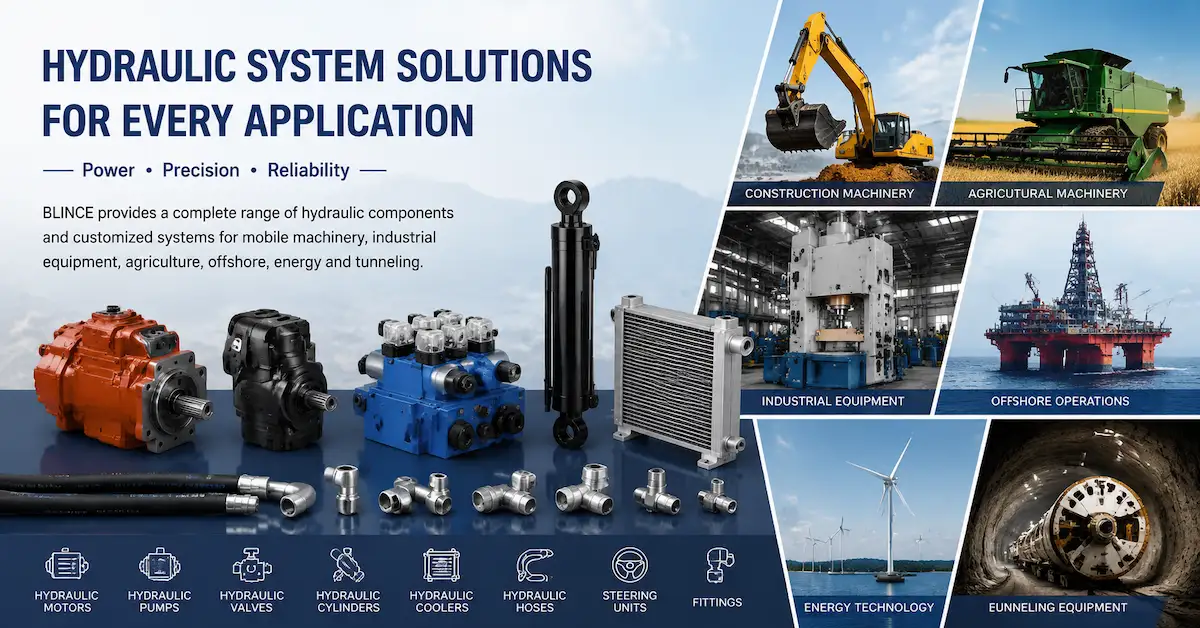
BLINCE lists fittings as part of its broader hydraulic product and system portfolio together with pumps, motors, valves, cylinders, steering control units, heat exchangers, hoses, and custom hydraulic systems. (BLINCE Hydraulic Products)
For buyers still comparing a manufacturer with a trading or supply partner, see the related Hydraulic Fitting Supplier Guide.
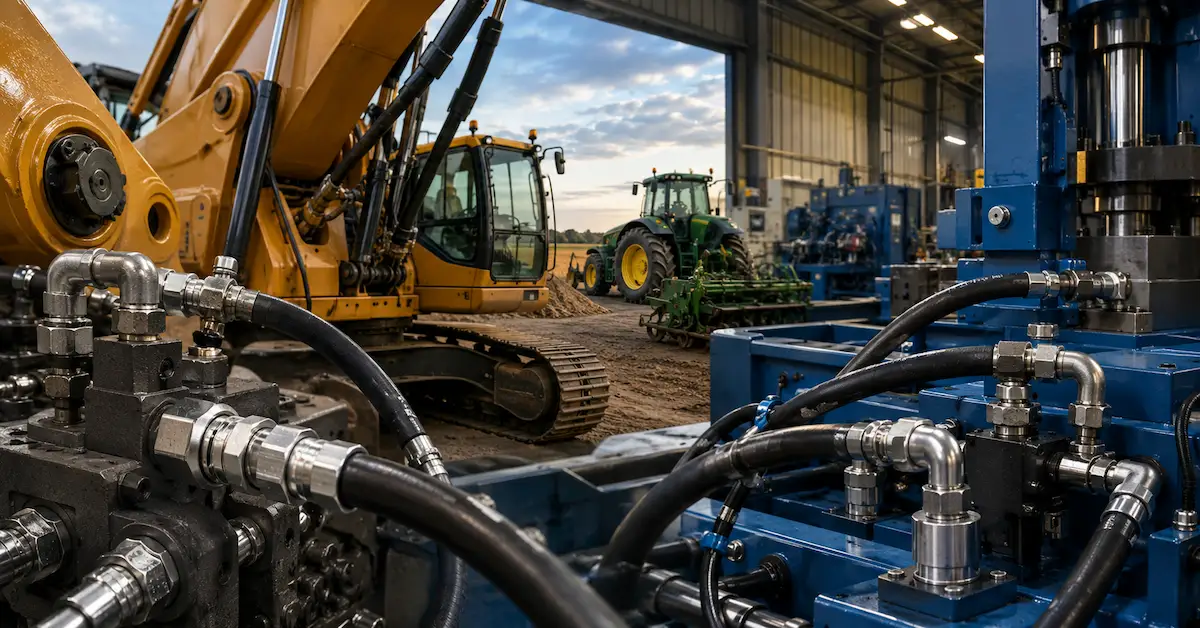
Who Should Source Directly From a Hydraulic Fittings Manufacturer?
Manufacturer-direct sourcing is particularly relevant when the buyer needs more than occasional standard fittings.
OEM Machinery Manufacturers
OEM equipment builders may need fittings for:
- Construction machinery
- Agricultural equipment
- Mining machines
- Material handling equipment
- Industrial machinery
- Marine equipment
- Specialized mobile hydraulics
Their main priorities are usually:
- Stable dimensions
- Repeat-order consistency
- Drawing control
- Compatible thread and sealing systems
- OEM customization
- Long-term availability
Hydraulic System Integrators
System integrators require fittings that work correctly with:
For this buyer group, thread identification and pressure rating are only part of the decision. Hose routing, installation space, vibration, service accessibility, sealing method, and connected component ports also matter.
Hydraulic Distributors and Importers
Distributors usually prioritize:
- Broad fitting series
- Stable replenishment
- Packaging consistency
- Private-label capability
- Technical documentation
- Replacement identification
- Batch-to-batch consistency
A lower unit cost has limited value if future orders no longer match previously supplied fittings.
Repair and Maintenance Companies
Maintenance companies often need to identify an existing fitting from:
- A sample
- Photos
- Thread measurements
- Equipment drawings
- Existing part numbers
These buyers need fast and accurate cross-reference support because the equipment may already be out of service.
Check 1: Does the Manufacturer Understand Hydraulic Fitting Standards?
This is one of the first areas an OEM buyer should investigate.
Hydraulic fittings are not interchangeable simply because two connectors appear similar.
Common connection families can include:
- 37° flared connections
- 24° cone connections
- O-ring face seal connections
- NPT/NPTF connections
- BSPP/BSPT connections
- Metric connections
- Hose fitting ends
- Adapter unions
For example, the current SAE J514-1 standard covers 37-degree flared tube fittings intended for hydraulic systems used on industrial equipment and commercial products. SAE specifically notes that application performance should be validated through appropriate testing between the user and fitting manufacturer. (SAE J514-1_202606)
ISO 8434-1 covers 24° cone connectors for fluid power applications and defines dimensional requirements for connectors used within specified pressure and temperature limits. (ISO 8434-1:2018)
The practical lesson for procurement teams is simple:
Do not purchase fittings using only a thread diameter measurement.
A proper identification should consider:
- Thread diameter
- Thread pitch
- Tapered or parallel thread
- Seat angle
- Sealing surface
- O-ring position
- Tube or hose size
- Male/female configuration
- Pressure requirement
Check 2: Can the Manufacturer Supply the Fitting Types Your Equipment Requires?
The required product family depends on the hydraulic circuit and mechanical layout.
| Fitting Type | Typical Purpose | Buyer Should Confirm |
|---|---|---|
| Straight adapter | Direct connection | Thread, size, seal |
| Elbow adapter | Direction change | Angle, clearance, pressure |
| Tee fitting | Branch connection | Flow path and port sizes |
| Reducer | Connect different sizes | Restriction and compatibility |
| Hose fitting | Hose termination | Hose series and assembly |
| Flared fitting | Tube connection | Flare angle and dimensions |
| O-ring face seal | Sealed connection | Seal size and surface quality |
| Custom fitting | Special machine interface | Drawing and tolerance |
Do not assume that a manufacturer with hundreds of fitting SKUs automatically matches your project.
The better question is:
Can the manufacturer consistently produce the exact fitting family, sealing method, thread, material, coating, and interface required by our machine?
Check 3: What Materials Are Used for Hydraulic Fittings?
Material affects pressure capability, corrosion resistance, machinability, weight, fluid compatibility, and service life.
Common options may include:
Carbon Steel
Carbon steel is widely used in industrial and mobile hydraulic connections because it can provide a practical balance of strength, machinability, and cost.
However, buyers should still confirm:
- Actual material specification
- Heat-treatment requirement where applicable
- Surface protection
- Operating environment
Stainless Steel
Stainless steel may be considered for applications involving:
- Corrosive environments
- Marine exposure
- Chemical processing
- Washdown conditions
- Higher corrosion-resistance requirements
The correct grade should be confirmed rather than assuming that all stainless steels provide identical performance.
Other Materials
Some specialized systems may use alternative materials depending on:
- Fluid
- Weight requirement
- Temperature
- Corrosion environment
- Electrical considerations
- Application standard
For OEM purchasing, simply writing “steel fitting” on an RFQ may not provide enough information.
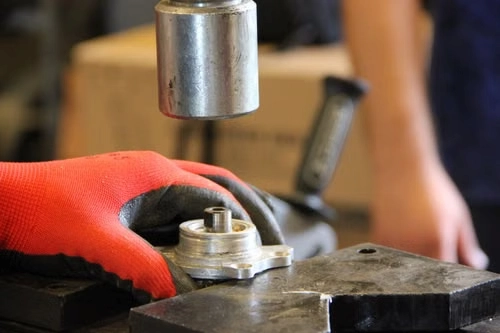
Check 4: How Accurate Is the Machining Process?
Thread and sealing geometry directly influence connection performance.
Important manufacturing characteristics include:
- Thread pitch accuracy
- Thread profile
- Concentricity
- Seat geometry
- Sealing-face finish
- Bore dimension
- Overall dimensional tolerance
- Burr removal
- Surface cleanliness
Poor machining can create fitting problems even when the nominal part number appears correct.
Common consequences include:
- Difficult assembly
- Incomplete sealing
- Damaged O-rings
- Connection misalignment
- Leakage
- Premature failure
For recurring OEM orders, buyers should also ask how critical dimensions are controlled between production batches.
Check 5: How Is the Sealing Interface Controlled?
The thread does not always create the seal.
Depending on the connection design, sealing may occur at:
- A flare seat
- Cone surface
- O-ring face
- O-ring boss
- Tapered thread
- Compression interface
This distinction matters.
For example, ISO 8434-3 specifies requirements for O-ring face seal connectors and includes performance and qualification testing. (ISO 8434-3:2005)
ISO 12151-1 separately addresses hose fittings with O-ring face seal ends and specifies dimensional and performance requirements for such hose fittings. (ISO 12151-1:2010)
A B2B buyer should therefore confirm both:
connection standard + sealing method
rather than treating the thread specification as the complete fitting specification.
Check 6: What Surface Treatment Is Used?
Surface treatment can influence:
- Corrosion resistance
- Appearance
- Storage life
- Assembly condition
- Environmental suitability
The correct coating depends on the application and customer specification.
Before bulk ordering, ask for:
- Coating type
- Coating requirement
- Corrosion-resistance expectation
- Restricted-substance requirements where relevant
- Color or appearance requirement
- Special customer specification
Do not rely on a photo to determine coating quality.
For demanding projects, the coating requirement should be written into the approved specification.
Check 7: What Quality Control Should a Hydraulic Fittings Manufacturer Perform?
“100% quality” is not a useful procurement specification.
Buyers should ask which characteristics are inspected and at what stage.
A practical QC plan can include:
Incoming Material Control
Confirm:
- Material identity
- Supplier documentation
- Batch identification where required
Machining Inspection
Check:
- Thread dimensions
- Critical diameters
- Length
- Seat geometry
- Port dimensions
Surface and Visual Inspection
Review:
- Burrs
- Scratches
- Sealing surfaces
- Coating condition
- Contamination
Functional or Pressure Validation
Testing requirements should depend on fitting type, application, and agreed standards.
SAE's hydraulic fitting guidance emphasizes that application performance should be validated through sufficient testing involving both the user and manufacturer rather than assuming a nominal pressure value guarantees performance in every system.
Final Inspection
Before shipment, buyers may require:
- Dimensional sampling
- Visual inspection
- Quantity verification
- Label verification
- Packaging inspection
The exact inspection level should be agreed before production.
Check 8: Can the Manufacturer Handle OEM and Custom Hydraulic Fittings?
For many machinery manufacturers, this is where direct manufacturing becomes more valuable than standard catalog sourcing.
Custom requirements may include:
- Special threads
- Non-standard dimensions
- Mixed-end adapters
- Special port combinations
- Different seat styles
- Custom material
- Surface treatment
- Customer drawings
- Product identification
- OEM packaging
A custom project should normally follow a controlled process:
Step 1: Application Review
Provide the application and operating conditions.
Step 2: Drawing Confirmation
Confirm:
- Dimensions
- Tolerances
- Threads
- Sealing surfaces
- Material
- Finish
Step 3: Sample Development
Where needed, manufacture samples before production.
Step 4: Fit and Functional Verification
The buyer should confirm installation and system compatibility.
Step 5: Specification Freeze
Approved drawings and specifications become the reference for future production.
Step 6: Batch Production
Production should follow the approved configuration.
This process reduces the risk of receiving a fitting that is technically “similar” but not interchangeable.
Check 9: Can the Factory Maintain Batch-to-Batch Consistency?
B2B buyers should distinguish between:
Can you make this fitting once?
and:
Can you supply the same fitting consistently for the next several production orders?
For OEM manufacturers, repeatability is critical.
Important controls may include:
- Approved drawing revision
- Material specification
- Tooling control
- Inspection records
- Product identification
- Packaging specification
- Change-management procedure
A manufacturer should not modify a critical dimension, sealing interface, material, or coating without customer approval when the fitting is part of an established OEM specification.
Check 10: Can the Manufacturer Support Your Commercial Requirements?
Technical capability alone does not make a successful supplier.
Procurement teams should also evaluate:
- Sample availability
- MOQ
- Production lead time
- Repeat-order lead time
- Customization lead time
- Packaging
- Private label
- Export documentation
- Communication speed
- After-sales handling
Exact MOQ and lead time can vary substantially by:
- Fitting series
- Material
- Size
- Surface treatment
- Tooling requirement
- Custom drawing
- Quantity
For that reason, avoid relying on generic promises such as “fast delivery.”
Request a project-specific production plan.
Hydraulic Fittings Manufacturer vs Hydraulic Fitting Supplier
These terms can overlap, but buyers often expect different capabilities.
| Evaluation Area | Manufacturer-Oriented Partner | General Supplier |
| Machining control | Direct manufacturing focus | May depend on upstream factory |
| Custom drawings | Usually more flexible | Depends on source |
| Material control | Can be production-linked | May rely on vendor documentation |
| OEM development | Stronger potential | Often catalog-focused |
| Small standard orders | May be less flexible | Often convenient |
| Stock availability | Depends on factory | May hold wider stock |
| Technical change control | Direct engineering communication possible | Additional communication layer |
| Best for | OEM/custom/repeat production | Standard replacement and mixed sourcing |
Neither model is automatically better.
If you need a small quantity of common replacement fittings immediately, a distributor may be more efficient.
If you need drawing-controlled fittings, OEM customization, recurring production, or tighter control over manufacturing variables, direct factory capability becomes more important.
What Drives Hydraulic Fitting Cost?
Professional buyers should understand why quotations can differ.
Major cost drivers include:
- Material
- Fitting size
- Machining complexity
- Thread type
- Number of machining operations
- Surface treatment
- Seal requirements
- Inspection requirements
- Custom tooling
- Batch quantity
- Packaging
- Documentation
A low quotation may not be comparable if one supplier has excluded:
- Special coating
- Required seals
- Inspection
- custom packaging
- testing
- documentation
When comparing prices, issue the same technical specification to every shortlisted manufacturer.
Common Procurement Risks OEM Buyers Should Avoid
Ordering by Appearance
Two fittings can look almost identical but use different:
- Threads
- Pitches
- Seats
- Seals
Assuming BSP, NPT, SAE and Metric Are Interchangeable
They are not general substitutes for one another.
Selecting by Pressure Alone
Pressure capability does not confirm:
- Thread compatibility
- Hose compatibility
- Fluid compatibility
- Vibration suitability
- Temperature suitability
Approving a Sample Without Freezing the Drawing
Without an approved specification, repeat orders can become difficult to control.
Comparing Quotes Without Equal Specifications
Different material, coating, testing, packaging, or tolerance requirements can create misleading price comparisons.
Buying a Fitting Separately From the Hose Requirement
For hose assemblies, fitting compatibility must be assessed together with the hose and assembly method.
BLINCE also provides a dedicated hydraulic hose product range, making hose-and-connection compatibility an important consideration for system buyers.
Hydraulic Fitting Manufacturing Checklist for OEM Buyers
Before supplier approval, use this checklist:
| Audit Item | What to Confirm |
| Fitting family | Exact connection type |
| Thread | Standard, size and pitch |
| Sealing method | Flare, cone, O-ring, thread, etc. |
| Material | Exact agreed specification |
| Finish | Coating/surface requirement |
| Pressure | Application requirement and validation method |
| Dimensions | Drawing and critical tolerances |
| Inspection | Incoming, machining and final QC |
| Testing | Agreed fitting/application requirement |
| Sample | Approval required or not |
| Packaging | Bulk, individual, OEM |
| Traceability | Required batch/product identification |
| MOQ | Confirm by fitting series |
| Lead time | Sample and production separately |
| Documentation | Drawing, reports or certificates required |
This table can also be attached directly to an RFQ.
What Should You Send With a Hydraulic Fitting RFQ?
Better RFQs generate faster and more accurate quotations.
Send as much of the following information as possible:
For a New OEM Fitting
- 2D drawing
- 3D file if available
- Thread standard
- Thread size
- Fitting geometry
- Material
- Surface treatment
- Sealing method
- Pressure requirement
- Temperature
- Fluid
- Quantity
- Annual demand
- Packaging requirement
For a Replacement Fitting
Send:
- Original part number
- Clear photos
- Male/female connection details
- Thread outside/inside diameter
- Thread pitch
- Seat type
- Hose or tube size
- Machine model
- Connected component
- Existing sample if possible
A photo alone is usually insufficient for a reliable replacement decision.
Why Consider BLINCE for Hydraulic Fitting and System Projects?
BLINCE's official product overview lists fittings as part of its comprehensive hydraulic solutions portfolio alongside motors, pumps, valves, cylinders, heat exchangers, steering control units, hoses, and custom systems.
The company states that it was established in 2004 and provides hydraulic product design, manufacturing, engineering consulting, quality control, testing, technical support, and after-sales services. Its website also states ISO 9001 and CE-related compliance and reports 10 registered patents. (About BLINCE)
For buyers, one advantage of discussing fitting requirements with a broader hydraulic company is that the connection can be evaluated in the context of:
However, BLINCE's public website currently does not publish a dedicated fitting category page showing every fitting series, material grade, fitting-specific pressure range, MOQ, or production capacity.
For a serious OEM fitting project, buyers should therefore send the exact drawing or sample and ask BLINCE to confirm:
fitting series + thread + material + coating + pressure requirement + QC method + MOQ + lead time + quantity
before approving an order.
This is more reliable than assuming specifications from a general product description.
FAQ
What does a hydraulic fittings manufacturer produce?
A hydraulic fittings manufacturer may produce hose fittings, adapters, elbows, tees, reducers, tube fittings, threaded connectors, and custom connection components used in hydraulic systems.
How do I choose a hydraulic fittings manufacturer?
Evaluate thread and sealing expertise, materials, machining accuracy, QC, testing, customization, drawing control, production consistency, lead time, and technical support.
What information should I send for a hydraulic fitting quotation?
Send drawings or samples, thread type, size, material, coating, pressure requirement, sealing method, application, quantity, and packaging requirements.
Are JIC, BSP, NPT and metric fittings interchangeable?
No. Different connection families can use different threads, pitches, seats, and sealing methods. The complete interface must be identified before replacement.
What is important when buying high-pressure hydraulic fittings?
Confirm the applicable fitting standard, material, dimensions, pressure requirement, hose or tube compatibility, sealing design, temperature, fluid, and validation requirements.
Can hydraulic fittings be customized for OEM machinery?
Yes, depending on manufacturing capability. Customization can involve threads, dimensions, mixed-end adapters, materials, coating, geometry, identification, and packaging.
Should I request samples before bulk production?
Samples are particularly valuable for custom, replacement, or high-risk OEM fittings because they allow dimensional, installation, and functional verification before mass production.
What causes hydraulic fitting leakage?
Common causes include incorrect thread or seat matching, damaged sealing surfaces, incorrect assembly, unsuitable seals, loose connections, contamination, excessive pressure, vibration, and component damage.
Is a hydraulic fitting manufacturer better than a distributor?
Not always. Manufacturers are often better suited to OEM, drawing-controlled, customized, or recurring production, while distributors can be more convenient for low-volume standard replacements and mixed inventories.
How do I request hydraulic fittings from BLINCE?
Send your fitting drawing, sample information, thread standard, dimensions, pressure requirement, material, coating, application, and order quantity through the BLINCE Contact Us page. Request technical confirmation before finalizing the order.
Conclusion
Selecting a hydraulic fittings manufacturer should be treated as a technical and supply-chain decision rather than a simple price comparison.
For OEM buyers, a reliable fitting depends on the combined control of:
- Connection standard
- Thread geometry
- Sealing interface
- Material
- Surface treatment
- Machining accuracy
- Inspection
- Application validation
- Batch consistency
The most effective sourcing process is to define the fitting specification first, then compare manufacturers using the same drawing, quality requirements, testing expectations, and commercial conditions.
BLINCE's hydraulic portfolio includes fittings, hoses, pumps, motors, valves, cylinders, and custom hydraulic solutions, allowing buyers to discuss connections in the context of the wider hydraulic system.
For an OEM or replacement project, send BLINCE Hydraulic your drawing or sample, thread type, material, pressure requirement, connected hose/component, application, quantity, and expected delivery plan. This gives the technical team enough information to evaluate compatibility and prepare a more accurate quotation.