
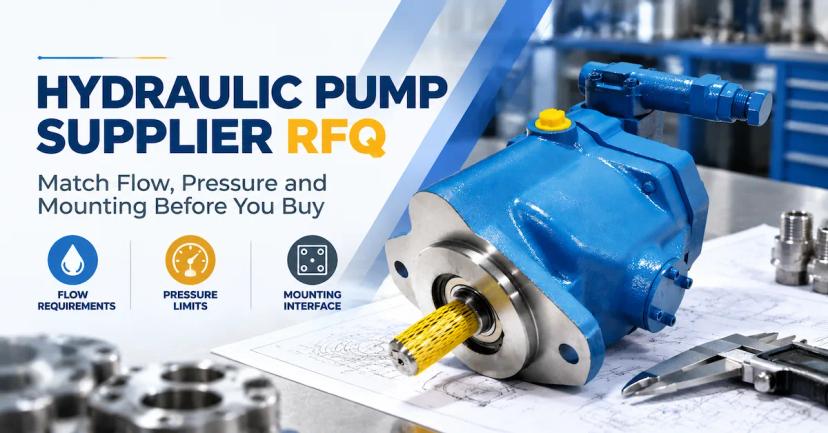
Quick Answer: What Should You Send a Hydraulic Pump Supplier for an Accurate Quote?
Send a hydraulic pump supplier the required flow at the actual drive speed, continuous and peak pressure, pump type, duty cycle, fluid and temperature, suction conditions, rotation, shaft, mounting flange, port details, control method, installation envelope, quantity and delivery requirement. For a replacement, add the complete old-pump code, nameplate photographs, views of every side, a dimensioned interface sketch and the machine model. A model name or a statement such as "40 L/min at 250 bar" is not enough to release a quotation for production.
The buyer should expect the supplier to return one exact proposed configuration, a model-specific datasheet and drawing, the continuous and intermittent operating limits, assumptions, available test evidence, sample terms, MOQ, lead time, packaging and any unresolved compatibility points. Flow, pressure and installation must be verified together because a pump can meet the hydraulic operating point and still be unsuitable for the prime mover, suction line, shaft, flange, ports or control circuit.
This guide is for hydraulic system integrators, construction machinery OEMs and industrial maintenance buyers who are ready to request a quote. Its unique purpose is to convert a machine requirement into a comparable pump RFQ. It does not repeat BLINCE's existing supplier article about delivery stability or its OEM articles about customization and batch consistency.
Compare BLINCE Hydraulic Pump Series
The Real Procurement Question: Which Pump Configuration Fits the Operating Point?
A pump supplier is not being asked to sell "a hydraulic pump." The supplier is being asked to convert shaft power into the flow and pressure that the machine needs, within an installation and operating envelope that the machine can support. The correct configuration depends on the relationship between displacement, speed, volumetric efficiency, pressure, inlet condition, control method and mechanical interface.
This distinction matters because the same requested flow can be produced by different displacement-and-speed combinations. The same nominal pressure can also represent very different duty cycles. A fixed-displacement gear pump may be the practical choice for a simple mobile circuit, while a pressure-compensated or load-sensing piston pump may be better for a variable-demand industrial system. A vane pump may be preferred where noise and smooth flow are priorities. The supplier needs the complete operating context before it can make that decision.
| RFQ layer | Buyer defines | Supplier confirms |
|---|---|---|
| Output requirement | Required flow, pressure and response at each machine state | Exact displacement, speed range, control and model limits |
| Input condition | Prime mover, drive speed, available torque, rotation and start sequence | Permitted speed, input torque, shaft load and drive compatibility |
| Installation | Shaft, flange, pilot, ports, envelope and coupling arrangement | Revision-controlled drawing and any required adapter |
| Supply | Sample quantity, annual demand, delivery date and documentation | MOQ, lead time, packaging, traceability and change control |
Step 1: Convert the Machine Cycle into Required Flow
Flow controls actuator speed. For a cylinder, begin with the effective piston area and the required extension or retraction time. For a hydraulic motor, begin with motor displacement, target speed and expected volumetric efficiency. For a system with several simultaneous functions, identify which functions run together and how flow is divided. Adding every actuator's maximum demand may oversize the pump if those functions never operate at the same time.
For initial pump screening, theoretical flow in litres per minute is pump displacement in cubic centimetres per revolution multiplied by drive speed in revolutions per minute and divided by 1000. Actual delivered flow is lower because volumetric efficiency is below 100 percent and changes with pressure, speed, temperature and wear. Ask the supplier to state the efficiency assumption used in its proposal rather than accepting a theoretical number as guaranteed output.
Flow information that belongs in the RFQ
- Normal required flow and the operating condition where it occurs.
- Peak flow, how long it lasts and how frequently it repeats.
- Prime-mover speed at idle, normal operation and maximum speed.
- Minimum controllable actuator speed and acceptable speed variation.
- Functions that operate simultaneously and any priority-flow requirement.
- Acceptable cycle time, including acceleration, holding and return stages.
A system integrator should attach the hydraulic schematic and a simple cycle table. An OEM should provide the engine or electric-motor speed range. A maintenance buyer should record the machine's actual speed and flow before removing the failed unit when measurement is still possible. These details allow the supplier to select displacement instead of guessing from the old housing size.
Step 2: Separate Continuous, Intermittent and Peak Pressure
Pressure is created by resistance to flow; the pump must tolerate the load imposed by the circuit. A useful RFQ distinguishes continuous operating pressure, intermittent pressure, short peak pressure and the relief-valve setting. It also states duration and frequency. A pump that can survive a brief peak may not be suitable for the same pressure continuously.
Do not ask a supplier only for "maximum pressure." The answer may refer to a momentary limit, a test condition or one model in a family. Request the exact proposed model's rated or continuous pressure, intermittent limit, peak limit, test conditions and permitted duty cycle. Confirm whether the published number is inlet pressure, outlet pressure, differential pressure or system relief setting.
| Pressure field | RFQ definition | Why it changes selection |
|---|---|---|
| Continuous pressure | Pressure during the longest normal loaded stage | Controls thermal load and long-duration component stress |
| Intermittent pressure | Higher pressure with defined duration and repetition | Requires a permitted duty cycle, not only a headline value |
| Peak pressure | Shortest transient measured or calculated during shock events | Checks transient capacity and circuit protection |
| Relief setting | Valve setting and tolerance, including location in the circuit | A relief setting is not automatically the pump's normal operating pressure |
Pressure and flow must also be checked together because hydraulic power rises with both. The prime mover must provide sufficient torque and power at the requested operating point. Ask the hydraulic pump supplier to identify the required input power, input torque and any derating applied for temperature, altitude, fluid or duty cycle.
Step 3: Choose the Pump Architecture Before Comparing Models
BLINCE's hydraulic pump commercial page organizes the available range into gear pumps, piston pumps, hydraulic pump cartridges and vane pumps. These architectures solve different procurement problems. A buyer should first identify the circuit behavior and then compare models inside the appropriate family.
| Pump architecture | Typical sourcing reason | Critical RFQ checks |
|---|---|---|
| Gear pump | Compact fixed-displacement supply for mobile and industrial auxiliary circuits | Displacement, speed, pressure, rotation, shaft, flange, ports and inlet condition |
| Variable piston pump | High-pressure or variable-demand systems requiring pressure compensation or load sensing | Control code, compensator setting, displacement, case drain, inlet pressure, fluid and contamination |
| Vane pump | Industrial systems where noise, smooth flow or cartridge serviceability matters | Cartridge code, rotation, porting, viscosity, pressure, speed and housing compatibility |
| Pump cartridge | Repair of an existing vane-pump housing when the body and interface remain serviceable | Exact series, displacement, rotation, locating features, seals and housing condition |
The current BLINCE range includes the HGP hydraulic gear pump, industrial piston-pump families and vane-pump cartridges. For a concrete example of why model-specific data matters, the PVQ axial piston pump page identifies a 10.5-45.1 cm3/rev series, 1800 r/min rated speed and model-dependent pressure up to 210 bar, together with several control, rotation, port and shaft options. The PVQ13, PVQ32 and PVQ45 values differ from other sizes, so a family maximum must not be applied to every model.
For larger high-pressure demand, the PVXS variable displacement piston pump page lists PVXS66 through PVXS250, flange or foot mounting depending on configuration, and model-specific flow data at 1500 and 1800 r/min. These public pages support early screening. Final values, control codes, drawings and compatibility still require confirmation for the quoted model and current revision.
Step 4: Lock the Drive and Installation Interface
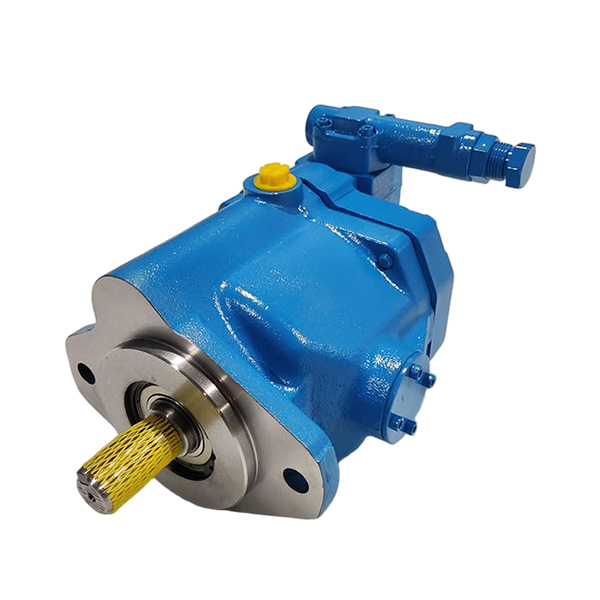
A technically suitable pump can still fail procurement review if it cannot connect to the prime mover or fit the machine. The supplier drawing should confirm the shaft type and dimensions, flange standard, pilot, bolt pattern, port threads and positions, overall envelope, rotation and coupling requirements. The buyer should compare the drawing with the machine, not only with a photograph of the old pump.
Rotation is especially important. Record whether clockwise or counterclockwise is defined when viewed from the shaft end. Do not rely on a hose arrangement to infer rotation. For tandem or through-drive configurations, specify the second-pump requirement, drive-torque limit and mounting stack. For belt or side-load drives, obtain written approval because many pumps are intended for aligned couplings and may not accept an external radial load.
Installation evidence to include with the inquiry
| Interface item | Required evidence | Release risk if missing |
|---|---|---|
| Shaft and coupling | Diameter, spline or key, length, thread and coupling arrangement | No fit, poor engagement or excessive shaft load |
| Mounting | Flange or foot, pilot, bolt circle, fasteners and alignment | Adapter rework or misalignment |
| Ports | Inlet, outlet, drain and control port thread, size and orientation | Connection mismatch, restriction or incorrect drain routing |
| Envelope | Length, width, height and service clearance | Interference with frame, hoses or maintenance access |
| Rotation | Direction viewed from the shaft end and prime-mover direction | No flow, internal damage or reversed circuit operation |
Step 5: Define Inlet Conditions, Fluid and Control Requirements
Many pump problems begin on the inlet side rather than the pressure side. The RFQ should state reservoir position, suction-line length and diameter, fittings, expected oil level, inlet pressure or vacuum, fluid viscosity, minimum start temperature, normal operating temperature and contamination target. A pump selected without these inputs may be noisy, cavitate, lose flow or suffer early wear even when its displacement and pressure appear correct.
For variable-displacement piston pumps, the control code is part of the pump identity. State whether the system needs pressure compensation, load sensing, remote pressure control, electric control, unloading or another control function. Include the valve architecture and required response. A pump with the correct displacement but the wrong compensator, sensing margin or control orientation is not a compatible substitute.
Do not omit the drain circuit
Where the selected pump requires a case drain, provide drain-line routing, expected case pressure, reservoir connection and cooler or filter arrangement. Confirm the permitted case pressure for the exact model. A restricted drain can damage seals or change control behavior. The public product family page is not a substitute for the model-specific installation instruction.
How the Three Target Buyer Types Should Frame the RFQ
Hydraulic system integrators
System integrators should provide the hydraulic schematic, cycle table, valve architecture, actuator demand, cooling method, filtration target and control logic. Their main risk is selecting a pump that meets one operating point but interacts poorly with the rest of the circuit. The quotation should identify compensator or load-sensing settings, expected standby behavior, heat implications, case-drain requirements and any assumptions about valve pressure loss.
Construction machinery OEMs
Construction machinery OEMs should include engine speed range, drive arrangement, cold-start conditions, shock loads, vibration, dust, water exposure, duty cycle and available installation space. They should define both prototype and annual production demand. A pump for a mobile machine must be evaluated at idle, normal working speed and maximum governed speed, not only at one nominal rpm.
Industrial maintenance buyers
Maintenance buyers should begin with evidence from the failed unit: complete nameplate, original code, photographs, shaft and flange dimensions, ports, rotation, control block, machine model, failure symptoms and oil condition. They should state whether the priority is an exact replacement, a functionally compatible alternative or a temporary repair. A fast quote is not useful if it requires unplanned piping, coupling or control changes.
Complete Hydraulic Pump RFQ Checklist
Send every candidate supplier the same structured information. A standard form prevents a low price from winning simply because important requirements were omitted from one quotation.
| RFQ section | Information to provide | Supplier response required |
|---|---|---|
| Application | Machine, function, circuit, duty cycle, environment and failure consequence | Recommended family, exact model and selection assumptions |
| Flow and speed | Normal and peak L/min; minimum, normal and maximum input rpm | Displacement, expected delivered flow and permitted speed range |
| Pressure | Continuous, intermittent and peak pressure with duration; relief setting | Model limits, duty-cycle conditions and required input power |
| Fluid and inlet | Fluid type, viscosity, temperatures, cleanliness, reservoir and suction line | Compatibility, inlet-pressure limits and filtration requirement |
| Control | Fixed or variable displacement; compensation, load sensing or other control | Full control code, settings and control-port information |
| Interface | Rotation, shaft, flange, pilot, ports, drain, envelope and coupling | Dimensioned drawing and written compatibility statement |
| Quality evidence | Required test, inspection, identification and traceability records | Available reports, acceptance limits and sample record format |
| Commercial | Sample quantity, annual volume, destination, date, packaging and labels | Price basis, MOQ, lead time, packaging, warranty and change notice |
Original Evidence to Request Before Supplier Approval
A high-quality quotation should be supported by evidence that belongs to the proposed model. A hydraulic pump supplier should provide a current product photograph, a revision-controlled drawing, specification data, material and seal information relevant to the fluid and environment, machining or assembly control points, test conditions, sample records, nameplate or batch identification and packaging photographs. Generic claims do not prove that the quoted configuration will be produced consistently.
BLINCE identifies Dongguan Blince Machinery & Electronics Co., Ltd. as a hydraulic component and solution provider established in 2004 and located in Dongguan, Guangdong, China. Its public company information describes hydraulic pumps, motors, valves, steering components and related hydraulic products, with R&D and testing capability. Buyers should still request documents tied to the exact pump and order because company-level credentials do not replace model-level acceptance evidence.
| Evidence | What to verify | Decision supported |
|---|---|---|
| Model drawing | Model code, revision, dimensions, shaft, mounting, ports and rotation | Installation compatibility |
| Performance record | Serial or batch identity, speed, pressure, flow, temperature and limits | Operating-point verification |
| Process evidence | Critical dimensions, cleanliness, assembly, inspection and release controls | Repeatability after sample approval |
| Commercial evidence | Written MOQ, lead time, packaging, warranty and change-notification terms | Supply planning and lifecycle support |
Do not publish unverified factory values as facts. MOQ, sample time, production lead time, materials, test limits and packaging can vary by pump family, configuration, quantity and destination. These fields should be completed with current BLINCE records and approved by the responsible engineering and sales teams before the page is released.
How to Compare Supplier Quotations Without Hiding Technical Gaps
Normalize every quotation into the same table. Mark each requirement as confirmed, conditional, not offered or unanswered. Never award an assumed pass to a blank field. Compare the exact model, not only the family name. The selected hydraulic pump supplier should make technical gaps visible before price approval. Separate unit price from adapter cost, testing cost, special packaging, freight, duties, engineering work and inventory exposure.
| Comparison area | Acceptable response | Warning sign |
|---|---|---|
| Flow and pressure | Model-specific values at stated speed, temperature and duty cycle | Only family maximums or theoretical flow |
| Control and interface | Complete code and drawing match the RFQ | "Equivalent" without a drawing or control-code comparison |
| Test evidence | Conditions, limits, sample identity and responsible reviewer are recorded | Undated generic report or no link to the quoted model |
| Commercial terms | MOQ and lead time tied to exact quantity, configuration and approval point | "Fast delivery" with no start condition or quantity basis |
Sample Test and Production Release
Approve a sample against a written plan before releasing a production order or a critical maintenance replacement. Begin with identity and dimensions, then confirm clean installation, correct rotation, priming and inlet condition. Run the pump through low-pressure start-up, normal flow, continuous load, intermittent load and approved transient conditions while recording input speed, inlet pressure, outlet pressure, flow, temperature, noise, leakage and control response.
The test should represent the real circuit. A short no-load bench run cannot prove loaded flow, thermal stability, control behavior or start performance. If the machine is unavailable, agree on a supplier bench procedure that reproduces the required operating points and define which tests must still be completed in the machine.
Minimum release record
- Approved full model and control code, drawing revision and sample identity.
- Measured dimensions and photographs of the installed interface.
- Pressure, flow, speed, temperature and leakage results at defined points.
- Inlet condition, fluid, filtration and test duration.
- Open deviations, responsible engineer and final disposition.
- Production identification, packaging and change-control requirements.
Frequently Asked Questions
What is the fastest way to get an accurate hydraulic pump quotation?
Send one package containing the machine and circuit, required flow, continuous and peak pressure, drive-speed range, pump architecture, control method, rotation, shaft, mounting, ports, fluid, temperature, quantity and delivery date. For replacements, add the old code, nameplate, photographs and measurements. Ask the supplier to list every assumption.
Should I select a hydraulic pump by flow or displacement?
Start with required flow and the actual drive-speed range, then calculate the displacement range with an efficiency allowance. The supplier should confirm expected delivered flow for the exact model at the stated operating conditions. Selecting displacement alone can miss speed variation and efficiency losses.
Is the relief-valve setting the pump pressure rating?
No. The relief setting protects the circuit and may include tolerance and transient behavior. The pump has separate continuous, intermittent and peak limits. Confirm all of them for the exact model and compare them with measured circuit pressure.
How do I choose between a gear, vane and piston pump?
Compare pressure, flow variation, control demand, noise, efficiency, contamination sensitivity, duty cycle, installation and lifecycle service. A simple fixed-flow circuit may favor a gear pump, a noise-sensitive industrial circuit may favor a vane design, and a high-pressure variable-demand system may require a controlled piston pump. The final choice depends on the complete circuit.
Can a visually similar pump replace the old unit?
Not without verification. Compare displacement, permitted speed, pressure limits, rotation, control code, shaft, flange, pilot, ports, drain, dimensions, fluid and inlet requirements. Obtain a drawing and complete a controlled test before release.
What should a pump test report contain?
It should identify the exact model and sample, test date, fluid, viscosity or temperature, input speed, inlet condition, outlet pressure, measured flow, leakage where relevant, control settings, acceptance limits and reviewer. A value without its test condition is difficult to use for approval.
How should an OEM compare MOQ and lead time?
Request separate terms for samples, the first production batch and repeat orders. Confirm whether lead time begins after purchase order, payment, drawing approval or sample approval. Include special shafts, controls, labels, packaging, testing and shipping in the schedule.
What does BLINCE supply in the hydraulic pump category?
The BLINCE commercial category page currently presents gear pumps, piston pumps, hydraulic pump cartridges and vane pumps. Buyers can review the hydraulic pump range, then send the operating point and interface data for a model-specific recommendation.
Where is BLINCE located and what markets does it serve?
Dongguan Blince Machinery & Electronics Co., Ltd. is located in Dongguan, Guangdong, China. Its public product and application pages cover hydraulic components for mobile machinery and industrial systems, including construction, agricultural, material-handling and industrial equipment. Buyers should confirm regional documentation, ports, standards and service requirements in the quotation.
Conclusion
Choosing a hydraulic pump supplier for a live project begins with a controlled RFQ, not a general supplier claim. Calculate the required flow at the real drive speed, separate continuous and peak pressure, select the appropriate pump architecture, and lock rotation, shaft, mounting, ports, fluid, inlet condition and control method. Then require a model-specific drawing, test conditions, sample plan, MOQ, lead time, packaging and change-control terms.
BLINCE provides a hydraulic pump range covering gear, piston, vane and cartridge options for mobile and industrial applications. Use the commercial category page to shortlist a family, but release an order only after the BLINCE engineering team confirms the exact model, ratings, interface and compatibility in writing. A complete RFQ produces a faster quotation, a more defensible comparison and a lower-risk sample test.