
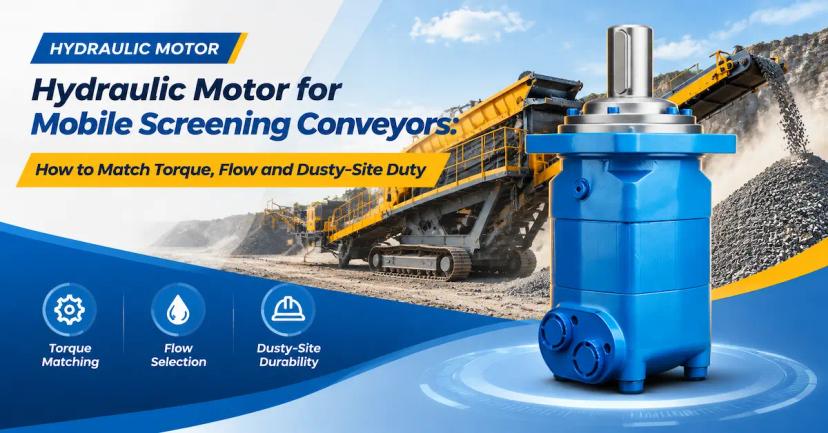
What Must a Mobile Screening Conveyor Motor Do?
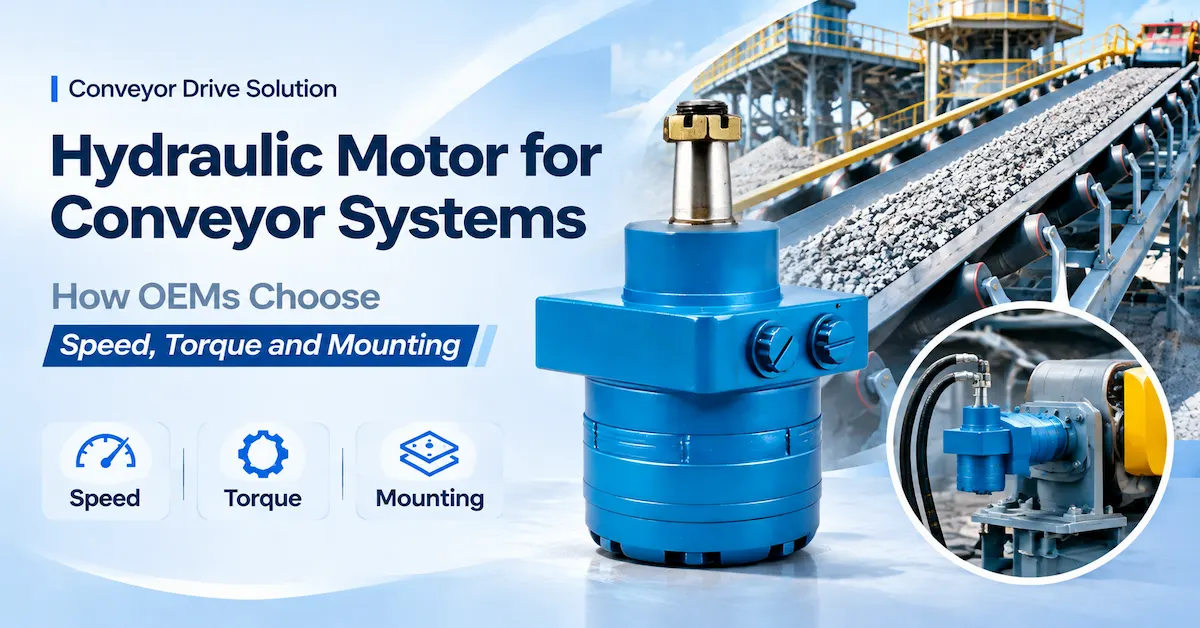
A hydraulic motor for mobile screening conveyor duty must start a loaded belt, maintain controlled speed while material is being screened, tolerate vibration and dust, and fit the drum, reducer, hoses and mounting bracket on a machine that moves between sites. The correct motor is therefore chosen from the complete load path, not from a catalogue displacement or a single maximum pressure number.
Mobile screening plants usually combine a feeder, screen deck, discharge conveyor and hydraulic auxiliaries. The discharge conveyor may run for long periods while the feed conveyor sees repeated starts and shock when wet, sticky or oversized material enters the machine. A motor that is adequate for an empty belt can stall when the belt is loaded, while a motor selected only for peak torque can demand excessive flow or generate heat at normal speed.
The practical selection sequence is: define the conveyor and material, calculate drum speed and torque, describe the hydraulic circuit, check the mechanical interface and shaft loads, compare orbital and piston-motor options, then validate a sample under the actual load profile. BLINCE's hydraulic orbital motor category is a useful starting point for compact and medium conveyor drives. An exact model still requires engineering confirmation of pressure, flow, speed, torque, external loads and compatibility.
Review BLINCE Conveyor Motor Options
Why Mobile Screening Conveyors Are Harder Than a Standard Belt
A fixed warehouse conveyor often has a predictable load, clean surroundings and a controlled start sequence. A mobile screening conveyor works at a quarry, demolition site, recycling yard or aggregate stockpile. The machine is transported, repositioned, levelled and exposed to changing material. The hydraulic motor must continue to work while the plant frame vibrates, hoses move, ambient temperature changes and dust reaches seals, connectors and cooling surfaces.
Loaded start and material surge
The conveyor may stop with material still on the belt. Restarting then requires breakaway torque plus the force needed to accelerate the material. A wet clay feed can adhere to the belt and increase resistance; a pile of stone can create a short impact when it lands near the drive drum. Record whether the control system unloads the belt before restarting or whether the motor is expected to start fully loaded. The two cases should not be quoted as if they were the same.
Vibration and frame movement
Screen decks generate vibration that can reach the conveyor bracket, motor flange and hose connections. A rigid coupling that is acceptable on a fixed frame can transfer misalignment to the motor shaft on a mobile machine. Check the pilot engagement, bolt preload, coupling alignment, hose bend radius and support bearing. If the drum or sprocket applies radial load to the motor shaft, provide the magnitude and distance from the mounting face so the supplier can confirm the configuration.
Dust, water and temperature
Screening plants can operate in fine dust, rain, washdown and high summer temperatures. Seal selection, shaft protection, port cleanliness and oil filtration matter as much as nominal torque. Temperature also changes viscosity and leakage. Ask the supplier to state the oil type, viscosity range, allowable temperature and return or case pressure used for the recommendation. Do not assume that a motor used on an agricultural attachment has the same environmental margin on a stone-processing site.
Transport and service replacement
A mobile plant may be repaired in a remote yard rather than in a factory. The spare motor therefore needs a complete, unambiguous configuration record. Keep the old-unit code, displacement, shaft, flange, pilot, bolt pattern, ports, seal option, rotation and installation drawing with the spare. A similar-looking motor can still have a different shaft load capability or port thread.
| Mobile screening condition | Motor risk | Evidence to provide |
|---|---|---|
| Belt stopped with material | Insufficient breakaway torque or pressure spike | Loaded-start torque, start frequency, relief setting and control sequence |
| Vibrating screen frame | Misalignment, loosened fasteners or hose fatigue | Bracket drawing, coupling, bolt torque, vibration and support-bearing details |
| Dust and washdown | Seal wear, contamination and corrosion | Oil, filtration, seal environment, cleaning method and storage conditions |
| Long loaded runs | Overheating, speed drift or leakage | Run hours, ambient temperature, pressure-flow profile and cooler capacity |
Hydraulic Motor for Mobile Screening Conveyor Sizing
Before asking for a quotation, identify which conveyor the motor drives and what happens at the most demanding moment. A feeder conveyor may see a short, high shock when material enters. A discharge conveyor may run continuously at a lower torque but at a higher thermal duty. A fines conveyor may need stable low speed to prevent spillage. The same mobile screening plant can therefore require different motor selections for different belts.
Define the material and geometry
Record bulk density, maximum lump size, moisture, stickiness, belt width, conveyor length, incline angle, belt mass, drum diameter, lagging and the amount of material present during a restart. If the conveyor can reverse to clear a blockage, record the direction-change procedure and how often it occurs. For a new design, include the expected throughput and the desired belt speed at empty and full load.
Separate steady, starting and abnormal loads
Make three load cases: normal running, loaded start and a defined transient such as a jam, plug or emergency stop. Do not use an unexplained service factor to hide all three cases. State whether the transient is permitted, prevented by a relief valve, or handled by a control ramp. This gives the supplier a usable basis for selecting displacement and pressure margin.
Measure the installed motor before replacement
Photograph the nameplate and every interface with a ruler in the frame. Measure shaft diameter and exposed length, keyway or spline, pilot diameter, flange face, bolt circle, hole size, port thread and port orientation. Note the motor's position relative to the reducer, drum and hose supports. If one dimension is unknown, mark the replacement proposal as conditional until it is measured.
Calculate Belt Speed, Drum Torque and Motor Flow
Use preliminary calculations to reject an obviously unsuitable proposal before a sample order. These equations are screening relationships, not a substitute for a model-specific performance map. The supplier should review the final result with the exact displacement, pressure drop, efficiency, speed range, oil temperature and external shaft load.
Drum speed
For belt speed v in metres per second and effective drum diameter D in metres, drum speed is approximately ndrum = 60 × v ÷ (π × D). Use the working diameter, including lagging and belt thickness. If a reducer has motor-to-drum ratio i, estimate motor speed as nmotor = ndrum × i. Confirm how the supplier defines the ratio because some drawings use the inverse convention.
Drum torque
If tangential force at the drum is Ft in newtons, the first torque estimate is Tdrum = Ft × D ÷ 2. Include belt resistance, incline, material acceleration, skirt friction and the loaded-start condition. If the conveyor has a take-up or tensioning system, use the actual tension values rather than a generic belt rating.
Motor torque through the reducer
With gearbox efficiency ηg, a preliminary motor torque estimate is Tmotor ≈ Tdrum ÷ (i × ηg). Keep the continuous and transient cases separate. A motor may have enough short-duration starting torque but still be unsuitable for continuous pressure or thermal duty. Ask the supplier to show the assumed ratio and efficiency in the quotation.
Flow and displacement
For displacement Vg in cm3/rev and speed n in rpm, preliminary flow is Q ≈ n × Vg ÷ (1000 × ηv), where ηv is volumetric efficiency. The real value changes with leakage, oil viscosity, temperature and pressure. The check tells you whether the pump and valve can supply the requested speed; it does not prove minimum stable speed, maximum permitted flow or efficiency.
| Calculation | Useful screening result | Still requires confirmation |
|---|---|---|
| Belt speed and drum diameter | Required drum and motor rpm | Minimum stable speed, reducer losses and control response |
| Force, radius and incline | Steady and starting drum torque | Continuous/intermittent torque and shock duration |
| Displacement and speed | Approximate pump flow requirement | Leakage, temperature rise and exact flow limit |
Check OMP Configuration Details
Compare Motor Architectures for Screening Duty
An orbital motor can be a compact solution for a conveyor, but it is not automatically the correct answer for every mobile screening plant. Use the load calculation and circuit design to decide when an orbital family is appropriate and when to request a piston-motor review.
Orbital motors for compact conveyor drives
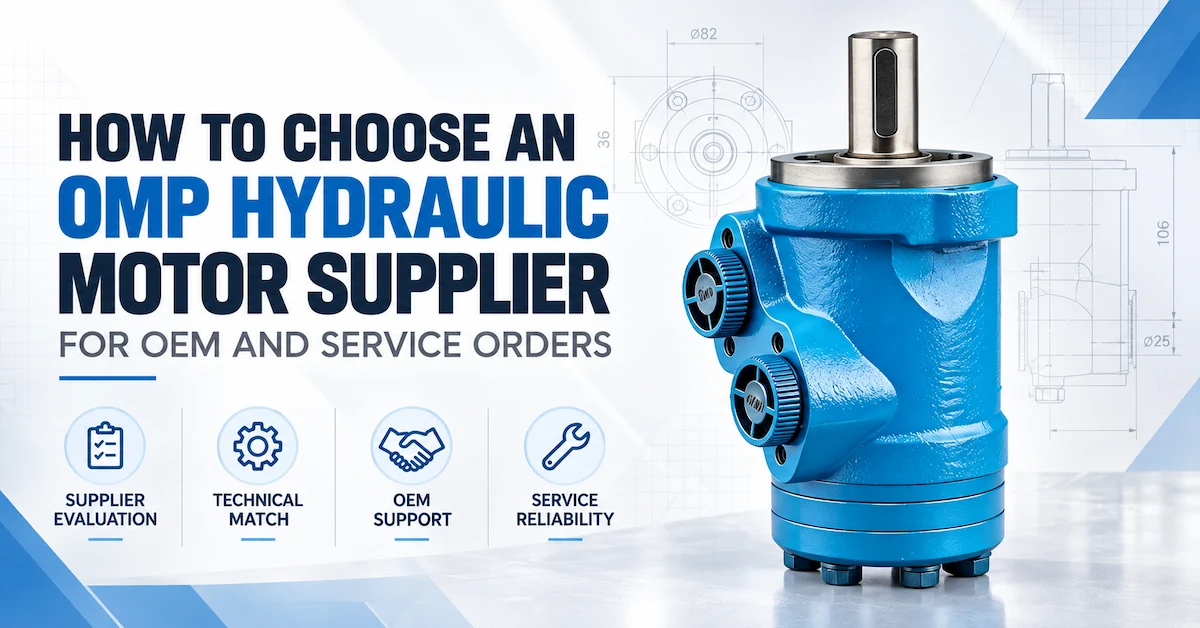
BLINCE presents the OMP family as a compact cycloidal motor with smooth low-speed operation, resistance to pressure fluctuations and shaft sealing suitable for series and parallel systems. Its public family-level guidance includes displacement from 36–500 cm3/rev, maximum speed indications up to 1500–1650 rpm, maximum flow up to 60 L/min and maximum torque up to 400+ Nm. These are orientation values for the family, not ratings for every OMP size, shaft or port configuration.
For a mobile screening conveyor, ask which exact OMP variant supports the required loaded start, continuous pressure, speed, flow, temperature, shaft load and rotation. Confirm whether the motor is connected through a gearbox, chain or direct coupling. If the conveyor uses a brake, the brake torque, release pressure and stopping sequence must be reviewed as part of the assembly.
OMPH when the orbital duty needs a higher family range
The BLINCE OMPH page gives family-level indications of 36–500 cm3/rev displacement, 1500–1650 rpm maximum speed, up to 486 Nm maximum torque, pressure up to 20+ MPa and flow of 60–75 L/min. The figures can help screen whether the family is worth discussing, but they do not approve a particular motor for a loaded feeder. Request the current model drawing, pressure definition, intermittent duration and external-load limits.
Axial or radial piston motors for heavier conveyor duty
An axial-piston motor becomes worth reviewing when the conveyor needs high power density, high pressure, closed-loop control, a wide controlled speed range or direct gearbox integration. A radial-piston motor may be considered when very high low-speed starting torque and shock tolerance dominate. Provide peak torque, duration, brake or reversal requirements, shaft loads and cooling conditions. A category page or family range is only a screening point; the exact model must be confirmed by engineering.
| Architecture | When to review it | Release evidence |
|---|---|---|
| Orbital | Compact package, low-speed control and moderate conveyor power | Exact displacement, pressure-flow map, start torque, shaft load and temperature check |
| Axial piston | High power, high pressure, closed-loop or gearbox integration | Exact size, case drain, control circuit, cooling and interface confirmation |
| Radial piston | Very high low-speed torque or severe shock duty | Peak torque duration, bearing loads, brake/reversal plan and sample test |
Verify the Reducer, Drum and External Shaft Loads
The conveyor's mechanical interface can decide whether a motor is usable. A drive sprocket or chain can apply radial force; a screw conveyor can apply axial thrust; a direct drum coupling can transmit misalignment. State which bearing carries each load. If the motor shaft carries an overhung load, provide force, direction, distance from the mounting face and shock profile.
Compare the supplier's dimensioned drawing with the actual reducer or bracket. Verify shaft diameter and length, key or spline, pilot, flange, bolt circle, port thread, port orientation and case-drain arrangement. Confirm whether the quoted sample and production batch use the same interface revision. “Same as the old motor” is not enough when the old code has a suffix for shaft, seals or ports.
Questions to put directly into the RFQ
- Which exact shaft, flange and port code is included, and does it match the supplied conveyor drawing?
- What radial and axial loads are permitted at the stated distance from the mounting face?
- Is a case drain, brake, support bearing, anti-cavitation valve or cross-port relief required?
- Which values are confirmed for the exact model and which remain subject to engineering review?
Check the Circuit and Thermal Duty
Mobile screening plants may use an open-circuit pump and directional valve, a closed loop, or a shared series/parallel arrangement. The circuit changes motor starting, stopping, return pressure, flow sharing and heat generation. Send the hydraulic schematic and identify which other actuators can pressurize the return line.
For an open circuit, review relief settings, valve pressure loss, return pressure, anti-cavitation protection and available flow during acceleration. For a closed loop, review charge pressure, flushing, cross-port relief, case drain and control response. For series motors, check pressure accumulation and speed differences. For parallel motors, check flow sharing and load imbalance. A product page that mentions series or parallel operation does not replace a circuit-specific confirmation.
Thermal duty is often the hidden limit. Record loaded run time, ambient temperature, reservoir volume, cooler capacity, oil viscosity and the pressure-flow profile. If a conveyor runs continuously while the screen deck vibrates and the feed changes, test until the oil temperature stabilizes. A short bench run cannot prove long-shift reliability.
| Circuit item | Failure risk | What to verify |
|---|---|---|
| Return/case pressure | Seal damage or unstable operation | Maximum exact-model pressure and drain routing |
| Start and stop | Pressure spike, rollback or belt shock | Ramp, relief, anti-cavitation and brake sequence |
| Filtration and oil | Contamination, leakage and wear | Fluid, viscosity, filtration, breather and service interval |
| Temperature | Heat-related speed drift and seal ageing | Ambient, oil temperature, cooler and stabilized test duration |
Prepare a Screening-Conveyor RFQ
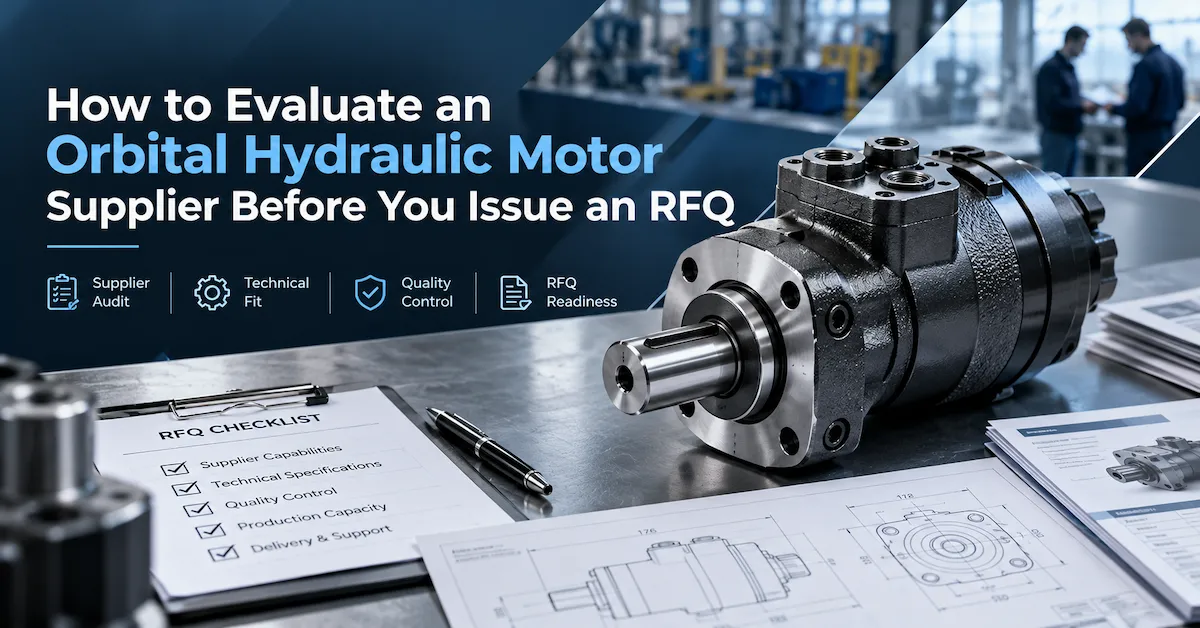
A complete RFQ lets the supplier distinguish a standard orbital configuration from a motor that needs a broader engineering review. Attach the plant layout, conveyor drawing, hydraulic schematic, old motor photographs, load calculation, expected annual quantity and target sample date. Mark every input as measured, calculated or assumed.
| RFQ field | Buyer provides | Supplier returns |
|---|---|---|
| Conveyor duty | Feeder or discharge belt, width, length, incline, material and throughput | Recommended motor family and assumptions |
| Operating profile | Speed, torque, flow, pressure drop, loaded start, reverse and run hours | Exact model limits, margins and test conditions |
| Mechanical fit | Shaft, key/spline, flange, pilot, bolts, ports, reducer and shaft loads | Revision-controlled drawing and adapter statement |
| Environment | Dust, water, oil, ambient temperature, storage and washdown | Seal, cleanliness, filtration and installation recommendations |
| Commercial plan | Sample quantity, annual demand, destination, packaging and launch date | Sample/repeat lead time, MOQ, packaging, warranty and change control |
Validate the Motor on a Representative Screening Run
A sample approval should reproduce the machine's difficult moments. Test the motor with the intended reducer, drum, bracket, hoses, valve and control sequence. Keep the approved part code and drawing with the test record.
- Document check: compare nameplate, displacement, shaft, flange, pilot, ports, seals and rotation with the approved proposal.
- Installation check: verify alignment, fasteners, coupling, bearing support, chain tension, hose routing and drain arrangement.
- No-load run: confirm direction, leakage, noise, speed control and response before adding material.
- Loaded run: measure pressure drop, flow, speed, temperature and torque or a validated load proxy at normal throughput.
- Loaded restart: stop with material on the belt and verify the agreed restart sequence without an uncontrolled pressure spike.
- Transient check: test stop, reverse or a defined jam-clearing event only within the machine's safe procedure.
- Thermal stabilization: continue until oil temperature and speed are stable, then record leakage and mounting movement.
Do not invent pass/fail limits from a family-level product page. The engineering team should set acceptance values from the exact model data, conveyor calculation and safe operating procedure. If the motor stalls, overheats, leaks, vibrates excessively or shows unstable speed, hold the production release and review the cause with the supplier.
Common Selection Mistakes
Copying a generic screening-plant range
A previous system article may state a broad displacement, pressure or speed range for screening plants. Such a range can orient a search, but it is not the rating of a specific motor. The current model drawing and technical confirmation must control the purchase.
Choosing from average running torque
Average torque can hide the loaded restart, wet material or stone impact that causes a stall. Separate steady, starting and transient cases and state their duration and frequency.
Ignoring support bearings and shaft loads
A chain, sprocket or drum can overload a shaft even when the hydraulic torque calculation is correct. Show the load path and obtain written allowable-load confirmation.
Approving after an unloaded bench test
An unloaded test cannot reveal loaded-start torque, material surge, oil heating or jam recovery. The sample must be tested on the actual conveyor or a representative rig.
Frequently Asked Questions
What is the best hydraulic motor for mobile screening conveyor duty?
The best choice depends on belt load, speed, pressure, flow, loaded-start torque, vibration, environment and interface. An orbital motor can suit a compact or medium conveyor when the exact model fits those conditions. Higher-power, closed-loop or severe shock duty may justify an axial-piston or radial-piston review. Request model-specific confirmation rather than selecting from a family maximum.
How do I size a motor for a screening conveyor?
Calculate drum speed from belt speed and effective diameter, drum torque from tangential force and radius, then transfer speed and torque through the reducer. Convert the motor speed and torque to preliminary displacement, pressure and flow requirements. Include loaded start, incline, material surge, temperature and external shaft loads before asking the supplier to confirm the exact model.
Can an OMP motor be used on a mobile screening conveyor?
It can be considered when the selected OMP configuration meets the conveyor's exact pressure, flow, speed, torque, loaded-start, shaft-load, temperature and interface requirements. BLINCE publishes OMP family-level guidance, but those “up to” values do not approve every displacement or option. Use the current drawing and written engineering review.
What information should I send for a quotation?
Send conveyor type, belt width and length, incline, drum diameter, material and throughput, target speed, torque, pressure drop, flow, loaded-start condition, duty hours, reverse or jam procedure, oil and temperature, hydraulic schematic, shaft loads, old motor code, photographs, interface measurements, quantity, destination and sample date.
Why does a screening conveyor overheat with a correctly sized motor?
Possible causes include excessive pressure drop from a partially blocked belt, undersized hoses or valves, too much flow for the required speed, poor cooling, high return pressure, contamination, misalignment or a motor running outside its efficient range. Measure pressure, flow, speed and oil temperature together before replacing the motor.
When should I consider a piston motor instead of an orbital motor?
Ask for an axial- or radial-piston comparison when the conveyor requires high power, high pressure, closed-loop operation, a wide controlled speed range, very high low-speed torque or repeated severe shock. Provide the same load and interface information so both options are compared on the complete system.
How should a replacement motor be approved?
Approve only after model, displacement, pressure, flow, speed, torque, shaft, flange, pilot, bolts, ports, seals, rotation, external loads and circuit compatibility are confirmed. Test no-load, loaded start, normal running, stop or reverse, temperature, leakage and the defined jam procedure on a representative conveyor.
Conclusion
A reliable hydraulic motor for mobile screening conveyor equipment is selected from the full operating story: material, belt geometry, loaded start, vibration, dust, temperature, hydraulic circuit, reducer, shaft support and service conditions. Begin with the load calculation, then compare orbital and piston architectures against the real pressure, flow and control requirements. BLINCE's orbital motor families provide a practical starting point for compact and medium drives, but family-level ranges are screening references only.
Before releasing a sample or repeat order, send the complete RFQ and request written confirmation of the exact model, displacement, pressure, flow, speed, torque, starting capability, shaft, flange, ports, seals, external loads, compatibility, test conditions and commercial assumptions. A loaded-start and thermal validation on the representative conveyor is the final step that turns a plausible catalogue choice into a defensible procurement decision.