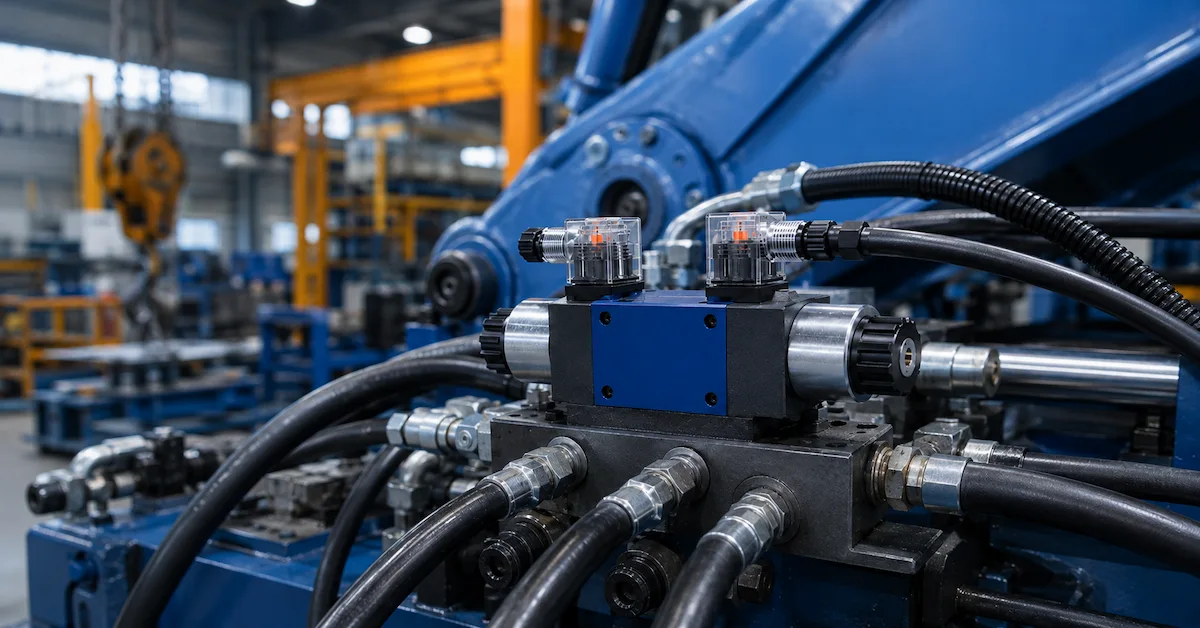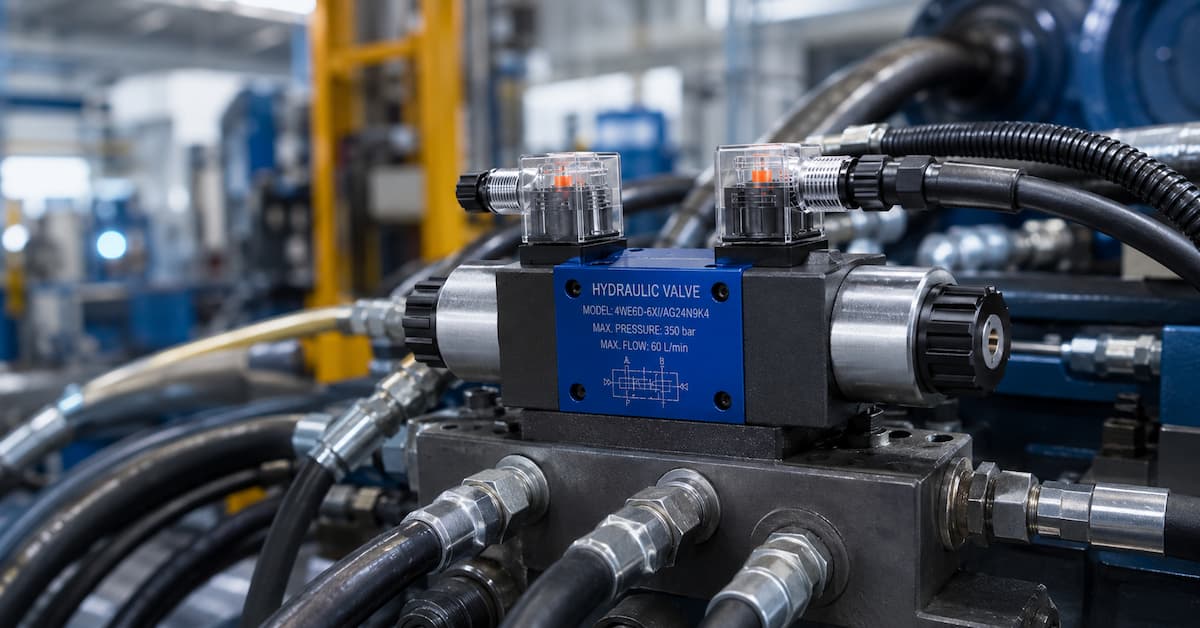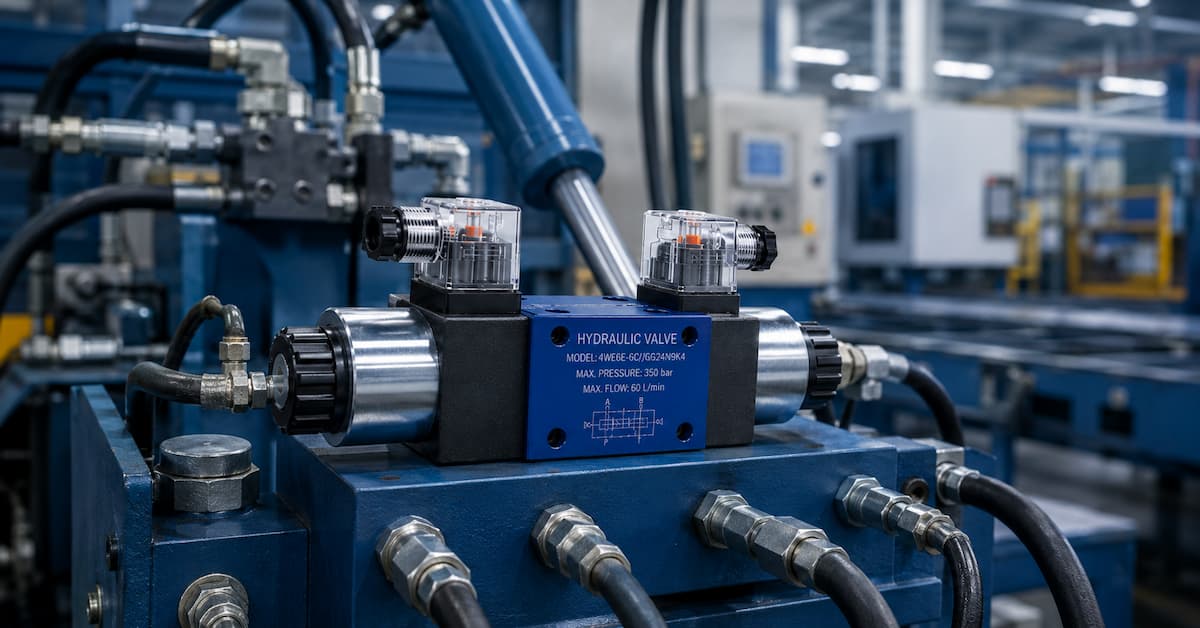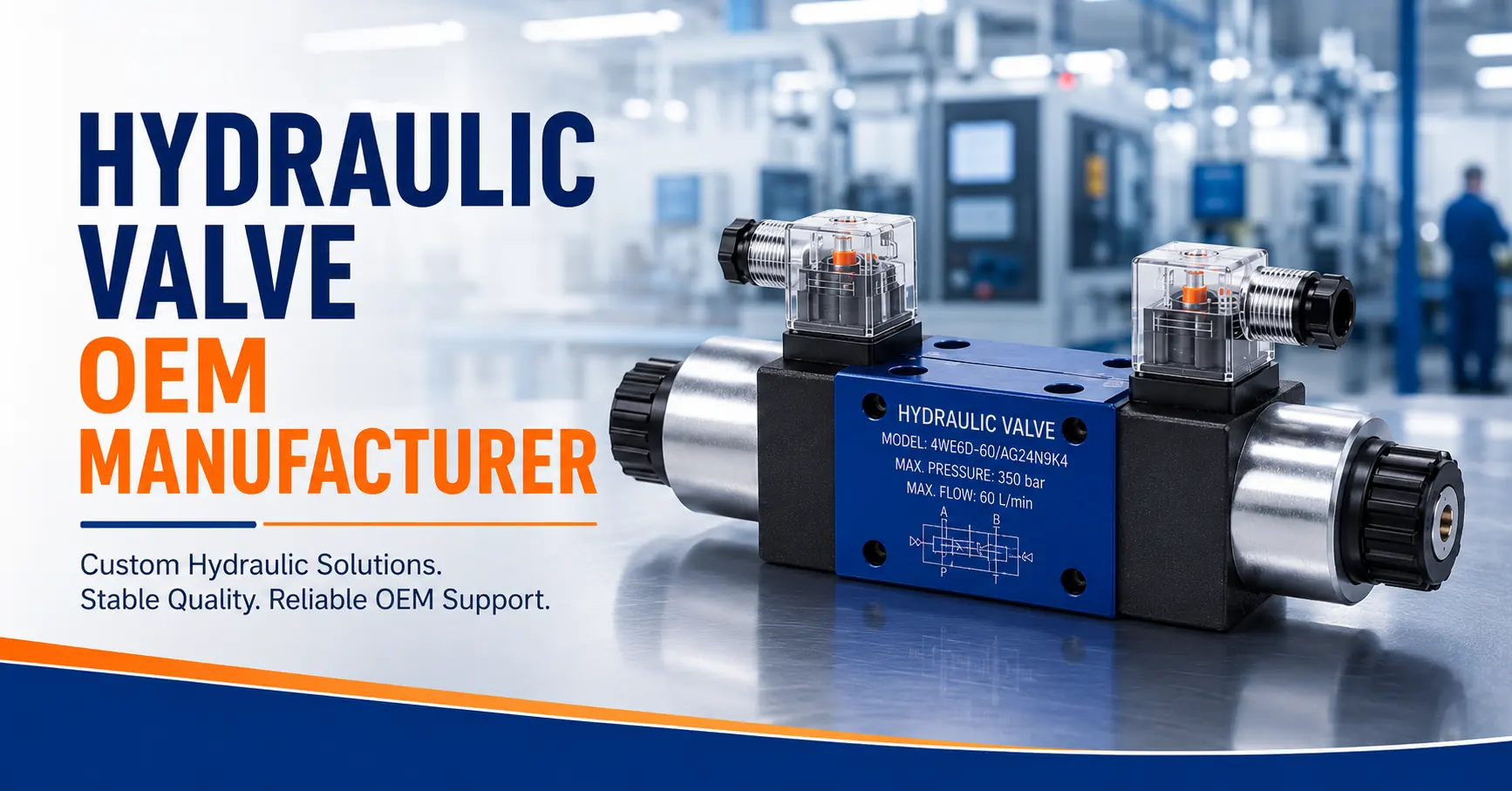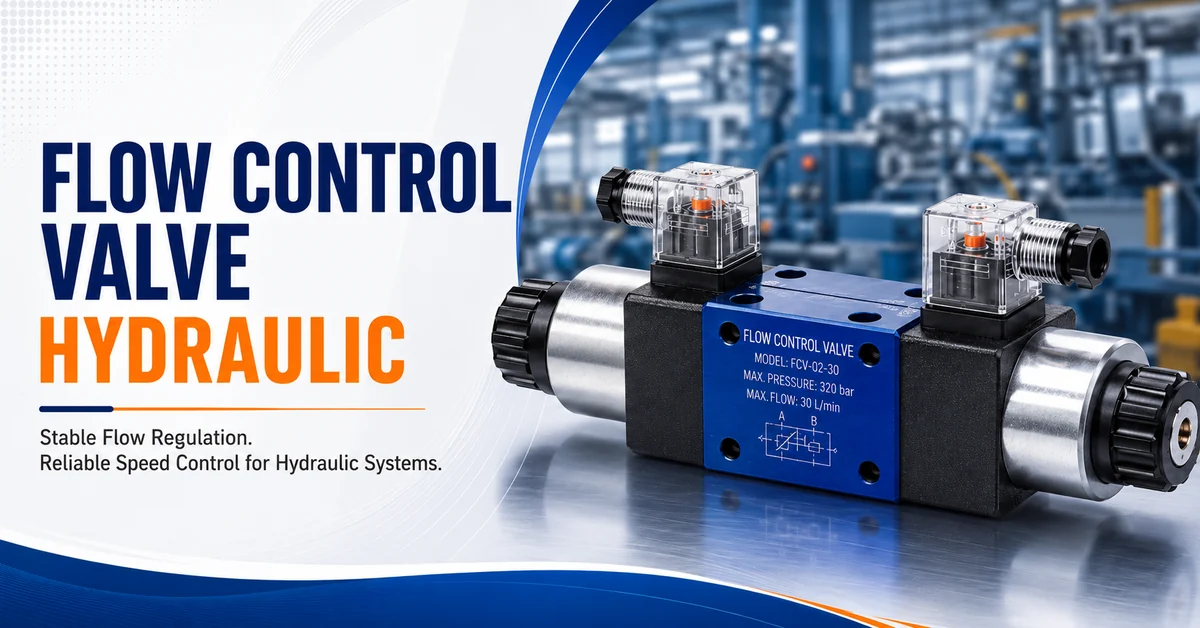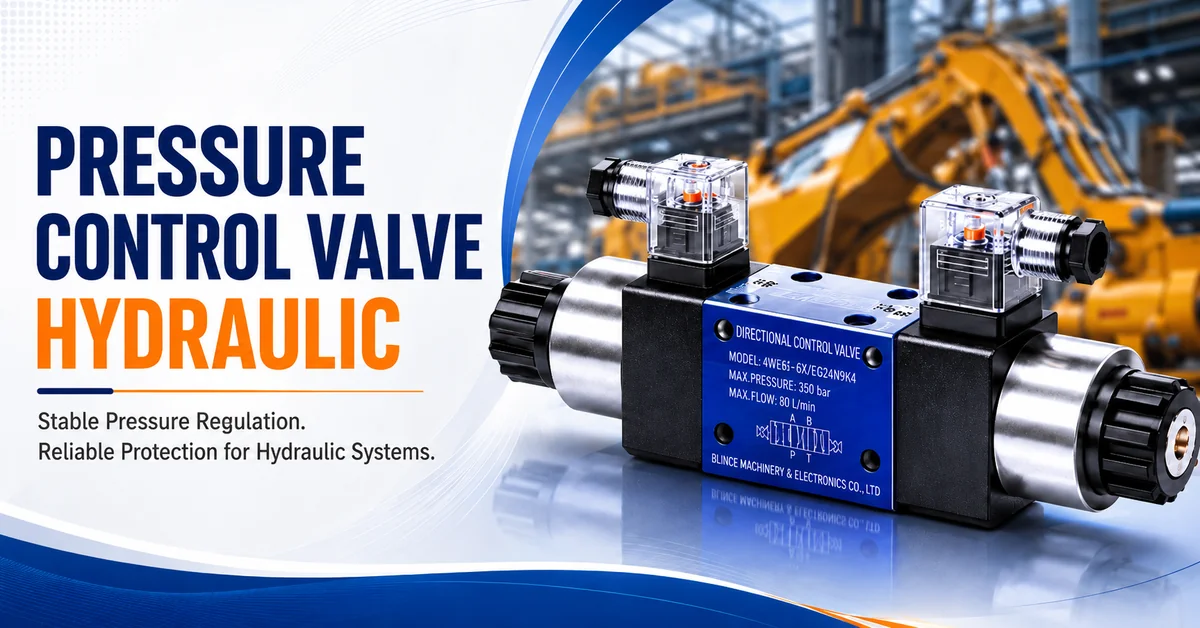



A directional control valve hydraulic system is one of the most important control points in mobile machinery, industrial equipment, agricultural machines, and heavy-duty hydraulic systems. It decides where hydraulic oil flows, which actuator moves, and whether a cylinder extends, retracts, stops, or holds position.
For OEM equipment manufacturers, hydraulic distributors, repair companies, and project buyers, choosing the wrong directional control valve can lead to slow response, unstable movement, oil leakage, overheating, system shock, or even equipment downtime.
This guide explains how to choose a hydraulic directional control valve from a practical B2B purchasing perspective. It covers working principles, valve types, key specifications, application scenarios, quality risks, OEM considerations, and how BLINCE supports global buyers with hydraulic valve solutions.
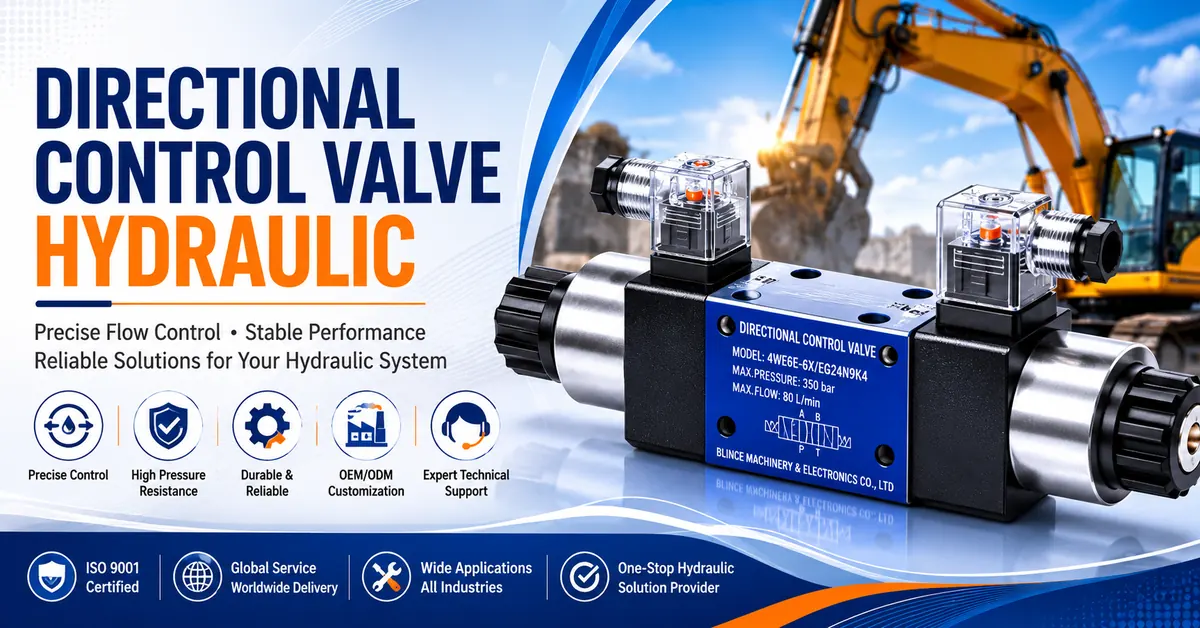
Quick Answer: What Is a Directional Control Valve in a Hydraulic System?
A hydraulic directional control valve controls the direction of hydraulic oil flow in a hydraulic circuit. It sends oil to different ports so that cylinders, hydraulic motors, or other actuators can move in the required direction.
In simple terms:
- It controls start, stop, and direction.
- It helps a cylinder extend or retract.
- It helps a motor rotate forward, reverse, or stop.
- It protects the system from incorrect oil routing.
- It improves machine control, safety, and operating efficiency.
For buyers looking for a directional control valve hydraulic solution, the main selection factors include working pressure, flow rate, spool configuration, actuation method, port size, sealing performance, installation space, and application environment.
Why Directional Control Valves Matter in Heavy Machinery
In heavy machinery, hydraulic oil does not simply move through pipes. It must be controlled accurately. A directional valve is the component that tells the system where the oil should go.
For example:
- In a construction machine, it may control boom lifting, bucket tilting, or steering movement.
- In harvesting machinery, it may control header adjustment, steering, or auxiliary hydraulic functions.
- In material handling equipment, it may control lifting, lowering, clamping, or tilting.
- In industrial equipment, it may control pressing, feeding, cutting, or positioning.
If the valve response is poor, the entire machine feels unstable. If the spool clearance is not precise, internal leakage may reduce system efficiency. If the valve body is not suitable for high pressure, the system may become unsafe under continuous load.
That is why a hydraulic directional control valve should not be selected only by price. It should be selected according to working conditions, flow demand, pressure level, control method, and supplier reliability.
BLINCE provides hydraulic valve products as part of its wider hydraulic product range, supporting machinery manufacturers, distributors, and maintenance buyers who need reliable hydraulic components for different equipment systems.
Common Buyer Pain Points When Choosing Hydraulic Directional Control Valves
Many customers search for a directional control valve hydraulic product when they already face a technical or sourcing problem. Common pain points include:
- Unstable actuator movement
The cylinder moves slowly, shakes, or does not stop accurately. - Internal leakage
Oil passes through the valve even when the spool is in the neutral position, causing pressure loss. - Wrong spool configuration
The valve does not match the hydraulic circuit, causing incorrect movement or poor holding performance. - Insufficient flow capacity
The valve restricts oil flow, causing slow actuator speed or high pressure drop. - Pressure mismatch
The selected valve cannot handle system pressure during peak load. - Port and thread incompatibility
The valve cannot connect correctly with existing hoses, fittings, or manifolds. - Poor sealing under harsh environments
Dust, vibration, heat, or oil contamination causes early failure. - Lack of supplier technical support
Buyers receive a product, but not enough help with selection, replacement, or installation.
To reduce these risks, buyers should confirm not only the valve model, but also the working pressure, flow rate, actuator type, spool function, port standard, installation layout, and working environment.
Main Types of Hydraulic Directional Control Valves
Different valve types are suitable for different machines and control requirements.
| Valve Type | Main Feature | Best For | Buyer Notes |
|---|---|---|---|
| Manual Directional Control Valve | Operated by hand lever | Simple machinery, agricultural equipment, repair systems | Easy to use and maintain |
| Solenoid Directional Control Valve | Electrically controlled | Automated equipment, industrial systems, mobile machinery | Requires voltage and electrical control confirmation |
| Hydraulic Pilot Operated Valve | Controlled by hydraulic pilot pressure | Heavy machinery and high-flow systems | Suitable for larger circuits |
| Monoblock Directional Valve | Compact one-piece valve body | Mobile machinery and small hydraulic systems | Cost-effective and space-saving |
| Sectional Directional Valve | Multiple sections can be combined | Multi-function equipment | Flexible for OEM designs |
| Proportional Directional Valve | Controls direction and flow more precisely | Advanced equipment and variable control systems | Higher control accuracy, higher cost |
For most B2B buyers, the best choice depends on how the machine is controlled, how many functions are required, and whether the valve must work in a manual, electric, pilot-operated, or automated control system.
Key Technical Specifications Buyers Should Confirm
Before ordering a directional control valve hydraulic product, buyers should prepare a technical checklist. This reduces model mismatch and saves time during quotation.
| Parameter | Why It Matters | What Buyers Should Confirm |
| Working Pressure | Determines whether the valve can withstand system load | Rated pressure and peak pressure |
| Flow Rate | Affects actuator speed and pressure loss | Required L/min or GPM |
| Number of Ports | Determines oil routing | P, T, A, B, and additional ports |
| Number of Positions | Controls operating states | 2-position, 3-position, or custom configuration |
| Spool Type | Affects neutral position and actuator holding | Open center, closed center, tandem center, float, etc. |
| Actuation Method | Determines control mode | Manual, solenoid, hydraulic pilot, pneumatic |
| Voltage | Required for solenoid valves | 12V, 24V, 110V, 220V or project-specific |
| Port Thread | Ensures connection compatibility | BSP, NPT, Metric, SAE or other standard |
| Mounting Type | Affects installation | Plate-mounted, subplate, monoblock, sectional |
| Oil Cleanliness | Influences spool life and leakage risk | Filtration level and oil contamination control |
| Working Temperature | Affects seals and valve response | Ambient and oil temperature range |
| Environment | Determines material and sealing needs | Dust, vibration, humidity, salt spray, heat |
A reliable supplier should help buyers check these parameters before recommending a model. BLINCE offers technical support for product selection, installation guidance, troubleshooting, and system matching.
How to Choose the Right Directional Control Valve Hydraulic Solution
1. Start from the actuator
The first question is: what does the valve control?
- A hydraulic cylinder?
- A hydraulic motor?
- A steering function?
- A lifting system?
- A clamping or pressing mechanism?
A cylinder usually requires controlled extension and retraction. A hydraulic motor may need forward, reverse, and stop functions. A lifting system may require better load holding. The actuator determines the spool type and oil routing requirement.
2. Match flow rate with machine speed
Flow rate affects actuator speed. If the valve flow capacity is too small, the machine moves slowly and pressure drop increases. If the valve is too large, control may become less precise and cost may rise.
Buyers should confirm required flow based on pump output, actuator size, and expected movement speed.
3. Match pressure with load
Heavy-duty machinery often works under shock load, vibration, and changing pressure. The valve should handle both rated pressure and peak pressure.
For construction machinery, crushing equipment, port machinery, and tunneling equipment, pressure safety margin is especially important.
4. Choose the correct spool function
Spool configuration is one of the most common causes of selection errors. Open center, closed center, tandem center, float, and motor spool designs behave differently in neutral position.
For example:
- Open center may allow pump flow to return to tank.
- Closed center may block flow in neutral.
- Float position may allow a cylinder to move freely under external force.
- Motor spool may protect hydraulic motors from sudden stopping.
The right spool depends on the hydraulic circuit.
5. Confirm control method
Manual valves are simple and cost-effective. Solenoid valves are suitable for electric control systems. Pilot-operated valves are often used in high-flow or heavy-duty applications. Proportional valves are used when more precise movement control is required.
6. Check installation and connection standards
A good valve must fit the machine. Buyers should confirm installation space, mounting hole layout, port size, thread standard, and hose connection direction.
If the valve is used as a replacement part, photos of the old valve, nameplate, circuit diagram, and installation dimensions can help avoid mistakes.
7. Consider harsh working environments
Hydraulic valves used in construction machinery, cement plants, offshore equipment, solid waste crushing, and tunnel reinforcement may face dust, vibration, shock load, heat, humidity, or oil contamination.
In these environments, buyers should pay attention to valve body strength, spool precision, sealing quality, surface treatment, and filtration requirements.
Typical Applications of Hydraulic Directional Control Valves
Directional control valves are widely used across the application fields served by BLINCE.
Construction Machinery
In excavators, loaders, pavers, compactors, and other construction machinery, directional valves control cylinders, motors, and auxiliary hydraulic actions. The valve must withstand vibration, pressure shock, outdoor dust, and continuous operation.
Harvesting Machinery
Agricultural machines need reliable hydraulic control for steering, lifting, header adjustment, and auxiliary equipment. Directional valves used in harvesting machinery should offer stable operation during seasonal high-intensity work.
Sheet Metal and Industrial Equipment
Pressing, bending, cutting, and clamping equipment require repeatable and stable movement. A properly selected hydraulic directional control valve helps improve movement accuracy and machine safety.
Cement and Solid Waste Crushing
These environments are dusty, heavy-duty, and often continuous. Valves must resist contamination, pressure fluctuation, and vibration.
Offshore and Port Machinery
Offshore equipment, platforms, and port machinery require hydraulic components that can handle humidity, corrosion risk, heavy load, and outdoor operation.
Shield Tunneling and Tunnel Reinforcement
Tunnel equipment works under high load and difficult site conditions. Hydraulic valve reliability directly affects continuous project operation and downtime control.
Buyers can explore more industry use cases through BLINCE’s applications page.
Materials, Workmanship, and Quality Control
A directional control valve looks simple from the outside, but its performance depends heavily on machining accuracy and internal spool quality.
Important quality factors include:
- Valve body material strength
- Spool machining precision
- Surface finish
- Internal clearance control
- Sealing performance
- Spring durability
- Solenoid reliability, if electrically operated
- Pressure testing
- Leakage inspection
- Clean assembly process
Poor machining may cause spool sticking. Poor sealing may cause external leakage. Excessive internal clearance may cause pressure loss. Poor material or heat treatment may reduce service life under high pressure.
BLINCE emphasizes manufacturing capability, product testing, and stable production support. Buyers who need long-term supply, OEM cooperation, or batch orders can review BLINCE’s manufacturing capabilities and certificates for more confidence before placing orders.
Directional Control Valve vs Flow Control Valve vs Pressure Control Valve
Hydraulic buyers sometimes confuse different valve functions. The table below explains the difference.
| Valve Type | Main Function | Common Use | Selection Focus |
| Directional Control Valve | Controls oil flow direction | Cylinder extension/retraction, motor forward/reverse | Spool type, actuation, ports, positions |
| Flow Control Valve | Controls oil flow volume | Speed adjustment | Flow range, pressure compensation |
| Pressure Control Valve | Controls system pressure | Safety, pressure limiting, unloading | Pressure setting, stability, response |
| Proportional Valve | Controls flow and direction with variable signal | Precise movement control | Signal type, response, accuracy |
| Logic Valve | Controls complex hydraulic circuit logic | Large flow systems, industrial equipment | Circuit design and pilot control |
A directional control valve hydraulic product is mainly chosen when the buyer needs to control where oil goes, not simply how fast or how much pressure the system uses.
OEM and Replacement Valve Purchasing Guide
For OEM manufacturers, the valve should match the machine design from the beginning. For distributors and maintenance buyers, the valve often needs to replace an existing model.
For OEM buyers
Confirm:
- Hydraulic schematic
- Pump flow and system pressure
- Number of functions
- Control method
- Installation space
- Port direction
- Electrical voltage, if applicable
- Required production quantity
- Testing and packaging needs
For replacement buyers
Prepare:
- Old valve photos
- Nameplate photo
- Machine model
- Port thread standard
- Mounting dimensions
- Spool function
- Working pressure and flow
- Failure symptoms
BLINCE can help customers review project information and recommend a suitable valve or hydraulic component solution. Buyers can also learn more about the company background through the BLINCE about page.
Common Risks When Buying Low-Cost Directional Control Valves
Price matters in B2B purchasing, but choosing only the lowest-priced valve can create hidden costs.
Common risks include:
- Oil leakage after short operation
- Spool sticking due to poor machining
- Slow response under pressure
- Incorrect spool function
- Solenoid burnout
- Port thread mismatch
- Short seal life
- High pressure drop
- Frequent equipment downtime
- No support after shipment
For heavy-duty machinery, one failed valve may stop an entire machine. The real cost is not only the valve price, but also downtime, repair labor, replacement shipping, and customer complaints.
A better purchasing strategy is to compare technical matching, supplier experience, QC process, lead time, documentation, and after-sales support.
What Information Should You Send for a Quotation?
To receive an accurate recommendation for a directional control valve hydraulic product, buyers should send the following information:
| Required Information | Example |
| Equipment Type | Loader, press machine, harvester, crane, crusher |
| Valve Function | Cylinder control, motor control, lifting, steering |
| Working Pressure | Rated and peak pressure |
| Flow Rate | L/min or GPM |
| Spool Type | Open center, closed center, tandem, float, motor spool |
| Actuation Method | Manual, solenoid, pilot-operated |
| Voltage | 12V, 24V, 110V, 220V |
| Port Thread | BSP, NPT, Metric, SAE |
| Mounting Size | Drawing or measured dimensions |
| Existing Model | Old valve model or nameplate |
| Quantity | Sample order, batch order, annual demand |
| Working Environment | Dust, vibration, humidity, high temperature |
Customers can send drawings, photos, parameters, or technical files through the BLINCE contact page for product matching and quotation.
Why Choose BLINCE for Hydraulic Directional Control Valves?
BLINCE is a China hydraulic product supplier with experience in hydraulic motors, pumps, valves, cylinders, coolers, steering control units, hoses, fittings, accessories, and hydraulic systems.
For buyers sourcing directional control valves, BLINCE offers several advantages:
- Broad hydraulic product coverage
- Support for machinery applications
- Technical support for selection and troubleshooting
- Manufacturing and quality control capability
- OEM and replacement support
- Ability to match valves with pumps, cylinders, motors, hoses, and fittings
- Suitable for construction machinery, agricultural machinery, port equipment, industrial systems, and other heavy-duty environments
Instead of treating the valve as an isolated part, BLINCE can help buyers consider the entire hydraulic circuit, including pump output, actuator movement, pressure control, oil temperature, hose connection, and installation compatibility.
FAQ
1. What does a directional control valve do in a hydraulic system?
A directional control valve controls the direction of hydraulic oil flow. It allows cylinders, hydraulic motors, and actuators to move forward, reverse, stop, extend, or retract.
2. What is the main keyword difference between directional control valve hydraulic and hydraulic directional control valve?
They refer to the same product concept. “Hydraulic directional control valve” is the more natural technical phrase, while “directional control valve hydraulic” is often used as a search keyword by buyers looking for hydraulic valve solutions.
3. How do I choose the right hydraulic directional control valve?
You should confirm pressure, flow rate, spool type, number of ports, number of positions, actuation method, port thread, mounting size, and working environment.
Conclusion
A directional control valve hydraulic solution is critical for controlling actuator movement, machine safety, and hydraulic system reliability. Buyers should not choose a valve only by appearance or price. The correct selection depends on pressure, flow, spool function, actuation method, port standard, installation space, and working environment.
For OEM equipment manufacturers, hydraulic distributors, maintenance companies, and project buyers, BLINCE can support valve selection, replacement matching, hydraulic component supply, and technical communication for demanding machinery applications.
To get a suitable recommendation, send your equipment model, hydraulic diagram, valve photos, pressure, flow, port standard, and quantity to BLINCE. A properly selected hydraulic directional control valve can reduce downtime, improve system control, and support long-term equipment performance.