
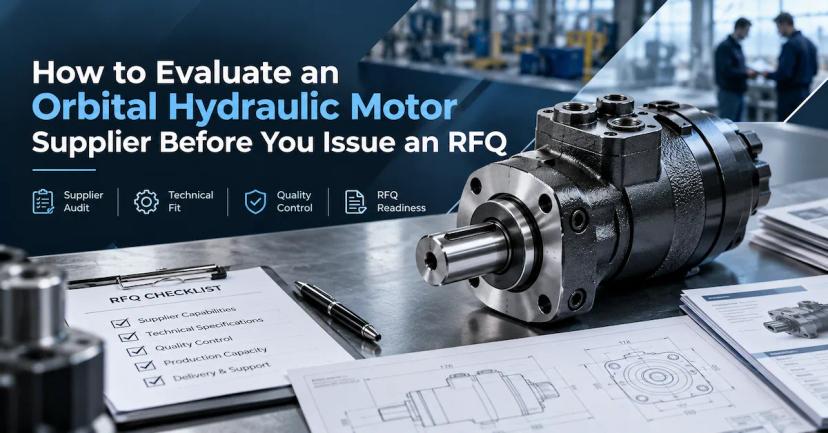
Quick Answer: What Should a Buyer Verify in an Orbital Hydraulic Motor Supplier?
The safest way to evaluate an orbital hydraulic motor supplier is to compare evidence against one complete RFQ, not to compare catalog prices or a single maximum-pressure number. Give every supplier the same displacement, speed, continuous and intermittent pressure, flow, torque, duty cycle, mounting, shaft, port, environment, quantity, packaging, and documentation requirements. Then verify that the proposed motor is supported by a model-specific datasheet, dimensional drawing, material and sealing information, test records, batch traceability, sample approval, and a written plan for lead time and after-sales support.
For buyers comparing BLINCE with other manufacturers, the relevant question is not simply "Which motor is cheapest?" It is "Which supplier can show that the selected motor will fit my machine, repeat the result in production, and support the order after the sample is approved?" BLINCE supplies orbital motor families for compact, general-purpose, high-pressure, high-torque, and heavy-load applications. The correct family still has to be confirmed against the actual machine data.
Review BLINCE Orbital Motor Series
Why Supplier Comparison Requires More Than a Catalog Price
An orbital motor is a power component, but procurement decisions are often made as if it were a standard commodity. That approach creates hidden risk. Two motors can show the same displacement and nominal pressure while behaving differently because of distribution accuracy, rotor and stator matching, seal selection, bearing capacity, shaft geometry, cleanliness control, or production variation. A lower unit price can disappear quickly when a replacement motor causes installation changes, unstable low-speed motion, unplanned downtime, or a second round of testing.
A capable supplier should be able to connect four layers of information:
- Application: what the machine does, how it starts, how often it cycles, and what loads reach the shaft.
- Product: the exact displacement, configuration, pressure mode, speed, flow, shaft, flange, ports, and seal options.
- Process: how components are machined, assembled, cleaned, tested, identified, and released by batch.
- Commercial support: sample quantity, MOQ, lead time, packaging, technical documents, warranty route, and response ownership.
If a supplier answers only the product layer, the comparison is incomplete. If a supplier makes broad performance claims but cannot provide a drawing, test method, or traceable sample, the claim is not yet useful for an engineering release. A good RFQ makes each layer visible and gives the supplier a fair opportunity to respond.
1. Start with a Complete RFQ Specification
The quality of a supplier comparison is limited by the quality of the input. "Please quote an orbital hydraulic motor, 200 cc" is not a complete RFQ because it leaves the most important selection variables open. A supplier may select a motor that turns at the required speed but cannot survive the starting load, radial load, oil temperature, or duty cycle. The buyer then receives a technically neat quotation that is not a reliable production solution.
RFQ information every supplier should receive
| RFQ field | What to specify | Why it changes the supplier recommendation |
|---|---|---|
| Machine function | Wheel drive, conveyor, auger, sweeper, winch, mixer, drilling attachment, roller, or another defined function. | The same displacement can behave differently in a continuous conveyor and a shock-loaded winch. |
| Speed | Required continuous rpm, intermittent rpm, minimum controllable rpm, and start-under-load condition. | Speed range affects displacement, leakage sensitivity, distribution design, and control stability. |
| Pressure | Continuous pressure, intermittent pressure, peak or relief setting, duration of each condition, and return-line pressure. | Maximum pressure alone does not describe the duty cycle or the pressure drop across the motor. |
| Flow | Continuous and peak flow in L/min, flow-control method, and expected flow variation. | Flow and displacement determine speed; excess flow can create heat or overspeed. |
| Torque/load | Running torque, starting torque, shock load, radial load, axial load, and direction changes. | Bearing and shaft options may be more important than the headline torque value. |
| Installation | Mounting flange, bolt pattern, pilot, shaft diameter and length, key or spline, port thread, and available envelope. | A motor can be hydraulically suitable and still fail to install without an adapter. |
| Environment | Oil type, oil cleanliness target, temperature, dust, water, vibration, corrosion exposure, and altitude where relevant. | Seal, coating, bearing, and service recommendations depend on the environment. |
| Commercial demand | Prototype quantity, annual volume, target launch date, packaging, labeling, and required documents. | MOQ, production planning, sample timing, and total landed cost cannot be assessed without volume. |
Ask each supplier to return the same fields in the same order. This simple discipline makes missing information visible. It also reduces the chance that a supplier wins the comparison by quoting a different interpretation of "continuous," "peak," "equivalent," or "replacement."
2. Verify Product and Application Fit
Displacement, flow, and speed must be evaluated together
Displacement is commonly stated in cubic centimetres per revolution. As a first approximation, a larger displacement produces more torque at a given pressure and requires more oil for the same speed. That relationship is useful, but it is not a complete sizing method. Actual speed is affected by volumetric efficiency, leakage, flow variation, load, oil viscosity, and temperature. A supplier should show the operating point, not only the largest displacement available in a family.
Request a model-specific operating envelope with continuous and intermittent speed clearly separated. Ask what happens at the lowest requested rpm, at start-up, and when the machine reverses. If your application needs smooth movement below the supplier's normal test speed, state that requirement explicitly. A motor that looks suitable at 500 rpm may not provide the same controllability at 30 rpm under a changing load.
Torque and pressure should be tied to a duty cycle
Torque is not one universal number. A supplier may list continuous torque, intermittent torque, peak torque, or theoretical torque. These values have different meanings and different allowable durations. Your RFQ should state how long the motor runs continuously, how often it sees a peak load, and whether the hydraulic relief valve can remain at that pressure. Ask the supplier to identify the pressure drop used for the quoted torque and to state whether the value is measured, calculated, or taken from a family-level catalog range.
When a motor starts a loaded auger, roller, or winch, starting torque and breakaway behavior can control the selection. When a motor drives a conveyor at a steady load, thermal balance and efficiency may matter more. A responsible orbital hydraulic motor supplier will ask for this distinction rather than selecting a motor from displacement alone.
Mounting, shaft, and ports are part of performance
Interface errors are a common source of avoidable RFQ delays. Confirm the flange standard, pilot diameter, bolt circle, shaft extension, key or spline form, shaft load direction, and port thread. For replacement work, provide the old motor drawing or clear dimensional photographs, but do not treat an external appearance match as proof of hydraulic compatibility. Internal timing, pressure capability, shaft seal arrangement, and bearing load ratings still need verification.
BLINCE product information shows multiple shaft and port configurations across its orbital motor families. For example, the OMR/OMRS range lists parallel-key, SAE spline, and tapered shaft options, with G1/2, 7/8-14 UNF, and manifold port choices. Confirm the exact configuration and dimensions against the model-specific drawing before releasing a purchase order.
3. Compare the Supplier's Orbital Motor Range by Buyer Need
A supplier with several orbital motor families can reduce redesign risk because the buyer can move to a more suitable configuration without changing the entire sourcing route. That does not mean every family is interchangeable. Use the table below as a conversation starter, then verify the proposed model, configuration, and rating in the supplier's current datasheet.
| BLINCE family | Website-listed orientation | Useful buyer question | Verification boundary |
|---|---|---|---|
| OMM | Compact gerotor motor; 8.2-50.3 cm3/rev; light agricultural, compact construction, conveyors, sweepers, small winches. | Can the compact package deliver the required start torque and minimum controllable speed without exceeding flow or temperature limits? | Confirm exact displacement, shaft, flange, pressure mode, and continuous/intermittent duty on the model datasheet. |
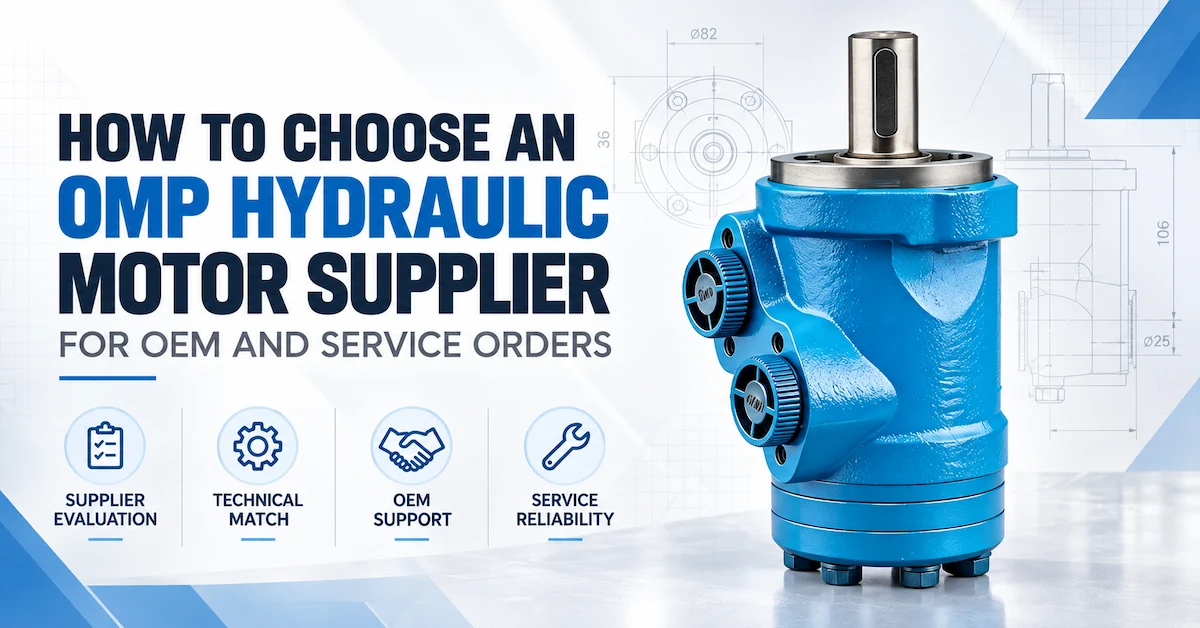
| OMP | General-purpose range shown from 36-500 cm3/rev, with applications in agriculture, forestry, construction, and material handling. | Which OMP configuration matches my mounting and shaft interface, and what is the validated duty cycle at my pressure? | Do not use a family maximum as the rating for every model; verify the selected displacement and configuration. |
| OMPH | Higher-pressure, low-speed/high-torque orientation; website information shows up to 20+ MPa and up to 486 N*m for the range. | Is the pressure requirement continuous, intermittent, or peak, and what test evidence supports the proposed operating point? | Compatibility with Eaton Char-Lynn or Danfoss references must be checked by dimensions, shaft, ports, displacement, and duty cycle. |
| OMR/OMRS | General-purpose motors with 36-375 cm3/rev options, speeds up to the listed range, and several shaft and port choices. | Will the selected bearing and shaft option carry the real radial and axial load from the attachment? | Confirm load ratings, pressure drop, speed, and port configuration for the exact model. |
| OMS/OMSE | Heavy-duty disc-valve design; website information shows 80-375 cm3/rev, tapered roller bearings, and high axial/radial load orientation. | Does the machine need bearing capacity and load tolerance that a standard motor cannot provide? | Confirm the selected displacement, torque, pressure, and allowable external loads; do not infer them from the family label. |
| OMER | Geroler motor family shown from 118-748 cm3/rev, with shaft, flange, and port options. | What combination of displacement, shaft, and bearing arrangement matches the machine's low-speed and load requirements? | Any leakage or life statement must be tied to a defined test method and operating condition. |
| OMV | Large-displacement heavy-duty family shown from 333-990 cm3/rev, with disc distribution and tapered roller bearing options. | Is the high displacement justified by the required torque, or will it create excess flow demand and heat? | Confirm speed, torque, pressure, external load, and installation dimensions for the specific OMV model. |
For a buyer, the value of this range is not the number of product names. The value is the supplier's ability to explain why one family is a better technical and commercial fit than another. Request a short written recommendation that names the proposed model, rejected alternatives, assumptions, and the data still needed for final approval.
Check OMP General-Purpose Options
4. Ask for Evidence of Materials and Manufacturing Control
Original evidence is what separates a useful supplier page from a generic product description. A procurement team should ask for evidence that can be connected to the quoted motor, not only broad statements such as "premium material" or "strict quality control." The evidence can be commercial, engineering, or production documentation, provided the scope and revision are clear.
Evidence to request before sample approval
- Material declaration: identify the material or material family used for the housing, shaft, gear set, bearing, and sealing elements where disclosure is commercially appropriate. Ask whether any substitution requires approval.
- Process overview: show the key machining, heat-treatment, grinding, cleaning, assembly, and inspection stages that affect leakage, torque ripple, and shaft life.
- Dimensional control: identify critical dimensions and how they are measured. Request the revision-controlled drawing used for the sample.
- Seal and oil compatibility: state the seal material family and the oil, temperature, and contamination assumptions used for the recommendation.
- Identification and traceability: explain how the motor, subcomponents, and test record are linked to a production batch.
- Factory evidence: request current product photographs, assembly or test-station photographs, and a description of what the images prove. A stock image is not evidence of the quoted configuration.
BLINCE's public product information identifies Dongguan Blince Machinery & Electronics Co., Ltd. in Dongguan, Guangdong, China, and presents orbital motors for conveyors, agricultural machinery, and mobile hydraulic systems. Those facts establish the supplier entity and product category. They do not, by themselves, prove the material, process, or test result for a particular purchase order. Ask the engineering or quality contact to attach the applicable evidence to the quotation package.
Publication evidence note: Before publishing this article as a first-party commercial asset, add at least one original BLINCE factory or test image, one model-specific dimensional or test document, and one named technical reviewer. Do not add a photo or number unless the team can identify its model, date, and source.
5. Check Testing, Acceptance Criteria, and Batch Consistency
"Tested" is not a sufficient answer. A useful test statement identifies the test type, input conditions, acceptance limit, sample identity, and record owner. The buyer should know whether a result represents a design validation sample, a first-off inspection, a routine end-of-line test, or a supplier's general capability study.
Questions for the technical and quality teams
- What is tested on every motor, and what is tested by sampling?
- Are pressure, leakage, rotation, noise, and torque results recorded against the serial number or batch?
- What oil temperature, viscosity, filtration level, speed, pressure drop, and run time are used?
- Which results are acceptance limits and which are engineering reference values?
- How are nonconforming motors contained, investigated, and released after corrective action?
- How does the supplier control changes to material, tooling, seal source, heat treatment, or assembly method?
For an OEM, the most important outcome is repeatability at production volume. Approve a sample only after the supplier has defined the sample configuration, test conditions, and dimensional baseline. Put the approved revision in the purchase specification. If the supplier later proposes a new seal source or machining route, require written change notification and a decision on whether revalidation is needed.
Build a practical incoming inspection plan
Incoming inspection does not need to repeat every factory test, but it should protect the failure modes that matter to your machine. Depending on risk, this may include visual identification, shaft and flange dimensions, port thread, rotation direction, leakage check, sample torque verification, and documentation review. Define the sampling level with your quality team. A supplier cannot be judged fairly if the buyer has no agreed acceptance criteria, and a buyer cannot protect production if every dispute is decided informally.
6. Evaluate MOQ, Lead Time, Packaging, and Documentation
Commercial terms should be compared together with technical risk. A supplier may quote an attractive price but require an MOQ that creates excess inventory. Another supplier may offer a low sample quantity but have a long production lead time for the approved configuration. These are not footnotes; they affect launch timing, working capital, and the cost of a design change.
| Commercial item | Ask the supplier to state | Buyer control point |
|---|---|---|
| Sample order | Available sample quantity, sample price, configuration, test documents, and expected dispatch date. | Ensure the sample is the same configuration as the production quotation. |
| MOQ | MOQ by model and configuration, and whether mixed models or phased releases are possible. | Compare MOQ with annual demand and inventory carrying cost; do not assume a public catalog has one universal MOQ. |
| Lead time | Time for engineering confirmation, sample, first production batch, repeat order, and any custom tooling. | Separate quoted lead time from shipping time and customs clearance. |
| Packaging | Individual protection, port plugs, rust prevention, labeling, pallet or carton quantity, and export marks. | Check that packaging protects shafts, flanges, and sealing surfaces during the actual transport route. |
| Documents | Datasheet, drawing, installation notes, test report, certificate or declaration where applicable, and revision history. | List required documents in the purchase order and define the language and file format. |
| Warranty and support | Warranty scope, claim evidence, response owner, spare-part policy, and escalation path. | Ask how the supplier distinguishes installation error, contamination, overload, and product nonconformance. |
Do not publish a fixed BLINCE MOQ, delivery promise, or test value unless the commercial or engineering team has confirmed it for the exact model and order. A responsible article can explain what to ask without turning an unverified internal assumption into a public commitment.
7. Review Replacement and OEM Compatibility Carefully
Replacement searches often use a competitor model number because the machine is already built around that interface. A supplier may describe a family as comparable or suitable as an alternative, but "replacement" should be treated as an engineering claim. Verify the complete interface and duty cycle before using that language in a quotation or product page.
Replacement verification checklist
- Compare displacement and the required continuous, intermittent, and peak pressure conditions.
- Compare shaft diameter, length, key or spline, seal position, pilot, flange, bolt pattern, and port threads.
- Check rotation direction, drain requirements, allowable case pressure, and relief-valve settings.
- Check radial and axial loads created by the machine, not just the motor's nominal torque.
- Run a sample in the actual hydraulic circuit or an agreed representative test rig.
- Record any adapter, hose, fitting, software, or control changes needed for installation.
BLINCE product pages describe OMPH as a suitable alternative or replacement option for selected Eaton Char-Lynn and Danfoss OMP/OMPH applications. That is a useful starting point for a buyer, not a blanket approval for every reference. Ask BLINCE to confirm the exact competitor model, displacement, interface, and operating conditions in writing.
OEM and private-label questions
OEM buyers should also discuss nameplate information, packaging language, drawing ownership, engineering change notification, forecast sharing, and whether the supplier can maintain the approved configuration over repeat orders. If a distributor will stock the motor, agree how technical revisions and field complaints are communicated to the end customer. These details protect both the machine builder and the supplier from ambiguity after launch.
8. Use a Supplier Comparison Scorecard
A scorecard turns a sales conversation into a repeatable decision. Weight the criteria according to your risk. For a prototype, engineering responsiveness may matter most. For a high-volume OEM program, process control, batch consistency, and change management may carry more weight. A low price should not be allowed to compensate for a missing safety-critical document.
| Criterion | Suggested questions | Evidence to record | Score |
|---|---|---|---|
| Application understanding | Did the supplier ask about duty cycle, load, environment, and installation? | RFQ response and assumptions list | 0-5 |
| Technical fit | Does the exact model meet speed, flow, pressure, torque, and load requirements? | Model datasheet, drawing, calculation, clarification log | 0-5 |
| Manufacturing evidence | Can the supplier explain critical processes and material control? | Process overview, material statement, factory evidence | 0-5 |
| Testing and traceability | Are test conditions and batch records clear? | Sample report, end-of-line test description, serial/batch link | 0-5 |
| Interface and replacement risk | Are dimensions and compatibility verified rather than assumed? | Signed drawing comparison and sample result | 0-5 |
| Commercial fit | Are MOQ, lead time, packaging, and documents suitable for the program? | Quotation and supply plan | 0-5 |
| Support and accountability | Is there a named technical contact and a clear escalation path? | Contact record, warranty process, change-notification rule | 0-5 |
Set a minimum score for critical categories. For example, a supplier should not pass a heavy-duty application if it scores well commercially but cannot explain external load capacity or pressure testing. Keep the scorecard with the approved supplier record so a future buyer can understand why the motor was selected.
9. What to Send to BLINCE for a Technical Recommendation
A concise, complete request helps BLINCE's team respond with a useful model recommendation instead of a generic product list. Include the information below in one message or attachment:
| Send this | Example of useful detail |
|---|---|
| Machine and application | "Hydraulic conveyor drive on a mobile agricultural machine; 8 hours/day; frequent starts under load." |
| Operating point | Required rpm range, continuous and intermittent flow, continuous and peak pressure, estimated running and starting torque. |
| External loads | Radial and axial loads at the shaft, overhung pulley or chain load, shock events, and direction changes. |
| Interfaces | Mounting drawing, shaft and key/spline dimensions, port thread, rotation direction, envelope limits. |
| Hydraulic circuit | Pump type, relief setting, valve type, return-line pressure, oil grade, filtration, and expected temperature. |
| Commercial plan | Sample quantity, annual volume, target SOP date, packaging, labeling, and required quality documents. |
| Decision needed | Ask for one recommended model, one alternative, the assumptions, and the data required to approve the final configuration. |
For the first quotation, ask BLINCE to identify which values are confirmed by the current model datasheet and which require engineering confirmation. This creates a clean handoff from marketing information to a technical purchase decision. You can begin with the BLINCE orbital motor product range and then request the exact family page, drawing, and commercial quotation.
FAQ
What makes a good orbital hydraulic motor supplier?
A good supplier combines a suitable product range with application engineering, controlled manufacturing, repeatable testing, clear documentation, and accountable after-sales support. The supplier should explain the assumptions behind the model recommendation and show how the approved configuration will be maintained in production. A long catalog or a low price is not enough evidence.
How should I compare two orbital hydraulic motor suppliers?
Send both suppliers the same RFQ and score their replies against the same criteria. Compare exact model ratings, operating conditions, interfaces, material and seal information, test method, batch traceability, MOQ, lead time, packaging, documents, warranty, and response quality. Make missing information visible instead of awarding it an assumed pass.
What information should be included in an orbital motor RFQ?
Include the machine function, continuous and intermittent speed, flow, pressure, torque, start-under-load condition, duty cycle, radial and axial load, oil and temperature, mounting, shaft, ports, environment, sample quantity, annual volume, launch date, packaging, and required documents. A drawing or marked-up photograph of the installation interface is highly valuable for replacement projects.
Are BLINCE OMPH motors direct replacements for Eaton Char-Lynn or Danfoss motors?
BLINCE presents OMPH as a suitable alternative or replacement option for selected Eaton Char-Lynn and Danfoss OMP/OMPH applications. Direct compatibility must be verified for the specific reference. Check displacement, pressure mode, shaft, flange, bolt pattern, ports, rotation, external loads, and actual duty cycle, then approve a sample in the target circuit.
Which BLINCE family should I choose for a compact machine?
OMM is presented as a compact option with a smaller displacement range and applications such as small agricultural machinery, light construction, conveyors, sweepers, and compact equipment. The correct choice still depends on torque, speed, flow, mounting, and load. Ask for the exact model rather than selecting from the family name alone.
Which family is suited to higher radial or axial loads?
OMS/OMSE and OMV are positioned for heavy-duty applications with disc distribution and tapered roller bearing arrangements. OMER also offers larger displacement and load-oriented configurations. The supplier must confirm the external-load rating for the exact model and mounting arrangement because machine loads can vary substantially.
Can I use a family-level maximum torque in my machine calculation?
No. A family-level maximum is not automatically the rating of every displacement or configuration. Use the model-specific continuous, intermittent, and peak values, with the applicable pressure drop and duty-cycle limits. If the document does not define the test condition, ask the supplier to clarify it before using the value in a design release.
What original evidence should a supplier provide?
Request a current factory or test-station photograph tied to the product, a model-specific drawing, material and seal information, a process overview, test conditions, sample or batch records, identification method, and named technical ownership. The evidence should be dated or revision-controlled where possible. A generic stock photograph or an undated claim does not demonstrate production control.
How do MOQ and lead time affect supplier selection?
MOQ affects inventory, cash flow, and the cost of a design change. Lead time affects prototype approval, launch timing, and service-part availability. Compare sample lead time, first-batch lead time, repeat-order lead time, tooling time, shipping time, and customs separately. Confirm each value for the selected configuration and order volume rather than relying on a general website statement.
What should I do if a supplier cannot provide a test report?
Ask whether the report is unavailable because the test is not routine, because the sample was not the final configuration, or because the supplier cannot disclose the format. Define an acceptance test that both parties can perform, record the conditions, and make sample approval conditional on the result. For a high-risk application, consider a witnessed test or an independent verification plan.
How can an orbital hydraulic motor supplier support OEM customization?
Discuss approved interface options, displacement, shaft and flange variants, seal selection, nameplate and packaging requirements, documentation, forecast, change notification, and service support. Customization should be recorded in a controlled drawing or specification. Avoid relying on an informal email description that cannot be matched to the production batch.
What is the fastest way to get a useful BLINCE recommendation?
Send one complete technical and commercial brief, including the operating point, drawing, external loads, hydraulic circuit, sample quantity, annual demand, and required date. Ask BLINCE to return a recommended model, an alternative, assumptions, dimensional documents, test evidence available for that configuration, and the data still requiring engineering confirmation.
Conclusion
Choosing an orbital hydraulic motor supplier is a verification exercise, not a catalog-shopping exercise. A reliable decision connects the machine duty cycle to the exact motor configuration, then checks the supplier's material control, manufacturing process, testing, batch consistency, interfaces, commercial terms, and support responsibilities. BLINCE offers a broad orbital motor range covering compact OMM applications, general-purpose OMP and OMR/OMRS use, higher-pressure OMPH requirements, and heavy-duty OMS/OMSE, OMER, and OMV configurations. The next step is to send a complete RFQ and confirm the selected model against current engineering evidence.