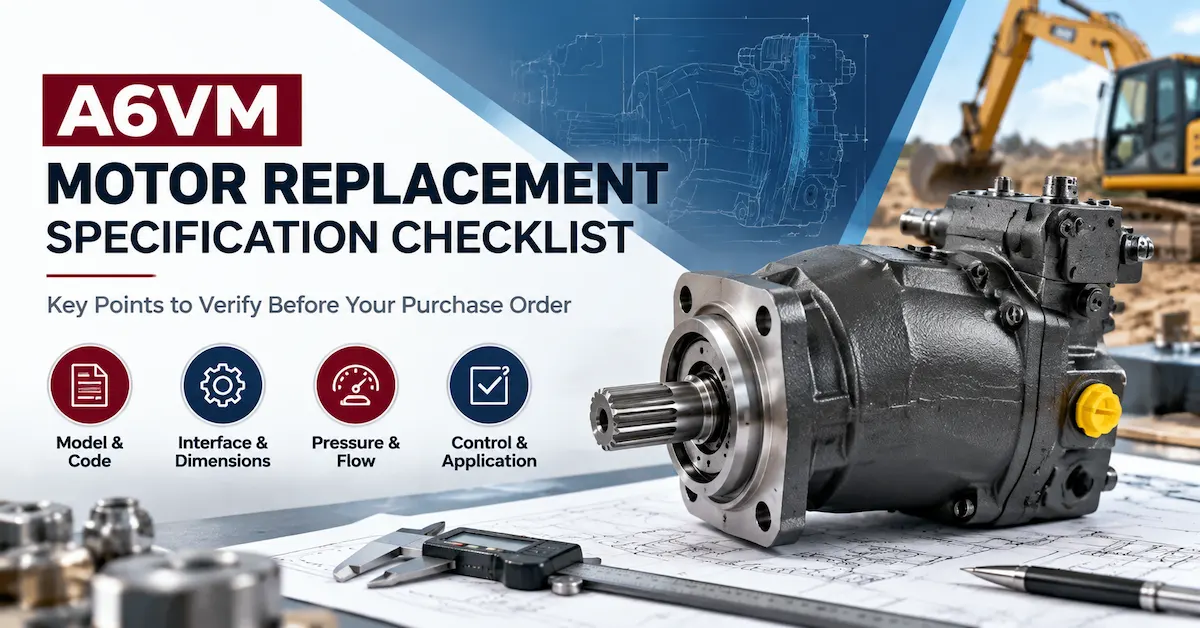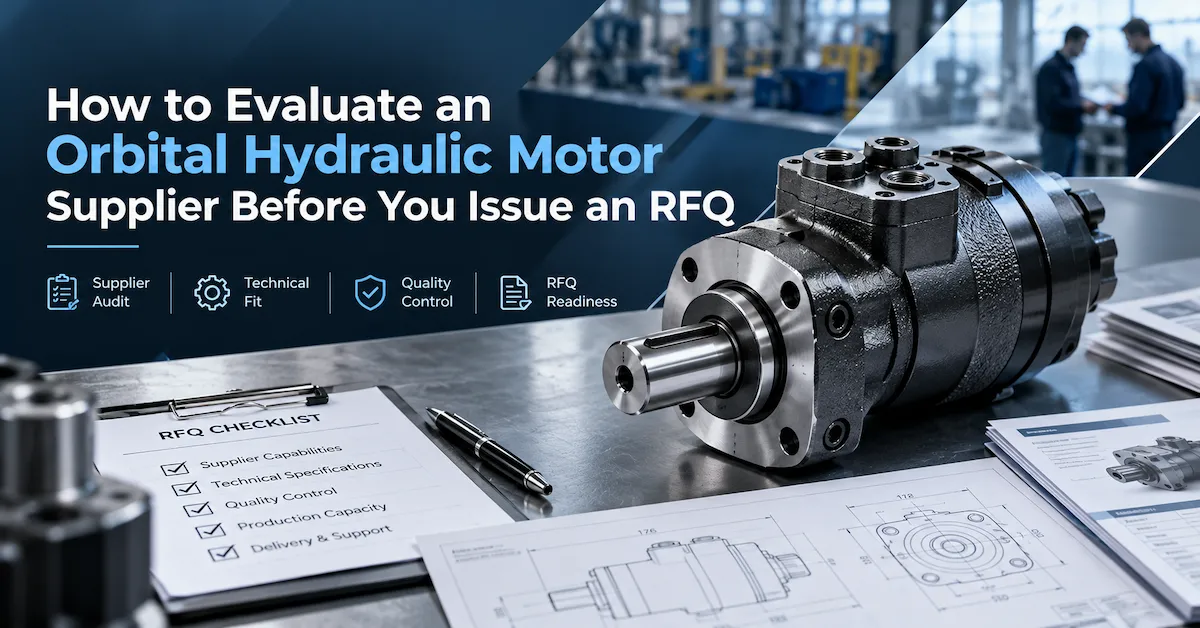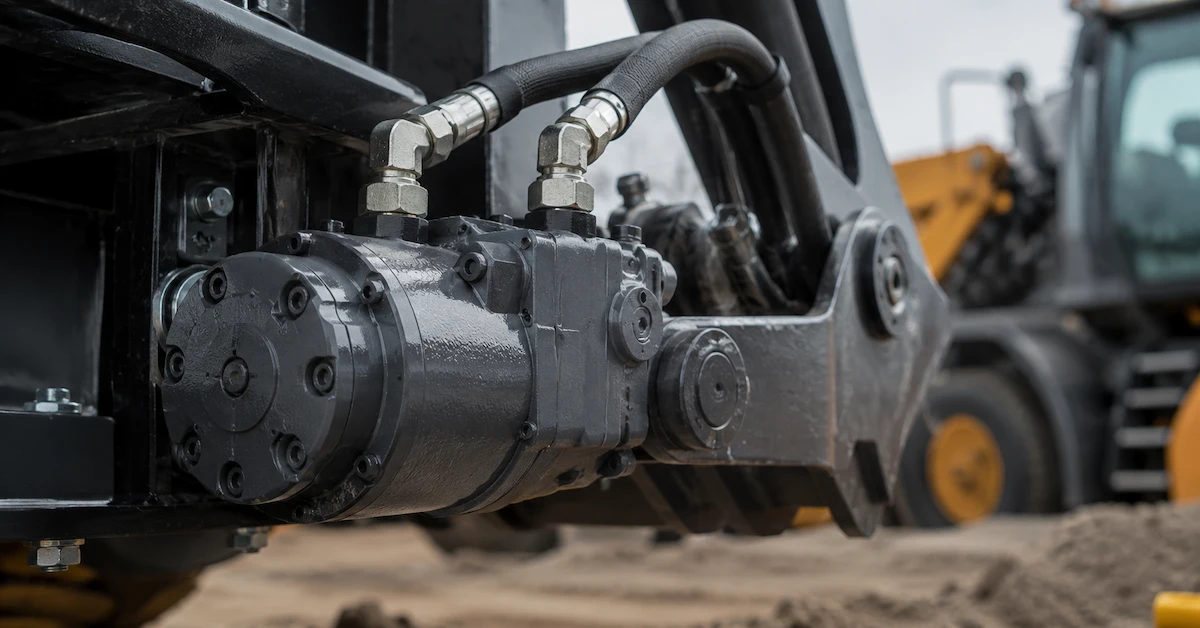

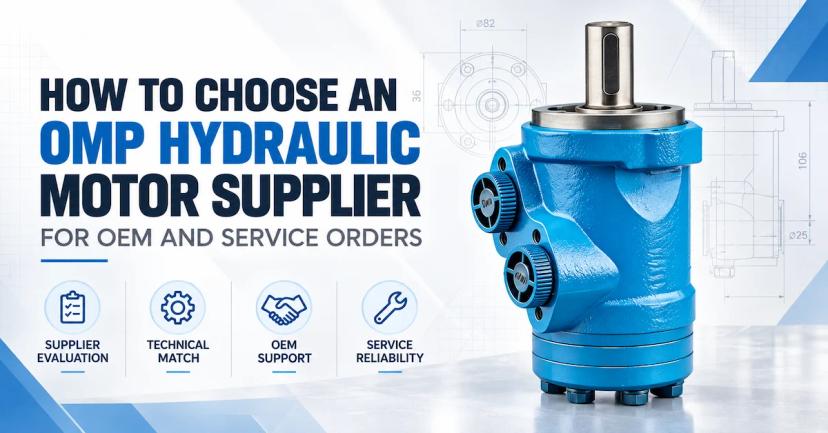
Quick Answer: How Should You Choose an OMP Hydraulic Motor Supplier?
Choose an OMP hydraulic motor supplier by matching the supplier's exact configuration and factory evidence to your machine duty cycle, not by comparing an OMP family name or one maximum number. A useful supplier response should identify the required displacement, continuous and intermittent pressure, flow, speed, starting torque, shaft and flange, port arrangement, seal option, external loads, sample plan, quality documents and commercial terms. It should also state which values are confirmed for the proposed model and which still require engineering approval.
For agricultural machinery OEMs, conveyor equipment manufacturers and aftersales distributors, the shortest reliable buying route is a five-step process: define the real operating point, send one complete RFQ, verify the mechanical interface, approve a controlled sample, and release the repeat order only after test and supply records are accepted. The BLINCE OMP page describes a compact orbital motor family with published family-level guidance of 36-500 cm3/rev displacement, speed up to 1500-1650 rpm, flow up to 60 L/min and torque up to 400+ Nm. These figures are orientation points for the family; they are not the rating of every OMP displacement or configuration.
This guide is written for a buyer who is ready to request a quotation or approve a replacement. It explains the data to send, the questions to ask and the evidence to retain so that a technically suitable motor also becomes a repeatable commercial part.
Review the BLINCE OMP Motor Page
What a Transactional Buyer Is Actually Purchasing
An OMP motor is not purchased only as a steel housing with a nominal displacement. The purchase includes the performance that the machine needs, the interface that allows the motor to install without rework, the manufacturing controls that keep the next batch consistent, and the support that makes a service replacement predictable. A low quote that omits one of these elements can create a higher total cost through adapters, field failures, emergency freight or repeated validation.
The commercial question should therefore be stated in operational language: "Can this supplier deliver the exact OMP configuration, at the required duty cycle, in the required quantity, with evidence that our engineering and service teams can approve?" The answer should be visible in a model-specific quotation, drawing, test record and supply plan. A catalogue page is the starting point, not the release document.
| Buying layer | Evidence to request | Release question |
|---|---|---|
| Application fit | Duty cycle, pressure-flow point, starting load, speed range and external loads | Will the motor do the real work, including starts, stops and shock loads? |
| Mechanical fit | Dimensioned drawing, shaft detail, flange, pilot, bolt circle and ports | Can the approved model install without an unplanned adapter or alignment risk? |
| Production control | Process description, inspection plan, test method, traceability and change control | Can the supplier repeat the sample result in the production batch? |
| Commercial supply | Sample quantity, MOQ, lead time, packaging, labels, warranty route and forecast assumptions | Can purchasing and service teams plan the part after approval? |
OMP Family Information: Useful for Screening, Not for Final Rating
The public BLINCE OMP product information identifies the product as an orbital, or cycloidal, hydraulic motor. It presents a compact and lightweight design, smooth low-speed operation, mechanical efficiency, resistance to pressure fluctuation and high shaft sealing performance for parallel and series systems. It also identifies agricultural machinery, forestry equipment, construction machinery and material-handling systems as application areas.
The same product information gives a family-level displacement range of 36-500 cm3/rev, a maximum speed indication of up to 1500-1650 rpm, a maximum flow indication of up to 60 L/min and a maximum torque indication of 400+ Nm. The wording “up to” matters. A buyer must not use the largest family value in a calculation for OMP 80, OMP 160, OMP 250 or another specific configuration without the current model drawing and datasheet.
| Family-level item | Public orientation | What must be confirmed for the order |
|---|---|---|
| Displacement | 36-500 cm3/rev family range | Exact displacement, tolerance, rotation direction and efficiency at the requested pressure |
| Speed | Up to 1500-1650 rpm, depending on configuration | Continuous, intermittent and minimum stable speed at the actual flow and load |
| Torque | Up to 400+ Nm family indication | Continuous, intermittent and starting torque at the specified pressure drop and duty cycle |
| Flow | Up to 60 L/min family indication | Permitted continuous and peak flow, temperature rise and speed at the selected displacement |
| Interface | Options depend on the model and configuration | Shaft, key or spline, flange, pilot, bolt pattern, ports, seals and rotation |
This distinction is important for both SEO and purchasing accuracy. A clear article can help a buyer find the right supplier, but only a controlled engineering document can approve a model. Ask the supplier to mark every quotation value as “confirmed,” “calculated,” “typical,” or “to be verified.”
Build the RFQ Around the Machine Duty Cycle
An OMP hydraulic motor supplier can recommend a useful model only when the RFQ describes the machine, not just the motor. Start with the driven function and record what the motor must do at start-up, during steady running, during a jam or overload and during a direction change. A conveyor that runs eight hours at a stable load has a different requirement from a seeder or spreader that starts repeatedly with material packed against the tool.
Minimum technical data for an OMP quotation
| RFQ field | Buyer should provide | Supplier should return |
|---|---|---|
| Machine function | Seeder, planter, sprayer, mower, harvester attachment, belt conveyor, screw conveyor, roller conveyor or feeder | Recommended OMP configuration and the assumptions behind it |
| Operating point | Target rpm, flow, pressure drop, torque, start-under-load and running hours | Model-specific continuous and intermittent limits, with test conditions |
| External loads | Radial load, axial load, belt tension, chain pull, overhung load and shock | Allowable load or required bearing/shaft option for the exact model |
| Installation | Drawing, old motor photograph, envelope, shaft detail, ports and rotation | Dimensioned drawing, interface confirmation and any adapter requirement |
| Environment | Oil type, temperature, dust, water, fertilizer, chemicals, washdown and storage conditions | Seal, coating, cleanliness, storage and service recommendations |
| Commercial need | Prototype quantity, annual volume, launch date, service demand and destination | Sample lead time, MOQ, repeat lead time, packaging, labels and warranty process |
Mechanical Interface: The Fastest Way to Prevent a Costly Mismatch
Many failed replacement projects are hydraulically plausible but mechanically wrong. Before comparing prices, capture the installed motor's nameplate and measure the interface. Photograph the shaft end with a ruler, the mounting face, the pilot, the bolt circle, every port marking and the motor orientation in the machine. Record whether the shaft uses a parallel key, involute spline or another profile. A visual similarity between two orbital motors is not evidence of interchangeability.
The OMP quotation should identify the exact shaft diameter and length, key or spline details, flange and pilot dimensions, bolt-hole pattern, port thread and port orientation. Ask whether the drawing is revision-controlled and whether the quoted sample will use the same interface as the production batch. If a change is proposed, make the adapter, alignment tolerance, fastener grade and installation space part of the approval record.
Interface checklist for agricultural and conveyor equipment
- Record the complete old-unit code, including suffixes for shaft, ports, seals and rotation.
- Measure pilot diameter, flange face, bolt circle, hole size and usable installation envelope.
- Measure shaft diameter, exposed length, keyway or spline, thread and retaining method.
- Identify A and B ports, drain requirement, port thread standard and hose routing.
- Check whether belt, chain, sprocket or wheel loads reach the shaft and where the bearing support is located.
- Confirm rotation direction under the machine's normal hydraulic connection, not only on a bench.
A supplier should flag an interface that cannot be confirmed from a photograph. That caution is useful: it tells the buyer exactly which measurement or drawing is needed before the quotation becomes a production recommendation.
Hydraulic Selection: Connect Flow, Displacement, Speed and Torque
For a first screening calculation, motor speed is related to flow and displacement. In simplified form, speed in revolutions per minute is approximately flow in litres per minute multiplied by 1000 and divided by displacement in cubic centimetres per revolution, with volumetric efficiency applied in a real calculation. Torque is related to pressure drop and displacement, with mechanical efficiency applied. These relationships help identify an impossible proposal; they do not replace the model-specific performance map.
For example, a conveyor designer who needs a low shaft speed should not select a small-displacement OMP simply because the motor is compact. The required flow may become excessive, the motor may exceed its stable speed range or the system may create unnecessary heat. Conversely, selecting an unnecessarily large displacement can make the motor slow, increase cost and reduce the control range available from the pump or valve.
| Calculation check | What it tells the buyer | What it does not prove |
|---|---|---|
| Flow versus displacement | Whether the requested speed is broadly achievable within the available flow | Stable minimum speed, leakage, heating or exact efficiency |
| Pressure drop versus displacement | Whether theoretical torque is in the required range | Continuous or peak pressure approval for the selected model |
| Duty-cycle review | Whether starts, stops, shock loads and running hours are represented | A guarantee that oil temperature and service life will be acceptable |
Ask the supplier to separate continuous, intermittent and peak values. Ask which pressure is meant: pressure drop across the motor, inlet pressure, system relief setting or another test condition. Ask for the maximum allowable return or case pressure where relevant. Without these definitions, two quotations can show similar numbers while representing different levels of risk.
Application Fit for Agricultural Machinery OEMs
Agricultural machines expose hydraulic motors to variable loads, contamination, long storage periods and frequent seasonal pressure on service availability. An OMP motor may be used for a metering device, auger, fan, conveyor, row cleaner, spreader, mower attachment or another auxiliary function. The selection must reflect whether the motor rotates continuously, indexes intermittently, starts with material on the tool or sees shock when the tool is blocked.
For a seeder or fertilizer applicator, low-speed smoothness and repeatable displacement can influence spacing and application rate. For a sprayer or fan drive, speed control, oil temperature and contamination control may dominate. For an auger or spreader, starting torque and the ability to tolerate transient resistance can be more important than a headline no-load speed. The RFQ should state which performance matters to the crop or material process.
Questions an agricultural OEM should answer
- Does the motor start with the implement empty, partially loaded or full?
- How many starts, reversals and blocked-tool events occur in one operating hour?
- What is the expected oil temperature after the longest continuous run?
- Will fertilizer, dust, water or washdown reach the shaft seal or mounting area?
- Does the machine need the same motor configuration in several markets with different hose and thread standards?
- What service-part quantity is needed before the next planting or harvest season?
A supplier that asks these questions is helping to control field risk. It is also a useful sign that the quotation is based on an application rather than a generic product description.
Application Fit for Conveyor Equipment Manufacturers
Conveyors often look simple because the motor runs in one direction, but the load profile can vary sharply. Belt conveyors may see high starting tension, screw conveyors may start packed, roller conveyors may have intermittent product impact, and feeders may demand stable low-speed control. The motor also has to work with the reducer, sprocket, chain, belt, drum and frame alignment.
For a conveyor OEM, provide the driven shaft speed, drum or sprocket size, reduction ratio, belt or chain tension, product mass, incline, start frequency and jam-clearing procedure. If the OMP shaft carries an overhung load, provide the distance from the mounting face to the load. Do not assume that a larger displacement or higher torque number automatically solves the problem; the shaft and bearing arrangement may become the limiting factor.
Conveyor-specific acceptance checks
| Check | Why it matters | Evidence to keep |
|---|---|---|
| Start-under-load | A motor can run well unloaded and stall when a belt or screw is full | Recorded pressure, flow, start time and load condition |
| Steady speed | Speed variation affects throughput and product spacing | Speed at empty, nominal and high load conditions |
| Jam event | Relief response and intermittent pressure determine recovery risk | Peak pressure, duration, temperature and restart result |
| External shaft load | Chain and belt tension can shorten bearing or seal life | Load calculation, shaft support arrangement and supplier approval |
Aftersales Distributor Requirements: Make the Part Identifiable
An aftersales distributor is buying availability as well as hardware. A service technician may have only a damaged motor, a partial nameplate and a machine serial number. The supplier should help the distributor identify the correct OMP configuration without turning every service request into a new engineering project. Agree on a cross-reference method, a part-number convention and a drawing pack before the first stocking order.
Request a clear nameplate or label, packaging that protects the shaft and ports, installation instructions, oil and flushing guidance, and a list of information required for a warranty review. If several OMP configurations look similar, the package and label should make the difference visible. A distributor should also know whether a part is a stocked service configuration, a made-to-order variant or a sample-only configuration.
Service supply questions
- What complete motor code and suffix should be used on the purchase order?
- Which dimensions must be checked before a field replacement is released?
- What photographs, operating data and installation records are needed for a failure review?
- How are batch numbers, production dates and revision changes recorded?
- Which service quantities can be quoted from stock, and which require production planning?
These questions reduce the chance that a distributor stocks a motor that cannot be matched to the machines in its territory. They also give the manufacturer better field feedback for future engineering changes.
Factory Evidence: What a Trustworthy OMP Supplier Can Show
Original evidence is especially important when the buyer is comparing similar orbital motors. Ask for evidence that belongs to the quoted configuration, not only a generic factory description. Useful evidence can include a product photograph, a current dimensioned drawing, a process photograph, inspection points, pressure and leakage test conditions, assembly cleanliness controls, material or seal specification, packaging photographs, sample test records and batch identification.
A supplier does not need to disclose confidential process details to demonstrate control. It should, however, be able to explain what is inspected, how the motor is tested, how nonconforming units are separated and who owns technical decisions. If a claimed value is “typical,” request the test condition and the acceptable range. If a material is critical to your environment, request the approved material grade or an equivalent written specification.
| Evidence item | Buyer should check | Why it supports the decision |
|---|---|---|
| Model drawing | Revision, dimensions, ports, shaft and interface match the quotation | Prevents a family description from being mistaken for an installation guarantee |
| Test record | Sample identity, pressure, flow, speed, oil temperature and acceptance limits | Makes a performance claim reproducible |
| Process evidence | Inspection points, cleanliness, assembly and traceability method | Shows how the next batch will be controlled |
| Packaging record | Port protection, shaft protection, label and moisture control | Reduces damage and identification errors in transit and storage |
Check OMP Configuration Options
Sample Approval: Turn a Quotation into a Controlled Decision
A sample is not simply a smaller purchase order. It is the point where the buyer checks the quoted motor against the machine and confirms that the supplier's assumptions are correct. Write the sample acceptance criteria before the sample ships. Include installation, hydraulic connection, oil cleanliness, running-in, load steps, temperature, speed, noise, leakage, direction and shutdown requirements.
A practical OMP sample sequence
- Document check: compare the nameplate, part code, drawing, ports, shaft and flange with the approved RFQ.
- Bench inspection: inspect finish, seals, shaft rotation, port cleanliness, fasteners and packaging condition.
- Installation check: confirm alignment, pilot engagement, fastener torque, hose routing and load support.
- No-load run: confirm direction, leakage, noise and basic speed control before applying machine load.
- Operating test: run empty, nominal and high-load conditions while recording pressure, flow, speed, temperature and torque or load proxy.
- Transient test: if the machine requires it, test starts, stops, reversals and a defined jam or overload event within the agreed limit.
- Release record: attach the result, photographs, serial or batch identity and any open engineering actions to the approved part number.
The exact test values must come from the application and the model-specific supplier documentation. Do not invent an acceptance pressure or speed from the family-level product page. When a result is outside the approved range, stop the release and ask the supplier's engineering team to review the data.
MOQ, Lead Time and Packaging: Commercial Details That Affect Engineering
MOQ and lead time are not only purchasing fields. They influence how quickly an OEM can validate a new machine, how much inventory a distributor must hold and how exposed a service network is to a seasonal demand spike. Request separate values for prototype samples, first production batch and repeat orders. Ask whether tooling, special shafts, labels or packaging inserts change the lead time.
A good quotation should state the assumptions behind the commercial terms: exact model and options, quantity, Incoterm or shipping basis, destination, packaging unit, documentation and payment conditions. Confirm whether a quoted lead time begins after drawing approval, purchase order, deposit or material release. The buyer should also ask how engineering changes are communicated and whether the supplier will notify the customer before changing an approved interface or material.
| Commercial item | Ask for | Risk if omitted |
|---|---|---|
| MOQ | Sample MOQ, first batch MOQ and repeat-order MOQ by configuration | Unexpected inventory or inability to support a small service requirement |
| Lead time | Sample, first batch and repeat lead time, plus shipping time | Missed launch or seasonal service window |
| Packaging | Port plugs, shaft protection, corrosion protection, labels, carton and pallet method | Transit damage, contamination or wrong-part dispatch |
| Change control | Notice period, approval route and revision marking | A later batch may no longer match the approved sample |
How to Compare OMP Hydraulic Motor Suppliers Fairly
Use the same RFQ and the same scoring logic for each candidate. Separate non-negotiable technical requirements from commercial preferences. A supplier should not receive a high score for a low price if its drawing, interface, test condition or delivery assumption is missing. Conversely, a supplier with a higher initial price may have lower total risk if it provides a complete drawing, traceable test evidence and a workable service plan.
| Score area | Pass evidence | Red flag |
|---|---|---|
| Technical fit | Exact model and limits match the duty cycle with stated assumptions | Only family-level maximums are supplied |
| Interface | Drawing confirms shaft, flange, pilot, bolts, ports and rotation | “Same as original” without a drawing or measurement |
| Evidence | Sample, test method, traceability and named technical owner | Generic photos or unsupported performance claims |
| Supply | MOQ, lead time, packaging and change control are written for the quoted model | A general “fast delivery” promise with no assumptions |
| Support | Clear warranty route, failure-data requirements and service response owner | No defined aftersales contact or failure review process |
For an OEM launch, make technical approval a gate before commercial award. For a distributor, make part identification and repeat availability a gate before stocking. For a conveyor builder, make start-under-load and external shaft load a gate before approving the sample. The scoring model should reflect the cost of failure in your application.
Common OMP Purchasing Mistakes
Mistake 1: Treating the family name as a complete part number
OMP may describe a family, while the installed part depends on displacement, shaft, flange, ports, seals, rotation and control details. Use the complete old-unit code and the drawing to define the candidate.
Mistake 2: Comparing only maximum pressure or maximum torque
Maximum values without pressure-drop definition, duration, speed, temperature and duty cycle are not a complete design input. Ask for continuous and intermittent limits under stated test conditions.
Mistake 3: Ignoring shaft and bearing loads
A conveyor chain or agricultural belt can apply a radial load that is invisible in a hydraulic calculation. Provide the load and distance from the mounting face, then obtain written supplier confirmation.
Mistake 4: Releasing production after an unloaded bench test
An unloaded test can miss start-up torque, temperature rise, speed instability and jam recovery. Test the actual machine duty or a representative load profile before production release.
Mistake 5: Leaving packaging and change control until after the first order
Ports, shaft surfaces and labels can be damaged or mixed during transport and storage. Agree on packaging, identification and revision notification before the part enters the service channel.
Frequently Asked Questions About an OMP Hydraulic Motor Supplier
What information should I send to an OMP hydraulic motor supplier?
Send the complete old-unit code, photographs, drawing and measured interface, required speed, flow, pressure drop, torque, start-under-load condition, duty cycle, external loads, oil and temperature, environment, sample quantity, annual demand, delivery date, packaging and documentation requirements. For a new machine, include the hydraulic circuit and the driven-load calculation.
Can the BLINCE OMP page be used as the final rating sheet?
No. The page is useful for family-level screening and application orientation. Its displacement, speed, flow and torque ranges must be checked against the current model-specific drawing and datasheet before they are used for design approval, purchase order release or a service replacement decision.
Is an OMP motor suitable for agricultural machinery?
The BLINCE OMP family is presented for agricultural machinery and other mobile or material-handling applications. Suitability depends on the exact function, load, speed, pressure, contamination, temperature, shaft load and service conditions. A supplier should confirm the selected configuration and seal or interface options for the specific machine.
Is an OMP motor suitable for conveyors?
It can be considered for conveyors when the displacement, starting torque, running speed, flow, pressure, external shaft load and duty cycle are within the exact model limits. Conveyor buyers should test start-under-load, steady speed, jam recovery and temperature rather than relying on a no-load run.
How do I verify that the replacement will fit?
Compare a dimensioned supplier drawing with the old motor and the machine interface. Verify shaft diameter and length, key or spline, flange, pilot, bolt circle, port thread and orientation, case drain requirement, rotation and available envelope. If one value is unknown, treat the quotation as conditional until the measurement is completed.
What evidence should I request before a sample order?
Request the model-specific drawing, current specification, test conditions, material or seal information relevant to the environment, inspection and traceability approach, packaging method, sample identity and a named technical contact. Ask which values are confirmed and which are assumptions. Keep the approved revision with the purchase record.
How should I compare MOQ and lead time?
Compare sample MOQ, first-batch MOQ and repeat-order MOQ for the exact configuration. Separate production lead time from shipping and customs time, and ask what starts the lead-time clock. Confirm whether special shafts, labels, packaging or documentation add time. Record the assumptions on the quotation.
What should an aftersales distributor keep in stock?
Stock only configurations that can be identified from the machines in the territory and that have a defined repeat supply route. Keep the complete part code, drawing, installation data, packaging and warranty requirements with the stock record. If several variants look similar, use labels and shelf controls that make the difference obvious.
How quickly can BLINCE confirm an OMP quotation?
Response time depends on how complete the technical and commercial brief is and whether a standard or special configuration is required. Send the old-unit evidence or machine drawing, operating point, quantity, destination and required date in one package. Ask BLINCE to return the recommended model, assumptions, drawing, available test evidence and any open compatibility questions.
Conclusion
The right OMP hydraulic motor supplier is the one that can connect your agricultural machine, conveyor or service requirement to an exact, traceable and supportable configuration. Start with the real duty cycle. Provide the complete interface and load information. Separate family-level orientation from model-specific ratings. Then approve a sample against written criteria for speed, pressure, flow, torque, temperature, leakage, installation and transient operation.
BLINCE presents the OMP family for compact orbital motor applications and offers a product page for technical review. Before placing a production or service order, send the complete RFQ to the engineering team and request written confirmation of displacement, pressure, flow, speed, torque, shaft, flange, ports, seals, compatibility, MOQ, lead time and packaging. That record turns a supplier search into a controlled purchasing decision.