
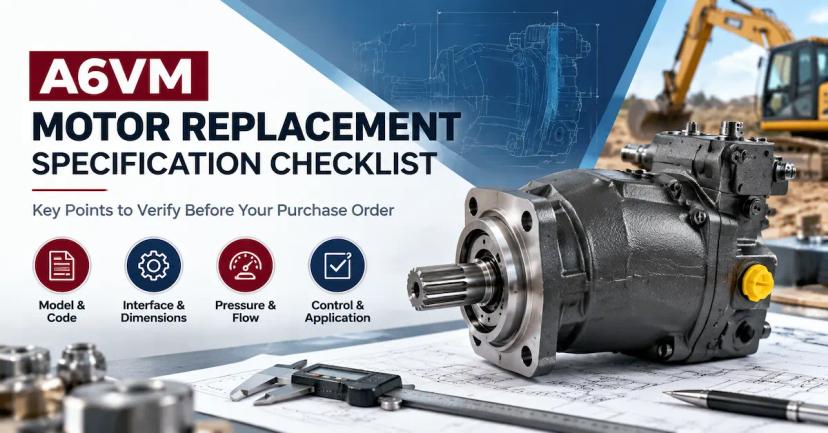
Quick Answer: What Must Be Checked Before an A6VM Hydraulic Motor Replacement?
An A6VM hydraulic motor replacement should be approved only after the old unit identity, displacement, control configuration, mounting interface, shaft, ports, case drain, pressure, flow, speed, rotation direction and closed-loop circuit conditions have been matched. A family name or a visual match is not enough. The candidate motor must be checked against the old nameplate or order code, the actual machine duty cycle and a model-specific drawing or datasheet.
For construction machinery OEMs, closed-loop system integrators and hydraulic repair companies, the fastest safe process is a four-stage workflow: capture the old motor evidence, compare the mechanical and hydraulic specification, obtain written engineering confirmation, and run a controlled sample test before production release. The public BLINCE A6VM page describes a variable-displacement bent-axis axial piston motor for demanding equipment, but public family ranges must not be treated as the rating of one specific model.
This checklist is designed to make the missing information visible before a purchase order is issued. It also gives a supplier enough data to recommend a suitable configuration instead of quoting a motor that only resembles the old part.
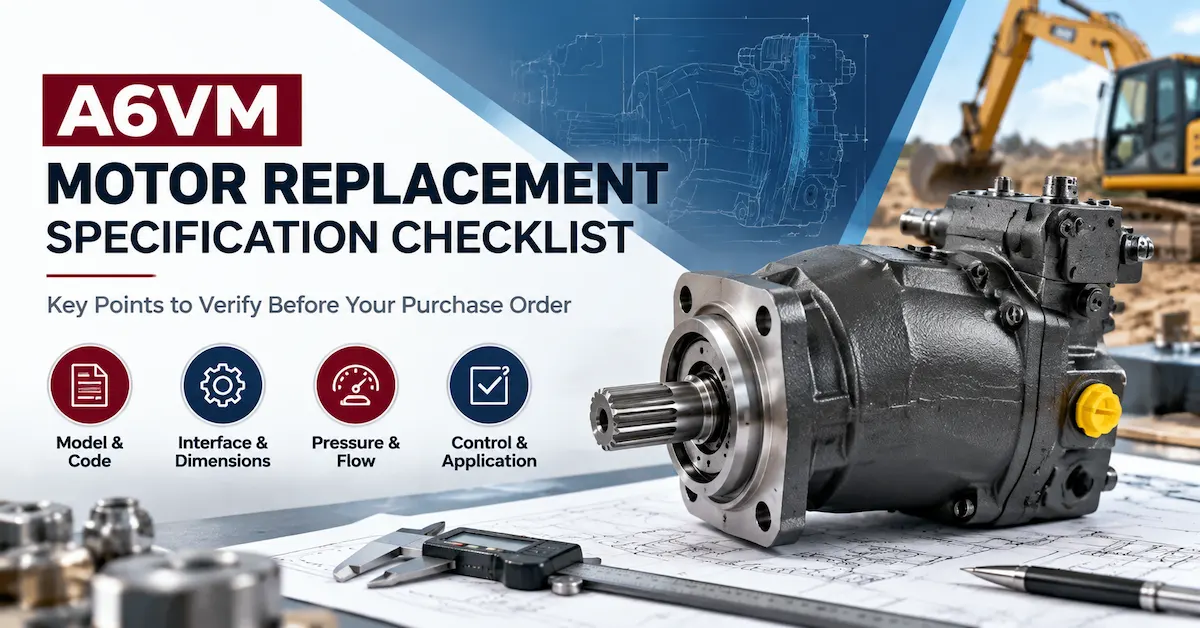
Why Replacement Should Begin with the Old Unit, Not a Search Result
Replacement buyers often begin with a phrase such as "A6VM 55 replacement" or "A6VM hydraulic motor replacement." That search is useful for finding candidates, but it does not define the part that will work in the machine. The same family can contain different displacements, shafts, flanges, control devices, port arrangements, rotation directions and pressure limits. A candidate with the same family label may still require an adapter, a different control signal or a different hydraulic setting.
The old unit is the best starting evidence because it captures the configuration that was actually installed. Record the complete nameplate, not only the first characters. Photograph every side of the motor, the control block, the shaft end, the port markings and the mounting face. If the nameplate is damaged, measure the installation and ask the supplier to identify what remains uncertain. Do not fill missing characters with an assumption.
A replacement decision also needs the machine context. A motor that worked on a test bench may fail in a closed loop if charge pressure, case pressure, flushing, oil temperature or control response is different. The correct replacement is therefore the one that matches the complete operating envelope, not simply the one with the closest catalog description.
1. Capture Complete Old-Unit Information
Before requesting a quotation, create one evidence pack for the old motor. A repair shop can usually collect the physical information quickly, while an OEM or system integrator may also have drawings, bills of material and test records. Send the same pack to every candidate supplier so that quotes are based on the same facts.
| Evidence to capture | What to record | Why it matters |
|---|---|---|
| Nameplate and stamped code | Brand, family, displacement, series, control code, rotation mark, serial number and revision characters. | The final characters can change the control, shaft, flange or pressure configuration. |
| Overall photographs | Straight-on views of the mounting face, shaft, ports, control block, drain port and nameplate, with a scale where possible. | Photos reveal options that may not appear in a short model reference. |
| Mechanical dimensions | Mounting flange, pilot, bolt circle, shaft diameter and length, key or spline, port locations and envelope. | A hydraulic match is still a failed replacement if the motor cannot be installed without redesign. |
| Circuit information | Open or closed loop, pump model, charge pressure, relief settings, flushing path, case-drain routing and control signal. | Circuit conditions determine whether a candidate motor can be operated safely. |
| Observed failure | Loss of torque, slow response, noise, high case flow, overheating, leakage, seizure or control instability. | The failure symptom may indicate a system problem that could damage a new motor. |
| Operating history | Hours, duty cycle, oil type, oil temperature, filtration, service events and recent circuit changes. | History helps distinguish normal wear from contamination, overload or incorrect installation. |
If the old motor is being returned for inspection, keep the photographs and measurements before shipment. A supplier may need to open the unit, but the original external evidence preserves the installation context. For an OEM project, attach the approved machine drawing and the hydraulic schematic to the RFQ rather than sending a product name alone.
A model code is a starting point, not a complete specification
A6VM references can contain information about displacement, series, nominal size, control, shaft, mounting and other configuration details. The exact coding logic must be checked against the relevant manufacturer document. Never infer a missing code from a photograph or assume that two codes with the same displacement have the same control block or interface.
2. Separate the A6VM Family Range from the Exact Model Rating
The BLINCE A6VM product page presents an angled-axis variable-displacement axial piston motor. It describes applications including construction machinery, special vehicles, industrial automation, agricultural and forestry equipment, and marine equipment. It also presents broad public reference information for displacement and pressure capability. These statements help a buyer understand the product family, but they are not a substitute for a model-specific data sheet.
For example, a public product description may show broad displacement and pressure values for the family. Those values must never be copied into a purchase order as the rating of an A6VM 55, A6VM 80 or any other single variant. The exact model, control option, operating mode, oil conditions and allowable duration must be confirmed by the BLINCE engineering team.
| Information type | What a buyer may see publicly | What must be confirmed before release |
|---|---|---|
| Displacement | A broad family range or several nominal sizes. | Exact displacement code, minimum and maximum setting, control response and approved duty cycle. |
| Pressure | A family-level continuous or peak pressure reference. | Continuous, intermittent and peak pressure, pressure drop, duration, case pressure and relief settings for the exact model. |
| Speed and flow | A general high-speed or variable-speed description. | Allowed rpm, flow, oil viscosity, temperature, control setting and operating duration. |
| Material and protection | Housing material alternatives and protective treatment descriptions. | Material declaration, seal compatibility, coating requirement and approved oil/environment. |
| Compatibility | A product family positioned for similar applications. | Dimensional comparison, hydraulic calculation, sample test and written engineering approval. |
Release rule: treat the public page as product-family orientation. Use the latest model-specific drawing and engineering confirmation as the release authority for an A6VM hydraulic motor replacement.
3. Check Mounting, Shaft, Ports and Case Drain
Mechanical compatibility is often the first visible replacement risk. A motor can have the correct displacement and still fail to install because the pilot is different, the shaft is too short, the port positions interfere with the machine frame or the control block needs a different clearance envelope. Measure the old unit and compare it with a controlled drawing from the candidate supplier.
Mounting face and flange
Confirm the flange standard, pilot diameter, bolt-hole count, bolt-circle diameter, mounting-face thickness and orientation. Check whether the machine uses a direct gearbox connection, an adapter plate or a special carrier. Photograph the mating surface and mark the top orientation. A drawing should show tolerances, not only nominal dimensions.
Output shaft and external load
Record shaft diameter, extension length, keyway or spline, thread, retaining method, seal position and direction of radial load. If the motor drives a gearbox, winch, wheel or pulley, provide the overhung load and distance from the bearing. A catalog torque value does not automatically prove that the shaft and bearings can carry the machine load.
Working ports, drain port and control block
Identify each port by function and thread, including A, B, case drain, flushing and control ports. Confirm port position and access for hose routing. Measure the control block envelope and identify whether the existing machine sends hydraulic, electric or proportional control. The candidate must support the same control logic or the OEM must approve the redesign.
Case-drain routing deserves special attention in a closed loop. Confirm the allowable case pressure, drain hose size, return location, oil temperature and whether the machine can keep the drain line unrestricted. A blocked or undersized drain can damage seals and bearings even when the main pressure is within the motor's stated range.
4. Validate the Closed-Loop Hydraulic Circuit
A6VM replacement work for a closed-loop system is not complete until the pump, motor, charge circuit, flushing circuit and controls are considered together. The motor receives pressure and flow from a circuit that changes during acceleration, deceleration, direction changes and relief events. These transients can be more important than the normal running point.
| Closed-loop checkpoint | Questions to answer | Replacement risk if omitted |
|---|---|---|
| Charge pressure | What is the normal range, low-charge alarm and make-up valve setting? | Cavitation, poor control response or insufficient lubrication. |
| High-pressure relief | What are the continuous, intermittent and peak settings, and how long can each occur? | Overload or heat generation hidden by a broad maximum-pressure claim. |
| Flushing | How is hot or contaminated oil removed from the loop, and what flow is available? | Rising oil temperature, accelerated wear and unstable efficiency. |
| Control command | Is displacement controlled hydraulically, electrically, proportionally or by a two-position device? | The motor may remain at the wrong displacement or respond in the wrong direction. |
| Case pressure | What is the measured case pressure during start, full load and deceleration? | Seal failure, leakage or damage to the rotating group. |
| Oil cleanliness | What filtration, flushing and cleanliness procedure applies before commissioning? | Contamination can damage a replacement before its performance is fairly evaluated. |
The supplier should receive the hydraulic schematic and the measured values where available. If the machine has no test ports, add temporary measurement points during the trial. Do not ask the supplier to approve a replacement from a pressure rating alone.
5. Calculate the Operating Point Before Comparing Candidate Motors
A first-pass calculation helps the buyer and supplier discuss the same operating point. It does not replace a manufacturer rating or an engineering test. Use the actual pressure drop across the motor, not only the pump relief setting, and state the efficiency assumptions clearly.
Speed from flow and displacement
A practical estimate is: speed (rpm) = flow (L/min) x 1000 x volumetric efficiency / displacement (cc/rev). The calculation shows why a larger displacement can reduce speed at the same flow and why a low-flow operating point needs attention to leakage and control stability. Ask the supplier to confirm the efficiency and allowable speed at the requested pressure and oil temperature.
Torque from pressure and displacement
A theoretical estimate is: torque (N.m) = pressure drop (bar) x displacement (cc/rev) / 62.83. Actual torque is lower after mechanical and volumetric losses. Starting torque, continuous torque, intermittent torque and peak torque must be separated. Request the applicable pressure drop and duration for each value.
Power and heat
A hydraulic power estimate is: power (kW) = pressure (bar) x flow (L/min) / 600 before efficiency losses. The difference between input hydraulic power and output mechanical power becomes heat. When replacing a motor in a closed loop, confirm cooling capacity, oil temperature and the expected time at high pressure. A motor can meet a short peak requirement and still be unsuitable for a continuous thermal duty.
| Parameter | Record for the old motor | Ask the replacement supplier |
|---|---|---|
| Displacement | Nominal size and variable range if known. | Exact candidate displacement and control setting at the operating point. |
| Flow | Normal, maximum and transient flow. | Continuous and intermittent flow limits for the exact configuration. |
| Pressure drop | Running, starting, relief and transient pressure. | Continuous, intermittent and peak limits, with duration and case pressure. |
| Speed | Minimum controllable, normal and maximum rpm. | Permitted rpm at the required oil temperature, pressure and control range. |
| Torque | Running, starting, shock and holding torque. | Theoretical and tested values, efficiency assumptions and allowable duration. |
6. Review Control Options and Rotation Direction
An A6VM replacement is not only a rotating body. Its control device determines how displacement changes, how the motor responds to a command and how the machine behaves during acceleration or braking. Record the old control code, pilot pressure, electrical signal, feedback device and fail-safe position. Confirm whether the machine controller expects a proportional response, a two-position response or an automatic pressure-related function.
The public BLINCE A6VM description refers to variable displacement and several possible control approaches. That broad description is useful for early sourcing, but the final quote must state the exact control option and its operating data. Ask for the control schematic, command range, response direction, required pilot or electrical conditions and any calibration procedure.
Rotation direction should be confirmed from the hydraulic schematic and the machine function, not inferred from the position of a port. If the motor drives a planetary gearbox or track drive, verify the direction under the actual hose connection and control logic. A reversed motor can move the machine in an unsafe direction even when every mechanical dimension is correct.
7. Do Not Treat a Similar Reference as Automatic Compatibility
Replacement language needs an engineering boundary. "Suitable alternative" can mean the supplier has a similar family, while "direct replacement" implies that the candidate has been checked against the specific reference and operating conditions. For an OEM or repair company, the second claim should require a documented comparison and a sample test.
| Comparison area | Pass condition | Evidence required |
|---|---|---|
| Hydraulic capacity | The candidate supports the actual continuous, intermittent and peak conditions. | Current model datasheet and engineering confirmation. |
| Mechanical interface | Flange, pilot, shaft, key/spline, ports and envelope match within approved tolerances. | Dimensioned drawing comparison, not a product photograph alone. |
| Control behavior | The machine controller can command the candidate through its required range. | Control schematic, signal data and bench or machine test. |
| External loads | Shaft and bearing loads remain within the candidate's exact limits. | Load calculation and model-specific bearing information. |
| Installation and service | Hoses, drain, mounting bolts, access and service procedures remain practical. | Installation review and controlled trial. |
If any row is unresolved, describe the candidate as "for engineering review" rather than "direct replacement." This wording protects the buyer and gives the supplier a clear task to close.
8. Prepare an Engineering Confirmation Package
A useful A6VM hydraulic motor replacement quotation should answer the buyer's technical questions in one controlled package. Request the following documents and confirmations before sample approval.
- Exact model and order code: include displacement, control, shaft, flange, port and any special option.
- Model-specific dimensional drawing: show pilot, bolt pattern, shaft, ports, drain, control block and envelope.
- Operating limits: identify continuous, intermittent and peak pressure, speed, flow, case pressure, temperature and duration.
- Control data: describe pilot or electric command, response direction, neutral position and adjustment requirements.
- Fluid and cleanliness requirements: state oil type, viscosity, filtration and commissioning cleanliness procedure.
- Material and sealing statement: identify material families and compatibility assumptions without inventing a grade that has not been confirmed.
- Inspection and test evidence: define what is tested, the test conditions, acceptance limits and batch traceability.
- Commercial confirmation: state sample quantity, MOQ, lead time, packaging, warranty route and change-notification process.
For the BLINCE quotation, tell the engineering team that the candidate will be used by a construction machinery OEM, a closed-loop system integrator or a hydraulic repair company. Include the machine model, old motor code, application, duty cycle and measured data. This gives the team enough context to recommend a configuration and identify the values that still need confirmation.
Mechanical sign-off
The drawing comparison should be signed off by the person responsible for the machine interface. Any adapter, shaft change, hose relocation or control-block clearance change must be shown in the released documentation.
Hydraulic sign-off
The hydraulic reviewer should confirm pressure, flow, speed, displacement control, charge pressure, case pressure, flushing, oil and temperature against the actual circuit. Open assumptions should be listed rather than hidden in a generic compatibility statement.
Review BLINCE Engineering and Manufacturing
9. Use a Controlled Sample and Trial Procedure
A sample is not simply a lower-quantity purchase. It is the controlled opportunity to verify whether the candidate works in the real circuit. Define the acceptance conditions before the sample arrives. Otherwise, the team may change the test after seeing the result and lose the ability to compare suppliers fairly.
Before installation
- Check the model code, nameplate and configuration against the approved quotation.
- Inspect the flange, pilot, shaft, ports, seals, plugs and control block for damage or variation.
- Flush hoses, verify oil cleanliness and confirm the case-drain route is open and correctly sized.
- Check relief, charge, flushing and control settings before applying the full machine load.
During commissioning
- Start at low pressure and low speed, confirm rotation direction and inspect for external leakage.
- Increase speed and pressure in stages while recording case pressure, oil temperature, noise and vibration.
- Test acceleration, deceleration, reversal and the minimum controllable speed where the machine requires it.
- Test the normal load first, then the agreed intermittent condition. Do not create an unapproved peak test.
- Record the hydraulic settings and measured results with the motor serial or batch information.
After the trial
Compare the result with the old motor baseline or the approved acceptance criteria. Document any adapter, hose, controller or relief-setting change. If performance is not acceptable, do not simply increase pressure or change the control setting until the supplier and engineering team have reviewed the evidence. A trial should reduce uncertainty, not hide it.
10. Verify Original Evidence, Quality and Supply Support
The replacement decision should include evidence about the supplier, not only a technical code. BLINCE identifies Dongguan Blince Machinery & Electronics Co., Ltd. in Dongguan, Guangdong, China, and its public company information describes hydraulic product design, manufacturing, R&D, testing and technical support. The same page states that the company maintains ISO 9001 and CE-related quality commitments. Buyers should still request the current certificate scope and the specific inspection records applicable to the A6VM configuration.
For a replacement program, ask for original evidence that can be connected to the actual order:
| Evidence area | Request | Reason for the buyer |
|---|---|---|
| Product identity | Current product image, exact model code, serial or batch identification and revision-controlled drawing. | Connects the quotation, sample and repeat order. |
| Manufacturing | Process overview for machining, assembly, cleaning, inspection and change control. | Shows how production consistency is maintained. |
| Testing | Pressure, speed, leakage or accuracy test method and acceptance record where applicable. | A test claim is useful only when conditions and limits are defined. |
| Materials and seals | Material family, seal material family, oil compatibility and any approved substitutions. | Protects the machine from incompatible fluid or uncontrolled changes. |
| Supply and support | MOQ, sample lead time, repeat lead time, packaging, warranty process and technical contact. | Turns a one-time replacement into a supportable supply plan. |
BLINCE's public application information covers mobile machinery, construction, mining, agricultural, forestry, marine and industrial equipment. Use the BLINCE applications page to place the replacement in its actual operating context, then request engineering confirmation for the exact A6VM model.
11. Send a Complete Replacement RFQ
A short RFQ can still be complete if it is structured. Copy the following fields into your request to BLINCE or another qualified supplier. Mark unknown fields as "to be confirmed" rather than leaving them blank.
| RFQ field | Buyer response |
|---|---|
| Machine and application | Machine model, function, environment and market. |
| Old motor | Full nameplate, serial, photos, dimensions and reason for replacement. |
| Circuit | Open or closed loop, pump, charge, flushing, case-drain and control information. |
| Performance | Flow, pressure, pressure drop, rpm, torque, duty cycle, oil temperature and external loads. |
| Interface | Flange, pilot, bolt pattern, shaft, key/spline, ports, drain and envelope. |
| Commercial | Sample quantity, annual demand, target date, packaging, documents and warranty expectations. |
| Decision requested | One recommended model, one alternative, assumptions, open risks and tests required for approval. |
For technical quotations, ask the supplier to separate confirmed data from assumed data. The quotation should identify the source revision for the dimensions and ratings. This is especially important when a public product page contains a family-level range rather than a complete model code.
FAQ
What is an A6VM hydraulic motor replacement?
It is the controlled substitution of an existing A6VM-type axial piston motor with a new motor that matches the machine's hydraulic duty, mechanical interface, control method and operating environment. A replacement is not approved by the family name alone; the exact model and installation conditions must be checked.
Can I replace an A6VM motor by matching displacement only?
No. Displacement affects speed and torque, but the replacement also needs the correct control, pressure boundary, flow, shaft, flange, ports, case drain, rotation direction, external-load capacity and duty cycle. Matching displacement is only one line in the comparison.
Can the public A6VM range be used as a single-model rating?
No. A broad displacement or pressure range describes the product family or a selection envelope. It must not be copied as the rating of a particular model. The current model-specific datasheet and BLINCE engineering confirmation control the purchase decision.
What old motor photos should I send for a replacement quote?
Send the nameplate, complete motor, mounting face, shaft end, every port, control block, drain port and any damage. Include a scale or dimensions in the photographs. Add the machine model, hydraulic schematic and the reason for replacement if available.
Why is the case drain important in a closed-loop motor replacement?
The case drain controls housing pressure and removes leakage and heat. An undersized, blocked or incorrectly routed drain can damage seals and bearings. Measure case pressure during the trial and confirm the candidate's drain requirements with the engineering team.
Does a similar flange prove that the motor is compatible?
No. The flange can match while the displacement, control response, pressure limits, shaft load capacity, ports or case pressure differ. A dimensioned drawing and hydraulic comparison are required, followed by an agreed sample test.
What pressure information should a supplier provide?
Request continuous, intermittent and peak pressure, pressure drop across the motor, allowed duration, case pressure, oil temperature and relief settings for the exact model. Do not use a maximum pressure without knowing whether it is continuous, intermittent or a short peak value.
Can BLINCE help an OEM replace an existing motor?
BLINCE can evaluate a replacement request using model information, photographs, drawings, dimensions, pressure, flow, displacement, torque and application conditions. The engineering team should confirm the exact A6VM configuration, interface, rating and compatibility before the OEM releases the design.
What should a hydraulic repair company check before installation?
Check the nameplate and configuration, dimensions, shaft and ports, control block, case drain, oil cleanliness, charge and relief settings, rotation direction and the cause of the old motor failure. A new motor should not be installed into a contaminated or over-pressurized circuit without correcting the root cause.
How should the replacement sample be tested?
Define acceptance criteria first. Start at low pressure and speed, confirm direction and leakage, then increase the operating point in stages while recording pressure, flow, rpm, case pressure, oil temperature, noise and vibration. Test the real duty cycle and record the motor serial or batch.
What documents should be included with the purchase order?
Include the approved model and order code, revision-controlled drawing, operating limits, control data, fluid and cleanliness requirements, inspection or test requirements, packaging, warranty and change-notification rules. Attach the approved sample record where applicable.
Conclusion
A reliable A6VM hydraulic motor replacement begins with evidence from the old unit and ends with an engineering-approved sample in the actual circuit. Record the complete model code, photograph and measure the interfaces, calculate the real pressure-flow-speed-torque point, review closed-loop charge and case-drain conditions, and separate family-level public information from the exact model rating. Then require a dimensioned drawing, control confirmation, test plan, quality evidence and supply terms before releasing the order.
BLINCE positions its A6VM axial piston motor for demanding mobile and industrial applications and provides a product page for technical review. For a replacement quotation, send the old-unit evidence and machine data to the engineering team and ask them to confirm the model, rated values, interfaces, pressure, flow and compatibility in writing.